
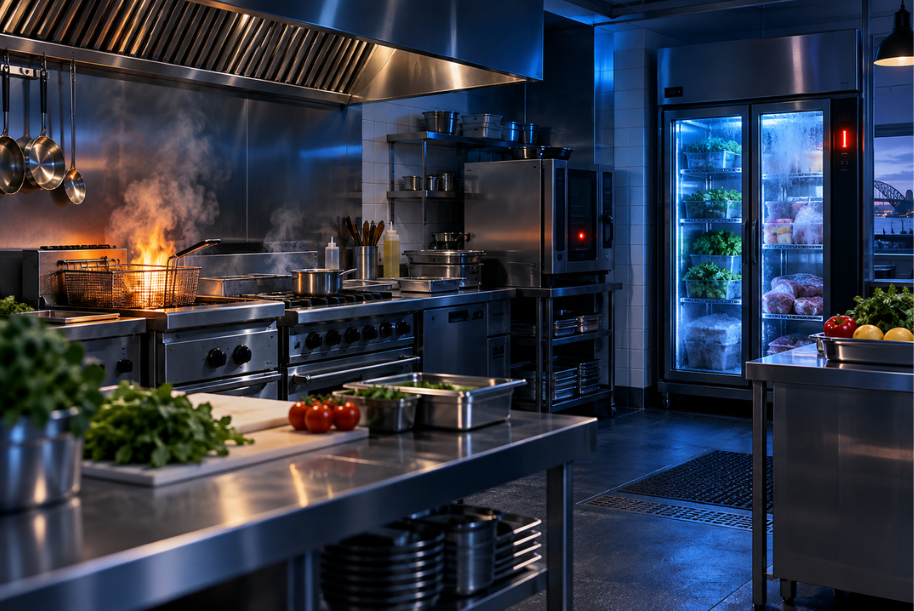
A commercial kitchen can lose its ability to trade in minutes. A fryer fire may damage the fit-out, a failed cool room may ruin food stock, or an electrical fault may stop essential equipment. Lost bookings, cancelled orders and continuing expenses can make the financial impact much larger than the initial damage.
Commercial kitchen insurance is not usually one standalone policy. It is generally a combination of covers selected around the premises, equipment, stock, staff and services of the business. The right structure may include property, machinery breakdown, deterioration of stock, business interruption, public and product liability, cyber and other covers, subject to the policy wording.
A Global Insurance Solutions (GIS), we help Australian hospitality and food businesses examine how these sections work together, including the triggers, limits and extensions that may affect a claim.
What Does Commercial Kitchen Insurance Cover?
Insurance for commercial kitchens may be relevant to restaurants, cafés, caterers, food production premises, shared kitchens, ghost kitchens and delivery-focused operators.
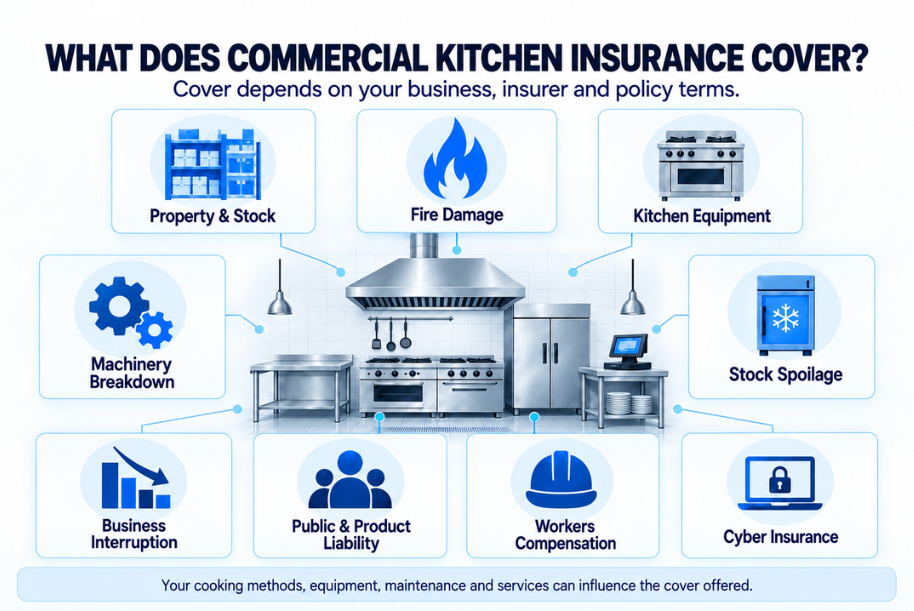
The final cover depends on the business model and insurer, but a commercial kitchen business insurance program may include:
- property cover for the building, contents, fit-out and stock;
- fire damage insurance for insured damage caused by fire, smoke or related events;
- commercial kitchen equipment insurance for specified physical damage;
- machinery breakdown cover for sudden mechanical or electrical failure;
- stock spoilage insurance or deterioration and spoilage cover;
- business interruption cover for insured loss of gross profit and increased costs;
- public and product liability insurance for certain third-party claims;
- workers compensation insurance where staff are employed; and
- cyber insurance for food businesses using POS, booking, payment or delivery systems.
Cooking methods, deep fryers, extraction systems, refrigeration, equipment maintenance, food delivery and off-site catering can all influence the terms offered. A generic hospitality business insurance package may not cover every exposure.
For a wider overview of hospitality risks, read our guide to essential insurance for restaurants, cafés and food vans.
How Commercial Kitchen Fire Cover May Respond?
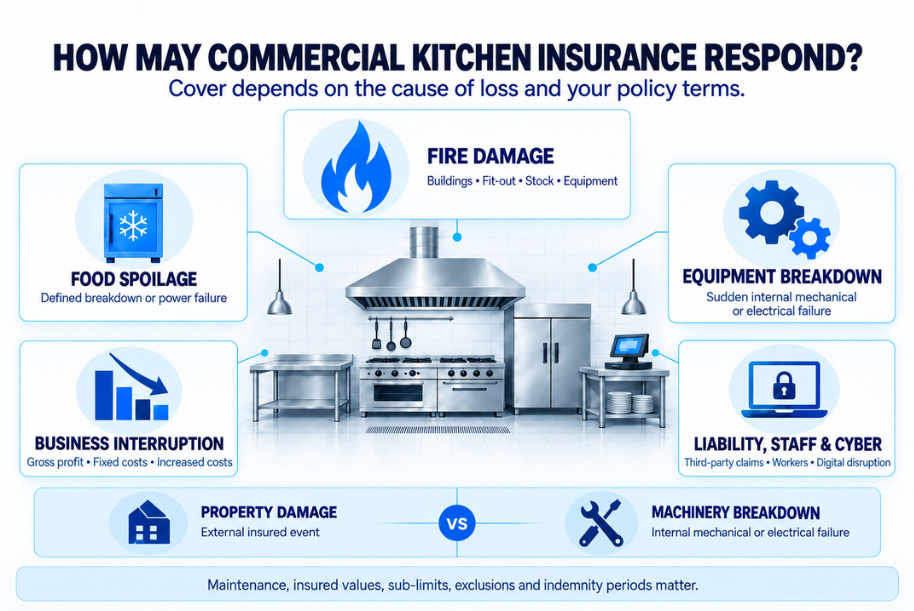
Fire is one of the most serious commercial kitchen risks. Flames, heat, smoke, water and firefighting activity can damage ovens, extraction ducting, electrical systems, refrigerated stock and customer areas. The premises may remain closed while authorities, landlords and contractors complete inspections.
Commercial property insurance may cover insured physical damage to buildings, contents, fixtures, fittings, stock and equipment. However, the insured values need to reflect the current replacement cost of the kitchen fit-out rather than its depreciated accounting value. Stainless-steel benches, exhaust systems, cool rooms, flooring, plumbing and electrical upgrades can be expensive to replace.
Check fire-protection conditions covering extraction and grease-filter cleaning, fire-suppression servicing, extinguishers and electrical maintenance. Non-compliance may affect a claim, depending on the wording and circumstances.
Our guide to commercial property fire insurance explains how property protection may apply to buildings, fit-outs, stock and equipment after an insured fire.
Does Commercial Kitchen Insurance Cover Food Spoilage?
Food stock insurance under the property section does not necessarily mean all spoiled stock is covered. The cause of the loss matters.
Deterioration and spoilage cover may respond when refrigerated or frozen stock is damaged following a defined insured event, such as an insured machinery breakdown or specified power failure. Cover can be subject to a separate sub-limit, excess, waiting period and conditions relating to refrigeration maintenance or temperature monitoring.
Consider a cool room that stops overnight. The spoiled meat, seafood, dairy or prepared food may be worth far more than the repair to the failed component. If the policy covers only the equipment repair but does not include deterioration of stock, the larger stock loss may remain uninsured.
Businesses should review:
- the maximum amount of food stock held during peak periods;
- seasonal or event-related increases;
- ownership of stock in shared kitchens;
- temperature monitoring and response procedures; and
- exclusions for utility failure, wear and tear or operator error.
These covers are not interchangeable. Spoilage cover focuses on insured stock damage. Product liability insurance may respond to certain allegations that food caused injury or illness, while product recall insurance may assist with specified recall costs.
Equipment Breakdown Is Different From Property Damage
One of the most important distinctions in restaurant kitchen insurance and café kitchen insurance is the cause of equipment failure.
Property insurance generally responds to external insured events such as fire, storm, impact or theft. Machinery breakdown insurance is designed for certain sudden and unforeseen internal mechanical or electrical failures. It may apply to refrigerators, freezers, cool rooms, ovens, compressors, air-conditioning equipment and other insured machinery.
For example, a refrigerator destroyed by an insured kitchen fire may fall under property damage. A refrigerator that stops because an internal electrical component suddenly fails may require machinery breakdown cover. Gradual deterioration, corrosion, poor maintenance, pre-existing faults and ordinary wear and tear are commonly excluded.
This distinction is explored further in our article on machinery breakdown versus property damage claims.
Maintain an asset register showing equipment values, ownership and service history. Identify leased and landlord-supplied items so responsibility is clear before a loss.
Protecting Income When the Kitchen Cannot Trade
Repairing damaged equipment does not replace the income lost while a kitchen is closed. Commercial kitchen business interruption insurance may cover insured loss of gross profit, continuing fixed expenses and reasonably increased costs of working when interruption follows an insured event covered by the policy.
A kitchen may need time to complete building works, obtain approvals, reinstall equipment, replace stock and rebuild bookings. The indemnity period should reflect this full recovery timeline, not only the repair period.
The gross profit sum insured also needs to follow the insurance definition, which may differ from the figure in the business accounts. Understating it can lead to underinsurance and a reduced claim settlement. Our articles on choosing a business interruption indemnity period and gross profit versus revenue explain these issues in more detail.
Our business continuity insurance guide addresses alternative premises, suppliers, utilities, technology and temporary operating costs.
Liability Staff and Digital Risks Still Matter
Fire, spoilage and machinery and equipment breakdown are major concerns, but they are not the only exposures.
Commercial kitchen public liability insurance may respond to certain third-party injury or property damage claims. Product liability insurance may apply to some food-related liability claims, including allegations involving contamination, allergens or illness. Keep incident reports, cleaning records, supplier details and temperature logs.
Workers compensation insurance is generally required for eligible workers, with arrangements varying by state and territory. Management liability insurance may also be relevant to employment, regulatory and management exposures.
POS system cyber risks are increasingly relevant to kitchens that depend on online ordering, delivery platforms, loyalty programs and electronic payments. A system outage caused by a cyber incident may not trigger ordinary property-based business interruption cover. Dedicated cyber insurance may provide a different response, subject to its terms.
How to Structure Commercial Kitchen Insurance Properly?<h5>
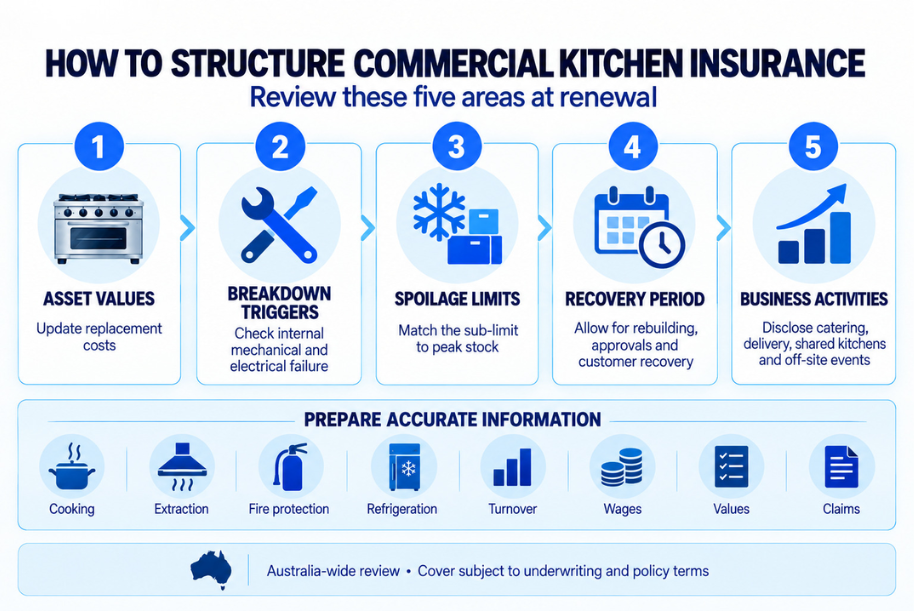
Before requesting terms, prepare accurate information about cooking processes, extraction, cleaning, fire protection, refrigeration, turnover, wages, stock and equipment values, delivery activities and claims history.
At renewal, GIS recommends reviewing five areas:
- Asset values: Update replacement costs for the kitchen fit-out, contents, stock and machinery.
- Breakdown triggers: Check whether internal mechanical and electrical failure is covered, not just external property damage.
- Spoilage limits: Compare the deterioration-of-stock sub-limit with the maximum stock held at any one time.
- Recovery period: Test whether the business interruption indemnity period allows for rebuilding, approvals and customer recovery.
- Business activities: Disclose catering, delivery, shared-kitchen use, multiple brands, food manufacturing and off-site events.
GIS can review commercial kitchen insurance Australia-wide, including in Sydney, Melbourne, Brisbane, Perth, Canberra and Adelaide. Cover remains subject to underwriting and policy terms.
Frequently Asked Questions About Commercial Kitchen Insurance
Q1. What insurance does a commercial kitchen need?
Ans 1. The answer depends on the operation. Common considerations include property, machinery breakdown, spoilage, business interruption, liability, workers compensation and cyber insurance. Limits and extensions should reflect the business model.
Q2. How much does commercial kitchen insurance cost
Ans 2. Cost depends on turnover, location, cooking methods, fire protection, asset values, stock, trading hours and claims history. A lower premium may reflect narrower cover, higher excesses or lower sub-limits.
Q3. What is the best commercial kitchen insurance?
Ans 3. There is no single best policy. Suitable cover reflects the kitchen’s activities, assets, controls, equipment dependencies and recovery time. Compare wording, exclusions and sub-limits as well as price.
Q4. Does commercial kitchen insurance cover equipment breakdown?
Ans 4. It may, but property insurance does not automatically cover internal failure. A machinery breakdown section may be required. Wear and tear and poor maintenance are commonly excluded.
Q5. Does insurance cover food spoilage after refrigeration failure?
Ans 5. It may respond following a defined insured event. Check the trigger, sub-limit, excess, waiting period, power-failure wording and maintenance conditions.
Q6. Do shared kitchens and ghost kitchens need their own insurance?
Ans 6. Operators should not assume the kitchen owner’s policy covers their stock, equipment, liabilities or lost income. Each party should review its property, food handling, delivery and digital exposures.
Q7. Is food trailer insurance Australia-wide the same as commercial kitchen cover?
Ans 7. Not necessarily. A food trailer may also need commercial motor, transit and liability cover. Disclose the vehicle, fitted equipment, stock and trading locations.
Speak to GIS About Insurance for Commercial Kitchens
A commercial kitchen relies on property, equipment, stock, people and technology working together. If one policy section is missing or a sub-limit is too low, a fire, refrigeration failure or equipment breakdown can expose a costly gap.
Global Insurance Solutions can help you review your commercial kitchen business insurance against the way you operate. Speak with GIS on 1300 710 665 to discuss cover for your premises, fit-out, machinery, stock, liabilities and business interruption exposure.
Important notice
This article is of a general nature only and does not take into account your specific objectives, financial situation or needs. It is also not financial advice, nor complete, so please discuss the full details with your insurance broker as to whether these types of insurance are appropriate for you. Deductibles, exclusions and limits apply. You should consider any relevant Target Market Determination and Product Disclosure Statement in deciding whether to buy or renew these types of insurance. Various insurers issue these types of insurance and cover can differ between insurers.
This article provides information rather than financial product or other advice. The content of this article, including any information contained in it, has been prepared without taking into account your objectives, financial situation or needs. You should consider the appropriateness of the information, taking these matters into account, before you act on any information. In particular, you should review the product disclosure statement for any product that the information relates to it before acquiring the product.
Information is current as at the date the article is written as specified within it but is subject to change. Global Insurance Solutions Pty Ltd make no representation as to the accuracy or completeness of the information. Various third parties have contributed to the production of this content. All information is subject to copyright and may not be reproduced without the prior written consent of Global Insurance Solutions Pty Ltd.

Risk Advisor, Insurance Broker & Director
With around 15 years in insurance, Yuvi Singh is a passionate Risk Advisor, Director, and Insurance Broker at Global Insurance Solutions. Backed by a Commerce degree and ANZIIF diploma, Yuvi leads a team servicing SMEs across industries like manufacturing, logistics, fuel, IT, and more. At GIS, clients benefit from tailored, transparent advice, access to 150+ insurers, and end-to-end risk solutions. Recognised as a 2022 Insurance Magazine Rising Star and 2024 Top Insurance Broker by Insurance Business Australia, Yuvi delivers flexible, effective outcomes with integrity and innovation.