

If a fire, flood, or cyberattack shut your doors tomorrow, would your business interruption insurance actually pay out what you need?
Many Australian business owners assume their cover is calculated on revenue — but most business interruption insurance policies in Australia are actually based on gross profit, not revenue.
Get this distinction wrong, and you could be significantly underinsured at the exact moment you need cover the most.
At Global Insurance Solutions, we see the gross profit vs revenue insurance mix-up during sum insured reviews every week — and it’s one of the costliest mistakes a business can make.
This guide unpacks the difference between gross profit and revenue in insurance terms, walks through how insurable gross profit is actually calculated, and explains why getting this number right matters.
What Is Business Interruption Insurance?
Business interruption insurance keeps your business financially whole after an insured event disrupts trading.
Rather than covering only physical damage to premises or stock, it replaces income lost while you’re closed or trading at reduced capacity, plus the extra costs of getting back to normal.
Here’s what catches people out: “income” under the policy isn’t your revenue. It’s your insurable gross profit — a defined figure insurers use as the basis of settlement, and rarely the same number your accountant reports.
Example: See business interruption insurance in action here.
Read business continuity insurance to know more about the difference.

Revenue vs Gross Profit: Understanding the Difference
Revenue, the term most Australian insurers prefer, is simply total sales income before any costs are deducted.
Accounting gross profit is revenue minus the cost of goods sold (COGS) — materials, stock purchases and direct production costs. It shows what you’re making before overheads like rent, wages, and utilities.
Here’s where confusion sets in: insurable gross profit isn’t the figure on your profit and loss statement. It’s a purpose-built calculation reflecting what you’d genuinely lose if trading stopped.
Accounting Gross Profit vs Insurable Gross Profit
Aspect | Accounting Gross Profit | Insurable Gross Profit |
Purpose | Profitability for tax/reporting | Basis for a claim |
Formula | Revenue – COGS | Revenue + Closing Stock − (Opening Stock + Purchases + Uninsured Working Expenses) |
Fixed costs (rent, wages) | Not deducted | Retained — what the policy replaces |
Set by | Accountant, annually | Broker, each renewal |
Some insurers use an equivalent approach: net profit before tax plus insured standing charges (fixed costs that keep running even if you stop trading — rent, salaries, loan repayments, insurance premiums). Either way, the ISR policy gross profit definition in your wording governs your claim, so have a broker check it against your real figures.
Why Is Business Interruption Cover Based on Gross Profit, Not Revenue?
So, is business interruption insurance based on revenue or profit?
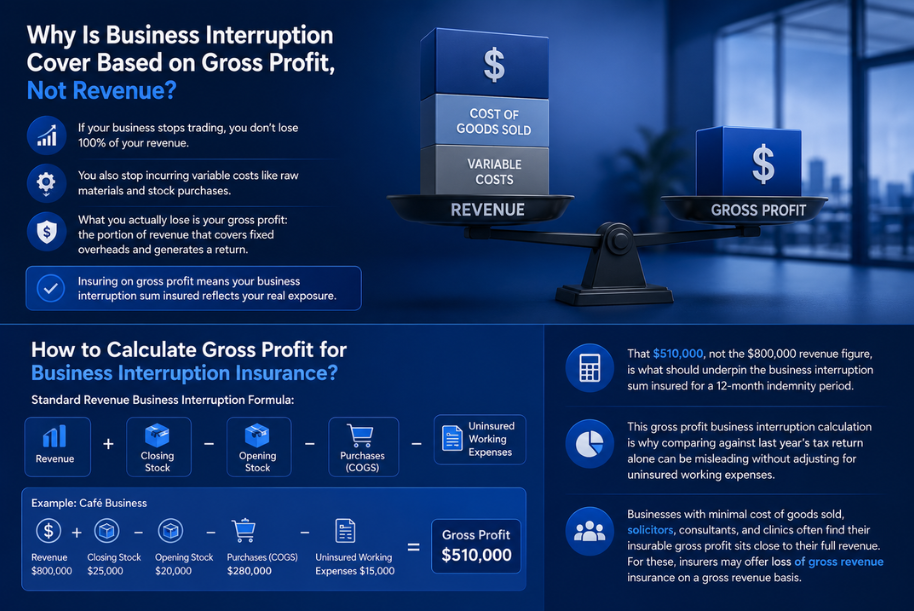
Almost always, profit. If your business stops trading, you don’t lose 100% of your revenue as a genuine loss; you also stop incurring the variable costs tied to producing that revenue, like raw materials and stock purchases.
What you actually lose is your gross profit: the portion of revenue that would have covered fixed overheads and generated a return.
Insuring on revenue means paying a premium on costs you’d never claim; insuring on gross profit means your business interruption sum insured reflects your real exposure.
How to Calculate Gross Profit for Business Interruption Insurance?
Here’s the standard revenue business interruption formula:
Gross Profit = (Revenue + Closing Stock) − (Opening Stock + Purchases + Uninsured Working Expenses)
Take a café with: revenue $800,000; opening stock $20,000; purchases (COGS) $280,000; closing stock $25,000; uninsured working expenses $15,000.
Gross Profit = ($800,000 + $25,000) − ($20,000 + $280,000 + $15,000) = $510,000
That $510,000, not the $800,000 revenue figure, is what should underpin the business interruption sum insured for a 12-month indemnity period. This gross profit business interruption calculation is why comparing against last year’s tax return alone can be misleading, without adjusting for uninsured working expenses.
Businesses with minimal cost of goods sold, solicitors, consultants, and clinics often find their insurable gross profit sits close to their full revenue. For these, insurers may offer loss of gross revenue insurance instead, essentially on a gross revenue basis, since there’s little cost of sales to deduct.
What Expenses Are Included in Insurable Gross Profit?
Typically retained as standing charges: rent, rates and lease payments; permanent staff wages; loan repayments; insurance premiums; and, under some wordings, depreciation.
Typically excluded as uninsured working expenses: raw materials and stock purchases; casual wages tied to production volume; freight and packaging; and sales commissions.
Getting this list right for your business is where a broker adds value — generic templates rarely match how your business actually operates.
Revenue vs Gross Profit: Understanding the Difference
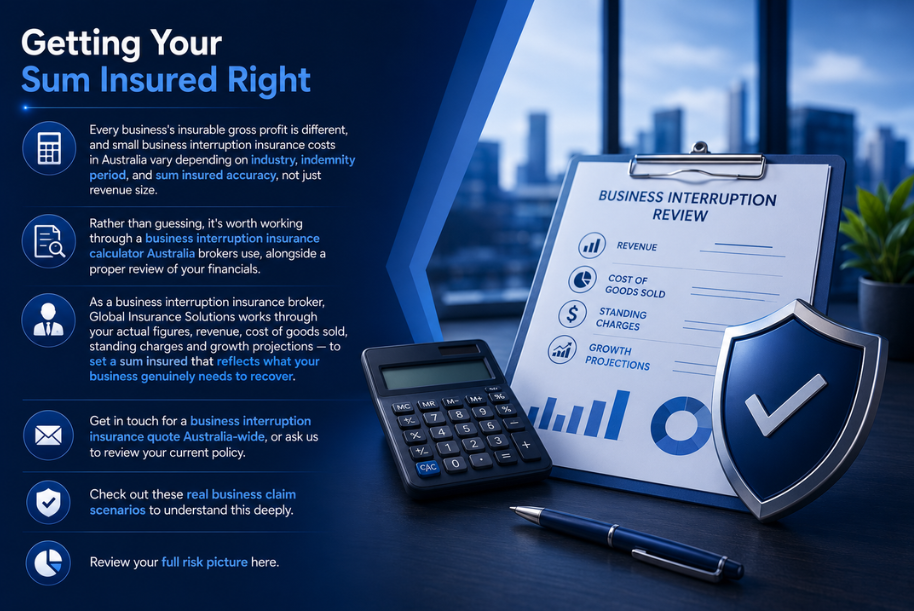
Most standard commercial policies default to a gross profit basis. Loss adjusters use the rate of gross profit — the percentage relationship between your gross profit and revenue- to calculate proportional payouts during periods of partial trading, such as when you’re operating from a temporary site at reduced capacity. Knowing your own rate of gross profit before a claim happens makes the settlement process considerably smoother.
What Happens If You Underinsure Your Gross Profit?
This is where the co-insurance clause (sometimes called the “average” clause) bites. Most business interruption policies in Australia include it, comparing your declared sum insured against your actual insurable gross profit at the time of loss.
If your sum insured is lower than your true figure, the insurer reduces your claim payout proportionally — even on a genuine loss. For example, a sum insured at just 70% of your actual insurable gross profit could mean the insurer pays only 70% of an otherwise valid claim.
This underinsurance business interruption penalty catches growing businesses most often — if revenue and gross profit have risen since your last renewal but your sum insured hasn’t kept pace, you may be carrying a shortfall without realising it.
Read the whole blog on how to avoid underinsurance.
Indemnity Period and Gross Profit Sum Insured Explained
The indemnity period is the length of time your policy will pay claims while your business recovers to pre-loss trading levels — commonly 12, 18, 24 or 36 months.
Your sum insured needs to reflect your insurable gross profit across the entire indemnity period, not just a single year, particularly for businesses that would take longer to rebuild after a major event, such as a total fire loss requiring reconstruction and rebuilding a customer base from scratch.
A sum insured based only on last year’s figures, without factoring in growth or a realistic indemnity period, is one of the most common gaps we find during policy reviews.
Read the blog we curated on choosing the right indemnity period.
Gross Profit vs Net Profit in Business Interruption Cover
Revenue | Gross Profit | Net Profit | |
Measures | Total sales income | Revenue minus COGS | Gross profit minus overheads |
Fixed costs included? | N/A | Yes, retained | Already deducted |
Basis for BI cover? | Rarely | Yes — standard basis | No — excludes standing charges |
Risk if used | Overinsured | Correctly priced | Underinsured |
Getting Your Sum Insured Right
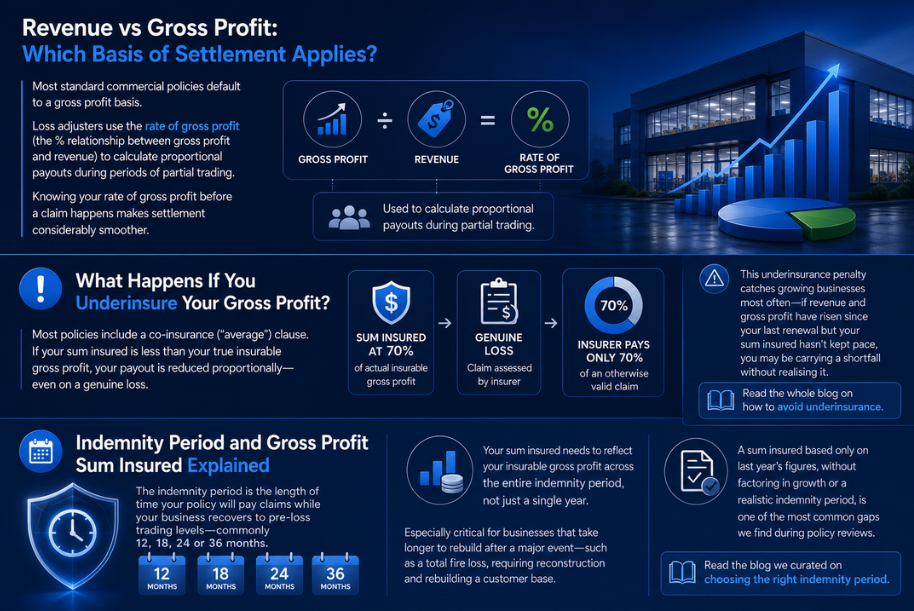
Every business’s insurable gross profit is different, and small business interruption insurance costs in Australia vary depending on industry, indemnity period, and sum insured accuracy, not just revenue size.
Rather than guessing, it’s worth working through a business interruption insurance calculator Australia brokers use, alongside a proper review of your financials.
As a business interruption insurance broker, Global Insurance Solutions works through your actual figures, revenue, cost of goods sold, standing charges and growth projections — to set a sum insured that reflects what your business genuinely needs to recover.
Get in touch for a business interruption insurance quote Australia-wide, or ask us to review your current policy.
Check out these real business claim scenarios to understand this deeply.
Frequently Asked Questions
Q1. What is the difference between gross profit and revenue?
Ans 1. Revenue is total sales income before costs. Gross profit is revenue minus the cost of goods sold — what’s left after direct production or purchase costs, before overheads like rent and wages.
Q2. Is business interruption insurance based on revenue or profit?
Ans 2. Almost always gross profit, not revenue. Insurers use a defined insurable gross profit figure, revenue adjusted for stock movements and uninsured working expenses — as the basis for settling claims.
Q3. What is insurable gross profit in insurance?
Ans 3. The figure used to calculate a business interruption claim: revenue plus closing stock, minus opening stock, purchases, and uninsured working expenses. It can differ from the gross profit on your accounts.
Q4. How is gross profit calculated for insurance purposes?
Ans 4. (Revenue + Closing Stock) − (Opening Stock + Purchases + Uninsured Working Expenses). Some insurers instead use net profit before tax plus insured standing charges — check your policy wording.
Q5. What happens if you underinsure your gross profit?
Ans 5. Most policies include a co-insurance (average) clause. If your declared sum insured is lower than your actual insurable gross profit, the insurer reduces your payout proportionally, even on a genuine loss.
Q6. Does business interruption insurance cover loss of revenue?
Ans 6. Generally no — it covers loss of gross profit. The exception is gross revenue policies, sometimes used by service businesses with minimal cost of goods sold, such as solicitors or clinics.
Q7. What is the co-insurance clause in business interruption insurance?
Ans 7. A policy condition comparing your sum insured to your actual insurable gross profit at the time of loss. If underinsured, your payout is reduced by the same percentage.
Q8. How long does business interruption insurance pay out?
Ans 8. For your chosen indemnity period, commonly 12 to 36 months, or until your business returns to the trading position it would have reached had the event not occurred, whichever comes first.
Important notice
This article is of a general nature only and does not take into account your specific objectives, financial situation or needs. It is also not financial advice, nor complete, so please discuss the full details with your insurance broker as to whether these types of insurance are appropriate for you. Deductibles, exclusions and limits apply. You should consider any relevant Target Market Determination and Product Disclosure Statement in deciding whether to buy or renew these types of insurance. Various insurers issue these types of insurance and cover can differ between insurers.
This article provides information rather than financial product or other advice. The content of this article, including any information contained in it, has been prepared without taking into account your objectives, financial situation or needs. You should consider the appropriateness of the information, taking these matters into account, before you act on any information. In particular, you should review the product disclosure statement for any product that the information relates to it before acquiring the product.
Information is current as at the date the article is written as specified within it but is subject to change. Global Insurance Solutions Pty Ltd make no representation as to the accuracy or completeness of the information. Various third parties have contributed to the production of this content. All information is subject to copyright and may not be reproduced without the prior written consent of Global Insurance Solutions Pty Ltd.

Risk Advisor, Insurance Broker & Director
With around 15 years in insurance, Yuvi Singh is a passionate Risk Advisor, Director, and Insurance Broker at Global Insurance Solutions. Backed by a Commerce degree and ANZIIF diploma, Yuvi leads a team servicing SMEs across industries like manufacturing, logistics, fuel, IT, and more. At GIS, clients benefit from tailored, transparent advice, access to 150+ insurers, and end-to-end risk solutions. Recognised as a 2022 Insurance Magazine Rising Star and 2024 Top Insurance Broker by Insurance Business Australia, Yuvi delivers flexible, effective outcomes with integrity and innovation.