

In today’s digital economy, understanding first-party vs third-party cyber insurance, cyber insurance Australia, and cyber liability insurance explained is critical for businesses navigating rising cyber risks. Many Australian organisations assume a cyber policy covers everything, but the reality is more nuanced. Different cyber insurance coverage types address different exposures, and misunderstanding this can leave significant gaps.
At Global Insurance Solutions, we regularly see businesses impacted by cyber incidents that trigger both internal financial losses and external legal liabilities. Knowing the difference between first party and third party cyber insurance is essential to ensure your business is fully protected.
Quick insight: First-party cyber insurance covers your own business losses from a cyber incident, while third-party cyber insurance covers claims made against your business by others. Most Australian businesses need both to fully protect against financial and legal cyber risks.
What is Cyber Insurance?
Cyber insurance, also known as cyber liability insurance, is designed to protect businesses from financial losses and legal liabilities arising from cyber incidents such as data breaches, ransomware attacks, and system failures.
In Australia, cyber risk is accelerating rapidly. According to the IBM Cost of a Data Breach Report 2023, the global average cost of a data breach reached USD $4.45 million, highlighting the financial severity of cyber incidents.

Additionally, the Office of the Australian Information Commissioner reports that human error and phishing remain leading causes of breaches in Australia.
Source: https://www.oaic.gov.au
Cyber insurance policies in Australia are broadly divided into two core components:
- First-party cyber insurance coverage
- Third-party cyber liability coverage
What is First-Party Cyber Insurance?
Understanding First-Party Cyber Insurance Coverage
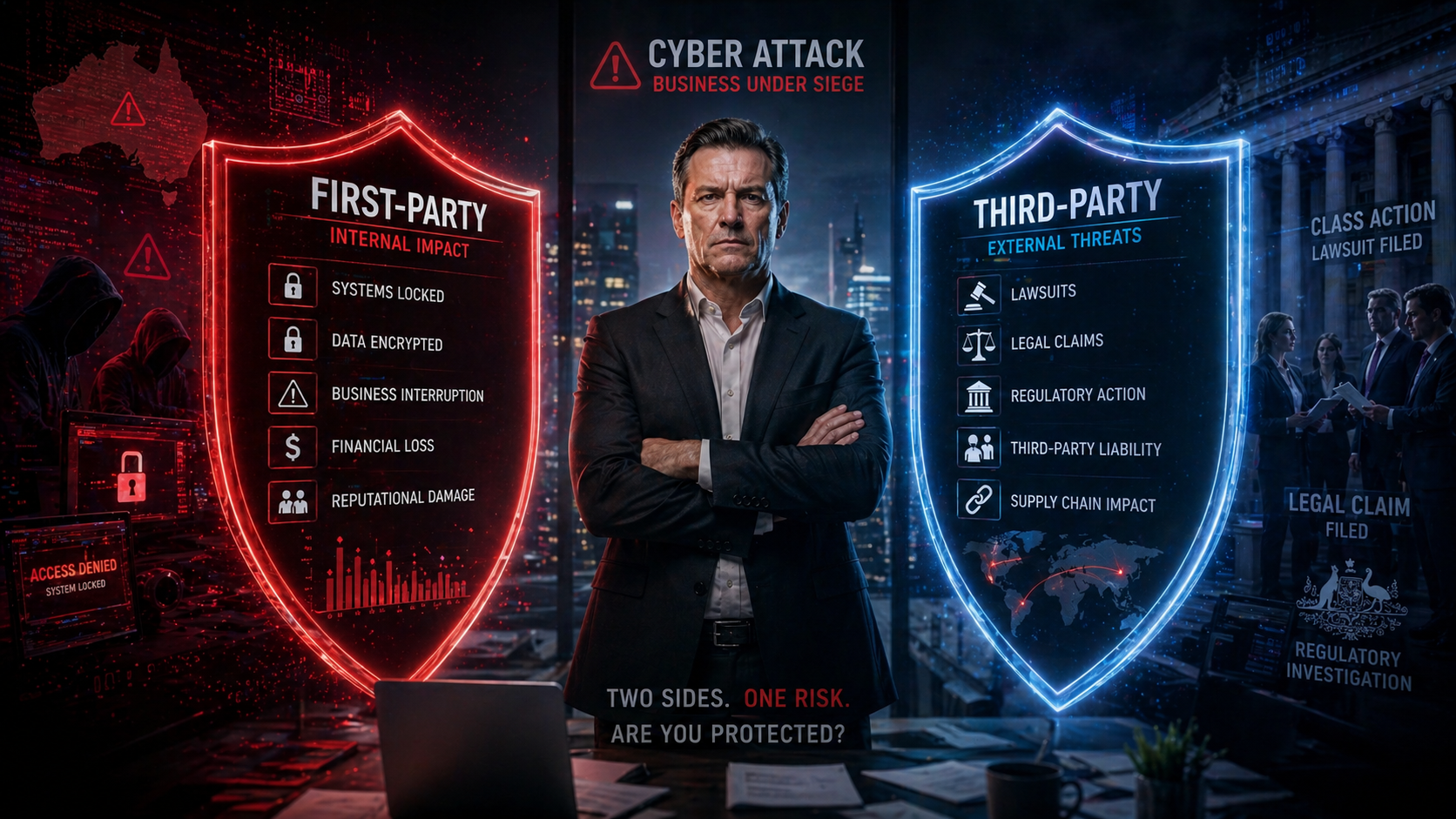
First-party cyber insurance protects your business against direct financial losses caused by a cyber incident. These are costs your organisation incurs internally.

What Does First-Party Cyber Insurance Cover?
Typical inclusions:
- Data breach response insurance
- Forensic investigation costs
- Data restoration and recovery
- Business interruption cyber insurance losses
- Ransomware and cyber extortion payments
- Notification and credit monitoring costs
- Public relations and crisis management
Example of First-Party Cyber Claims
A retail business in Australia experiences a ransomware attack:
- Systems are locked for 5 days
- Sales stop completely
- IT specialists are hired to recover data
First-party cover responds to:
- Loss of income
- Recovery costs
- Ransom payment (if applicable)
This highlights the financial impact of cyberattacks that many businesses underestimate.
What is Third-Party Cyber Insurance?
Understanding Third-Party Cyber Liability Coverage
Third-party cyber insurance covers claims made against your business by external parties due to a cyber incident.
What Does Third-Party Cyber Insurance Cover?
- Legal costs and cyber liability
- Privacy liability insurance Australia claims
- Customer data breach liability
- Regulatory fines (where insurable)
- Defence costs and settlements
- Network security liability claims

Example of Third-Party Cyber Claims
A healthcare provider suffers a data breach exposing patient records:
- Patients file lawsuits
- Regulators investigate under the Privacy Act
Third-party cover responds to:
- Legal defence costs
- Compensation claims
- Regulatory penalties
This is where many businesses realise that a cyber insurance policy explained incorrectly at purchase can lead to major exposure gaps.
Key Differences Between First-Party and Third-Party Cyber Insurance
Feature | First-Party Cyber Insurance | Third-Party Cyber Insurance |
Who it protects | Your business | External parties (clients, regulators) |
Type of loss | Direct financial losses | Legal and liability claims |
Examples | Data recovery, downtime | Lawsuits, regulatory fines |
Trigger | Internal impact | External claims |
Focus | Operational recovery | Legal defence |
Understanding this distinction is crucial when evaluating what cyber insurance covers in Australia.
Real-World Examples of Cyber Insurance Claims
Example 1: Ransomware Attack (First-Party)
A manufacturing company loses access to systems for 7 days:
- Revenue loss: $250,000
- IT recovery costs: $80,000
First-party policy responds.
Example 2: Client Data Breach (Third-Party)
An IT company exposes client data due to a security flaw:
- Client sues for financial loss
- Legal costs exceed $150,000
Third-party policy responds.
Example 3: Combined Claim Scenario
A cyber attack leads to:
- Internal downtime (first-party)
- Customer lawsuits (third-party)
This is why relying on one type of cover is risky.
Do Australian Businesses Need Both Covers?
Short Answer: Yes
Most businesses require both first-party cyber insurance coverage and third-party cyber liability coverage.
Why Both Are Essential?
Cyber incidents rarely occur in isolation. They typically trigger:
- Financial losses (first-party)
- Legal exposure (third-party)
Industries with High Cyber Risk
- IT and SaaS companies
- Healthcare providers
- Financial services
- Professional services
- eCommerce businesses
These sectors face increasing cyber risk trends in Australia due to data dependency.
What to Look for in a Cyber Insurance Policy?
At Global Insurance Solutions, we help businesses go beyond generic policies. Not all cyber insurance policies are created equal.
Key Factors to Consider
1. Coverage Scope
Ensure both first-party and third-party risks are covered.
2. Policy Wording
Cyber policies can look similar until a claim tests the wording.
3. Incident Response Support
Look for policies with access to:
- IT forensic experts
- Legal advisors
- PR consultants
4. Business Interruption Triggers
Check how downtime is defined and compensated.
5. Regulatory Coverage
Understand how the Privacy Act breaches Australia’s insurance applies.
Cyber Insurance Costs in Australia
How Much Does Cyber Insurance Cost in Australia?
Costs vary based on:
- Business size
- Industry
- Revenue
- Data exposure
- Risk controls
SMEs can expect policies starting from a few hundred dollars annually, but high-risk industries will pay more.
How Cyber Insurance Works After a Data Breach
Step-by-Step Process
- Incident occurs
- Insurer notified immediately
- Incident response team engaged
- Systems investigated and secured
- Losses assessed
- Claims paid based on policy terms
A strong data breach response plan ensures smoother claims outcomes.
Why Businesses Get This Wrong?
Many businesses assume:
- “Cyber insurance covers everything”
- “We only need basic cover”
In reality:
- Policies differ significantly
- Exclusions can limit claims
- Poor structuring leads to denied claims
This is where working with experienced Australian cyber insurance brokers becomes critical.
Final Thoughts from Global Insurance Solutions
Cyber risk is no longer optional to manage. The question is not if a cyber incident will occur, but when.
Understanding the difference between first party and third party cyber insurance ensures your business is not left exposed at the worst possible time.
At Global Insurance Solutions, we structure cyber insurance policies Australia SMEs can rely on when it matters most, not just when it’s purchased.
FAQs
Q1. What is the difference between first-party and third-party cyber insurance?
Ans 1. First-party cyber insurance covers your own business losses, such as data recovery, business interruption, and ransomware payments. Third-party cyber insurance covers claims made against you by clients, customers, or regulators due to a cyber incident.
Q2. Does cyber insurance cover ransomware attacks in Australia?
Ans 2. Yes, most cyber insurance policies in Australia include ransomware coverage, which may cover ransom payments, forensic investigations, and system recovery costs, depending on policy wording.
Q3. Do I need both first-party and third-party cyber insurance?
Ans 3. Most Australian businesses require both, as cyber incidents can lead to direct financial losses as well as legal claims from affected third parties.
Q4. What costs are covered under first-party cyber insurance?
Ans 4. First-party cover typically includes data restoration, business interruption losses, incident response, forensic investigations, and notification costs.
Q5. What does third-party cyber liability insurance cover?
Ans 5. It covers legal defence costs, settlements, regulatory fines (where insurable), and claims arising from data breaches or privacy violations affecting others.
Q6. Is cyber insurance mandatory in Australia?
Ans 6. Cyber insurance is not legally mandatory, but many contracts, clients, and industries require it as part of risk management.
Q7. How much does cyber insurance cost in Australia?
Ans 7. Costs vary based on business size, industry, revenue, and risk exposure, but SMEs can expect policies starting from a few hundred dollars annually.
Q8 Which businesses need cyber insurance the most?
Ans 8. Businesses handling sensitive data, such as IT companies, healthcare providers, financial services, and eCommerce businesses, have the highest need.
Important notice
This article is of a general nature only and does not take into account your specific objectives, financial situation or needs. It is also not financial advice, nor complete, so please discuss the full details with your insurance broker as to whether these types of insurance are appropriate for you. Deductibles, exclusions and limits apply. You should consider any relevant Target Market Determination and Product Disclosure Statement in deciding whether to buy or renew these types of insurance. Various insurers issue these types of insurance and cover can differ between insurers.
This article provides information rather than financial product or other advice. The content of this article, including any information contained in it, has been prepared without taking into account your objectives, financial situation or needs. You should consider the appropriateness of the information, taking these matters into account, before you act on any information. In particular, you should review the product disclosure statement for any product that the information relates to it before acquiring the product.
Information is current as at the date the article is written as specified within it but is subject to change. Global Insurance Solutions Pty Ltd make no representation as to the accuracy or completeness of the information. Various third parties have contributed to the production of this content. All information is subject to copyright and may not be reproduced without the prior written consent of Global Insurance Solutions Pty Ltd.

Risk Advisor, Insurance Broker & Director
With around 15 years in insurance, Yuvi Singh is a passionate Risk Advisor, Director, and Insurance Broker at Global Insurance Solutions. Backed by a Commerce degree and ANZIIF diploma, Yuvi leads a team servicing SMEs across industries like manufacturing, logistics, fuel, IT, and more. At GIS, clients benefit from tailored, transparent advice, access to 150+ insurers, and end-to-end risk solutions. Recognised as a 2022 Insurance Magazine Rising Star and 2024 Top Insurance Broker by Insurance Business Australia, Yuvi delivers flexible, effective outcomes with integrity and innovation.