

When a customer does not pay an invoice, the effect can extend well beyond one overdue account. A significant bad debt may restrict cash flow, affect supplier payments and reduce the funds available for wages, tax obligations or growth. Where a business relies heavily on a small number of customers, this exposure should also be considered as part of its broader business continuity planning.
The short answer is that trade credit insurance can cover certain losses caused by customer insolvency or protracted default. However, it does not make every unpaid invoice recoverable. Cover depends on the policy wording, the insured buyer, the approved credit limit, when the goods or services were supplied, notification requirements and any applicable exclusions or waiting periods.
In Australia, “insolvency insurance” is often used as a general search term for this protection. The recognised product is usually trade credit insurance, which may also be described as debtor insurance, bad debt insurance or accounts receivable insurance.
What Is Insolvency Insurance?
Insolvency insurance is not one standard policy with identical cover across the market. In a business-to-business context, it generally refers to trade credit insurance protecting eligible accounts receivable when a customer cannot or does not pay.

It is designed for businesses supplying goods or services on credit terms. The business may be indemnified for an agreed portion of a covered loss, subject to the policy terms.
Depending on the policy, cover may also include buyer assessments, monitoring and debt-recovery support. It does not replace a business’s own credit controls.
Can Trade Credit Insurance Cover Customer Non-Payment?
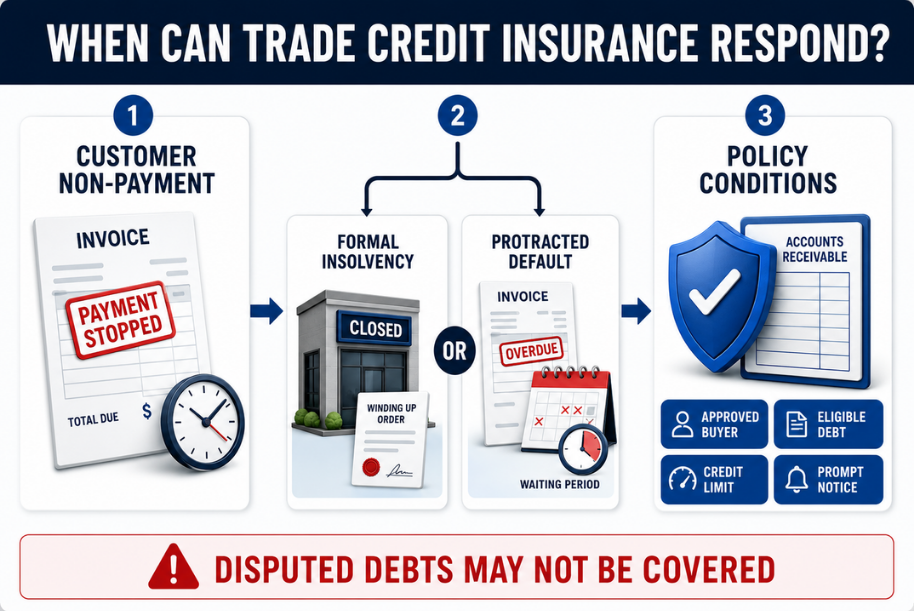
Yes, trade credit insurance can provide customer non-payment insurance where the cause of loss falls within an insured event. Common triggers may include a customer entering a defined form of insolvency or failing to pay an undisputed debt within the policy’s protracted-default period.
Cover generally applies only to approved business customers and eligible debts incurred during the insured period. The insurer may set a credit limit for each buyer, with claims subject to the insured percentage, excess or deductible and recoveries.
This means insurance for unpaid invoices is most effective when arranged before a customer shows signs of financial distress. A business usually cannot wait until an account is seriously overdue and then insure that known loss retrospectively.

When Does Customer Insolvency Trigger Cover?
A late payment and customer insolvency are not the same event. Formal insolvency may involve liquidation, voluntary administration or receivership, or bankruptcy for an individual. The policy defines the exact insured events.
If a customer enters a covered insolvency process, notify the broker or insurer promptly. Evidence may include invoices, contracts, delivery records and confirmation from the insolvency practitioner.
Being a creditor does not guarantee full recovery. Trade credit cover may reduce this exposure, but only within the insured credit limit and policy conditions.

Insolvency Versus Protracted Default
Protracted default can be important where a customer has not entered formal insolvency but still fails to pay an undisputed debt. Under some policies, cover may respond after a specified waiting period and after required collection steps have been taken.
The difference is the trigger. Insolvency depends on a defined legal or formal event, while protracted default is based on non-payment continuing for the period stated in the policy. Neither should be confused with a genuine dispute about workmanship, delivery, pricing or contractual performance.

What Does Trade Credit Insurance Cover?
What trade credit insurance covers varies, but a policy may insure eligible business-to-business receivables arising from:
- the insolvency of an approved customer;
- protracted default by an approved customer;
- goods delivered or services completed on agreed credit terms; and
- selected export risks, including certain political or transfer risks, when specifically included.
Whole-turnover credit insurance may cover a broad portfolio of eligible customers. Key-account or single-debtor cover may focus on major buyers, subject to underwriting.
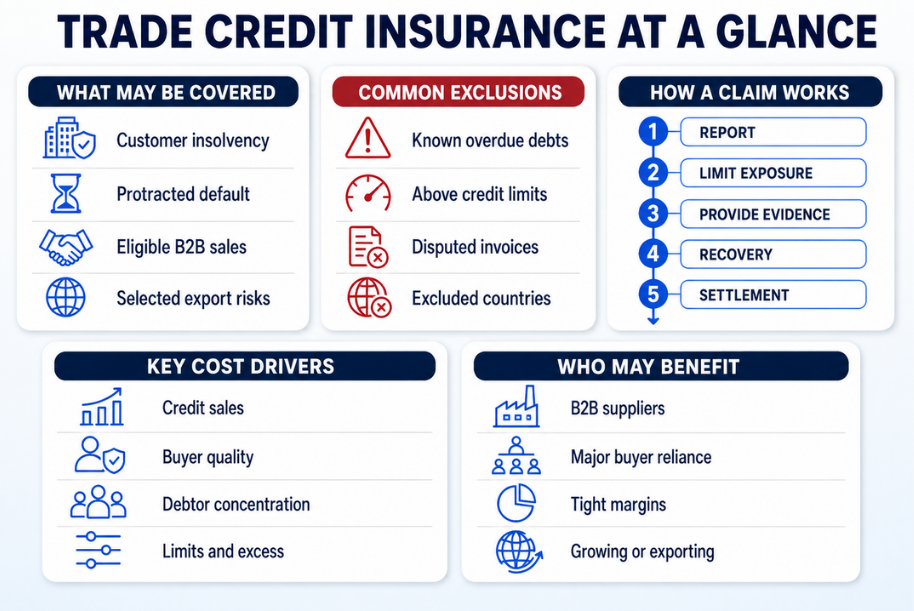
The policy specifies credit limits, maximum liability, payment terms and reporting obligations. Sales above an approved buyer limit may remain uninsured, so limits should be reviewed as exposures change.
What Does Trade Credit Insurance Exclude?
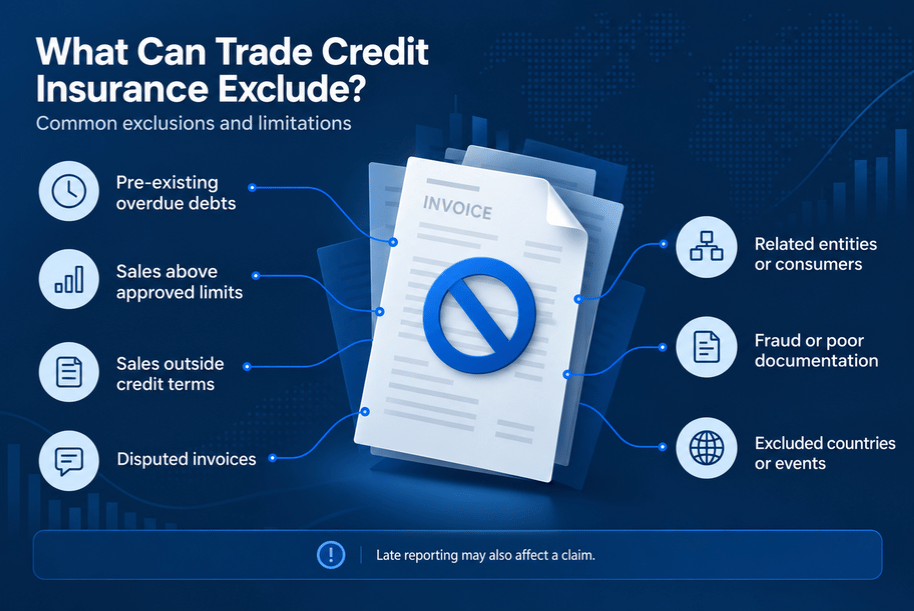
Trade credit insurance exclusions and limitations vary between insurers and policy structures. Matters that may not be covered include:
- debts that were already overdue or known to be doubtful before cover began;
- sales above an approved credit limit;
- transactions outside the insured credit terms;
- disputed invoices, particularly while the underlying dispute remains unresolved;
- sales to related entities or private consumers;
- debts affected by fraud, misrepresentation or inadequate documentation—some fraud-related losses may need to be considered separately under crime insurance; and losses arising from excluded countries, sanctions or political events.
A customer failing to pay is different from invoice manipulation, payment fraud or other cybercrime. These exposures may need to be considered separately under cyber insurance, subject to the policy terms and circumstances.
Late reporting of overdue accounts or adverse information may also affect a claim. The schedule, endorsements, buyer approvals and insurer instructions all matter.
Late reporting of overdue accounts or adverse information may also affect a claim. The schedule, endorsements, buyer approvals and insurer instructions all matter.
How Does a Trade Credit Insurance Claim Work?
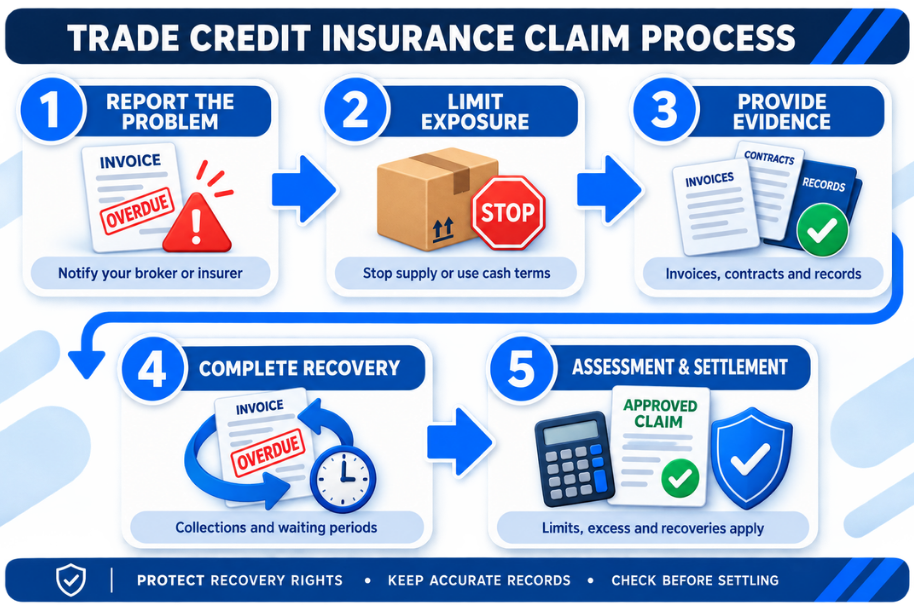
Trade credit insurance claims commonly involve the following steps:
- Report the problem: Notify the broker or insurer when an account reaches the reporting threshold or an insolvency event occurs.
- Limit further exposure: Follow any direction about stopping supply or changing future sales to cash terms.
- Provide evidence: Supply invoices, contracts, delivery records, statements and recovery correspondence.
- Complete recovery requirements: An appointed collection agency may pursue the debt. Protracted-default claims may have a waiting period.
- Assessment and settlement: If accepted, the insurer calculates the loss within the approved limit, applying the insured percentage, excess or deductible and recoveries.
Protect recovery rights and keep accurate records. Check before waiving a debt or accepting an unusual settlement that could affect cover.
How Much Does Trade Credit Insurance Cost?
There is no standard trade credit insurance cost. Premium may be calculated using insured turnover or another agreed pricing basis. Underwriters may consider:
- annual credit sales and average debtor days;
- the industry and financial quality of customers;
- concentration in one or several major debtors;
- domestic and export exposure;
- payment terms, overdue accounts and bad-debt history;
- the business’s credit-control processes; and
- the selected limits, insured percentage, excess and policy structure.
Compare the cost of suitable cover with the cash-flow impact of a major customer failure—not premium alone.
Who Should Consider Trade Credit Insurance for Small Business?
Trade credit insurance for small business may be worth considering when a business:
- sells goods or services to other businesses on credit;
- relies heavily on a few large customers;
- operates in sectors experiencing financial pressure or business failures;
- is expanding into unfamiliar customers, industries or export markets;
- has tight margins or limited capacity to absorb a large bad debt; or
- needs greater confidence when setting commercial credit limits.
Wholesalers, manufacturers, importers, transport operators, labour-hire firms and construction suppliers can all face substantial exposure. The potential effect of a customer default matters more than business size.
This exposure can be particularly relevant for chemical manufacturers and distributors supplying products to wholesalers, industrial customers or overseas buyers on credit terms.
Customer non-payment can also create significant cash-flow pressure for transport and logistics businesses that provide services on credit terms, particularly where a few commercial customers account for a large share of outstanding invoices.
Construction suppliers can face heightened non-payment risk where delayed payments or insolvency elsewhere in the contracting chain affect their outstanding invoices and cash flow.
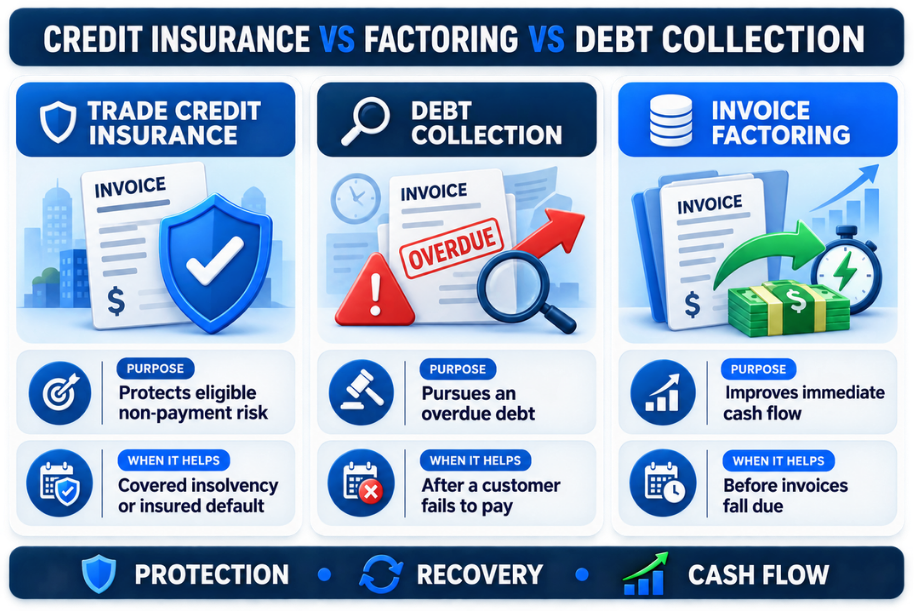
Credit Insurance Versus Factoring and Debt Collection
These tools address different parts of the receivables problem:
Solution | Primary purpose | When it generally helps |
Trade credit insurance | Transfers an agreed portion of eligible non-payment risk | When a covered customer becomes insolvent or meets another insured default trigger |
Debt collection | Pursues an overdue amount | After a customer fails to pay and recovery action is needed |
Invoice factoring | Sells or finances receivables to improve immediate cash flow | Before invoices fall due, subject to the facility terms |
Insurance may include recovery activity, while collection alone does not guarantee payment. Factoring can release cash earlier, but who carries the bad-debt risk depends on whether the facility is with or without recourse.
How GIS Can Help Review Customer Non-Payment Risk?
As a trade credit insurance broker in Australia, GIS can help a business assess its debtor profile, customer concentration, payment terms, credit procedures and recent bad-debt experience. We can then approach suitable insurers, compare policy structures and explain how credit limits, waiting periods, exclusions and claims conditions may apply.
Beyond obtaining a trade credit insurance quote, we help assess whether proposed cover addresses key customer exposures and fits the broader risk strategy.
If unpaid invoices could materially affect your operations, speak with GIS about reviewing your customer non-payment risk and available trade credit insurance options.
Frequently Asked Questions About Insolvency Insurance
Q1. Can you insure unpaid invoices?
Ans 1. Eligible future invoices may be insured when the customer, credit limit and transaction meet policy requirements. Known or overdue debts generally cannot be insured retrospectively.
Q2. A company in liquidation owes me money—what should I do?
Ans 2. Submit the required proof of debt to the liquidator. If cover was in place, notify your broker or insurer immediately. Consider legal or insolvency advice about your creditor rights.
Q3. Does trade credit insurance cover disputed invoices?
Ans 3. A commercial dispute commonly must be resolved before the loss can qualify. Notify the insurer early because the wording and circumstances determine the outcome.
Q4. Can export credit insurance cover overseas customers?
Ans 4. Policies can cover approved export customers and may include specified political or transfer risks. Countries, buyers and limits require insurer acceptance.
Q5. What Is the Difference Between Insolvency Insurance and Bad Debt Insurance?
Ans 5. Both expressions are often used when discussing trade credit insurance. “Insolvency insurance” focuses on customer insolvency, while “bad debt insurance” is a broader informal description. The policy wording—not the label—determines the actual cover.
Important notice
This article is of a general nature only and does not take into account your specific objectives, financial situation or needs. It is also not financial advice, nor complete, so please discuss the full details with your insurance broker as to whether these types of insurance are appropriate for you. Deductibles, exclusions and limits apply. You should consider any relevant Target Market Determination and Product Disclosure Statement in deciding whether to buy or renew these types of insurance. Various insurers issue these types of insurance and cover can differ between insurers.
This article provides information rather than financial product or other advice. The content of this article, including any information contained in it, has been prepared without taking into account your objectives, financial situation or needs. You should consider the appropriateness of the information, taking these matters into account, before you act on any information. In particular, you should review the product disclosure statement for any product that the information relates to it before acquiring the product.
Information is current as at the date the article is written as specified within it but is subject to change. Global Insurance Solutions Pty Ltd make no representation as to the accuracy or completeness of the information. Various third parties have contributed to the production of this content. All information is subject to copyright and may not be reproduced without the prior written consent of Global Insurance Solutions Pty Ltd.

Risk Advisor, Insurance Broker & Director
With around 15 years in insurance, Yuvi Singh is a passionate Risk Advisor, Director, and Insurance Broker at Global Insurance Solutions. Backed by a Commerce degree and ANZIIF diploma, Yuvi leads a team servicing SMEs across industries like manufacturing, logistics, fuel, IT, and more. At GIS, clients benefit from tailored, transparent advice, access to 150+ insurers, and end-to-end risk solutions. Recognised as a 2022 Insurance Magazine Rising Star and 2024 Top Insurance Broker by Insurance Business Australia, Yuvi delivers flexible, effective outcomes with integrity and innovation.