

Business interruption insurance can be one of the most important covers a business holds, yet it is often misunderstood or underestimated. Many business owners focus heavily on insuring their physical assets, such as buildings, stock, machinery and equipment, but do not always consider how long it may realistically take to recover after a major insured event.
For accountants, advisers, brokers, and business owners, one of the most critical questions to ask is simple: is the business interruption indemnity period long enough?
An inadequate indemnity period can leave a business financially exposed at the exact time it needs support most. In many cases, a 12-month indemnity period may appear sufficient, but after a serious fire, storm, flood, machinery breakdown, or major property loss, recovery can often take much longer than expected.
What Is a Business Interruption Indemnity Period?
The indemnity period is the maximum length of time a business interruption policy may respond after an insured event. It is the period during which the insurer may cover loss of income, increased costs of working and other insured financial losses, subject to the terms, conditions and limits of the policy.
For example, if a business has a 12-month indemnity period, the policy may only respond for up to 12 months after the insured event. If the business is still recovering after that period ends, any ongoing loss of income may no longer be covered.
This is why choosing the right business interruption indemnity period is so important.

Why a 12-Month Indemnity Period May Not Be Enough?
Many Australian businesses still carry a 12-month indemnity period by default. While this may be suitable for some lower-risk businesses, it can be inadequate for businesses with complex operations, specialised equipment, imported stock, long rebuilding timelines or strict regulatory requirements.

After a major loss, a business may need time to:
- Assess the damage
- Lodge and progress the insurance claim
- Obtain council or regulatory approvals
- Demolish damaged structures
- Rebuild or repair premises
- Source replacement machinery or equipment
- Rehire and retrain staff
- Restore supply chains
- Rebuild customer relationships
- Return revenue to pre-loss levels
Each of these steps can take weeks or months. When combined, the recovery period can easily exceed 12 months.
Common Reasons Recovery Takes Longer Than Expected
Business recovery is rarely immediate. Even with the right insurance cover in place, delays can occur for many reasons.
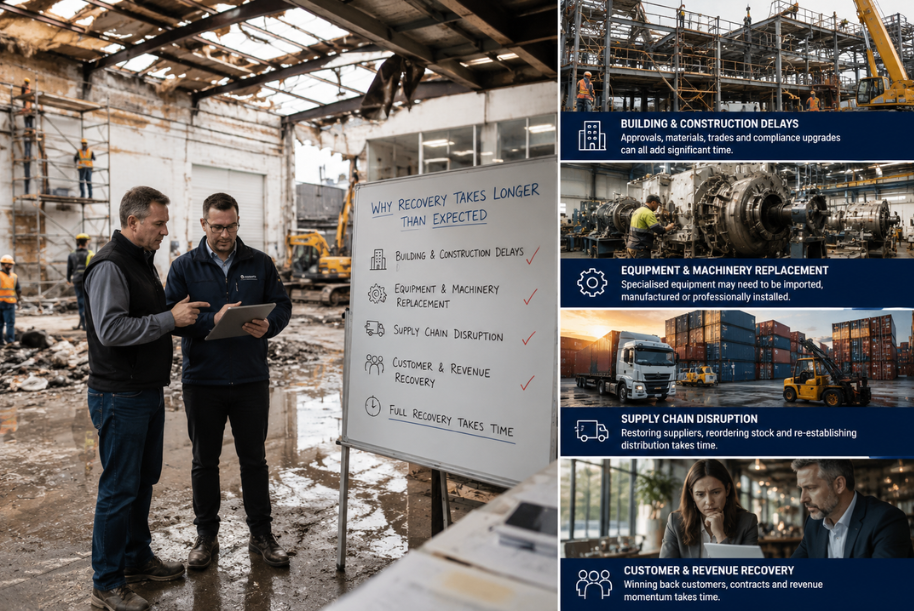
1. Building and Construction Delays
Rebuilding commercial premises can be affected by builder availability, material shortages, engineering requirements, council approvals, and compliance upgrades. In some cases, a building may need to be rebuilt to current standards, which can add further time and cost.
2. Equipment and Machinery Replacement
Manufacturers, fuel businesses, logistics companies, and other specialised industries may rely on equipment that is not readily available in Australia. If replacement machinery must be imported, manufactured to order, or professionally installed, the recovery period can be significantly extended.
3. Supply Chain Disruption
A business may not be able to resume operations immediately even after its premises are repaired. It may need to restore supplier relationships, reorder stock, replace inventory systems, or secure alternative distribution arrangements.
4. Customer and Revenue Recovery
A business does not always return to full revenue as soon as it reopens. Customers may have moved to competitors, contracts may have been lost, and sales momentum may take time to rebuild. A proper indemnity period should consider the time required to restore revenue, not just reopen the doors.
The Risk of Business Interruption Underinsurance
Business interruption underinsurance can occur when the declared gross profit, sum insured, or indemnity period is too low. Even if the business has coverage, the policy may not provide enough protection if the assumptions used at renewal are inaccurate.

An inadequate indemnity period is a common form of underinsurance. The business may be insured, but only for a recovery period that is too short.
This can create serious cash flow pressure, especially where the business still needs to pay fixed expenses such as rent, wages, loan repayments, utilities, leasing costs, and other overheads.
Who Should Review Their Indemnity Period?
Every business should review its business interruption cover at renewal, but some industries require particular attention.

Businesses that may need longer indemnity periods include:
- Manufacturers
- Service stations and fuel retailers
- Hospitality venues
- Construction businesses
- Warehouses and logistics operators
- Importers and wholesalers
- Food and beverage businesses
- Medical and healthcare operators
- Commercial property owners
- Businesses with specialised plant or machinery
- Businesses operating from highly customised premises
For these businesses, a 12-month indemnity period may not reflect the true recovery timeline.
How Long Should a Business Interruption Indemnity Period Be?
There is no single correct answer. The right indemnity period depends on the business, its operations, premises, equipment, suppliers, customer base, and likely recovery timeline.

Common indemnity periods include:
- 12 months
- 18 months
- 24 months
- 36 months
For many businesses, 18, 24, or even 36 months may provide a more realistic recovery window after a major loss.
When reviewing the indemnity period, business owners and advisers should consider:
- How long would it take to rebuild the premises?
- Are council or regulatory approvals required?
- Is the building older or subject to compliance upgrades?
- Is specialist machinery required?
- Would replacement equipment need to be imported?
- How long would it take to regain customers?
- Would staff be retained during the shutdown?
- Could the business operate from a temporary location?
- Are there seasonal revenue peaks?
- Are key suppliers or customers difficult to replace?
These questions help determine whether the current indemnity period is adequate.
Why Advisers Should Raise This With Clients?

Accountants, finance brokers, risk advisers, and insurance brokers are often well placed to identify business interruption risks. They understand the financial impact that a prolonged shutdown could have on cash flow, debt servicing, profitability, and business continuity.
Raising the issue of indemnity periods can help clients avoid unexpected gaps in cover. It also encourages a more strategic insurance review rather than a simple premium comparison.
A lower premium may not be beneficial if the business is left exposed after a major claim.
Business Interruption Insurance Should Reflect the Real Business
Business interruption insurance should not be treated as a standard add-on to a property policy. It should be reviewed in line with the business’s actual financial structure and operational risk.

Business interruption cover for larger organisations is frequently structured within an Industrial Special Risks insurance program.
This includes reviewing:
- Gross profit calculations
- Revenue projections
- Fixed expenses
- Payroll requirements
- Increased cost of working
- Claims preparation costs
- Indemnity period
- Policy exclusions
- Supply chain dependencies
A proper review can help ensure the policy is aligned with the business’s real exposure.
When Should Businesses Review Their Cover?
Business interruption cover should be reviewed at least annually, especially before renewal. However, a review should also take place when the business experiences major changes.

These may include:
- Business expansion
- Increased revenue
- New premises
- New equipment
- Higher stock levels
- New contracts
- Changes in suppliers
- Increased debt or financial obligations
- Renovations or upgrades
- Change in business model
Waiting until after a claim is too late.
Final Thoughts
Business interruption insurance is designed to help protect a business from the financial impact of an insured disruption. However, the protection is only effective if the indemnity period is long enough.
For many Australian businesses, the true recovery period after a major loss may be much longer than expected. A 12-month indemnity period may not allow enough time to rebuild, replace equipment, restore operations, and recover revenue.
Reviewing business interruption indemnity periods should be a key part of every commercial insurance review. By taking the time to assess realistic recovery timelines, business owners and advisers can help reduce the risk of underinsurance and improve long-term business resilience.
If your clients have not reviewed their business interruption cover recently, now is the time to ask whether their indemnity period is truly adequate.
Also Explore: Commercial Property Insurance | Business Insurance | Machinery Breakdown Insurance | Business Continuity Insurance
We have curated blogs on – Why Are Commercial Property Insurance Costs Surging Across Australia | Marine Transit Claim Rejected? Understanding the Fine Print Before It’s Too Late | Guide on Annual Insurance Review | Landlord Insurance vs Building Insurance
Frequently Asked Questions About Marine Transit Insurance Claims
Q1.What is a business interruption indemnity period?
Ans 1. It is the maximum period your Business Interruption Insurance may cover lost income and insured operating costs after an insured event, subject to your policy terms.
Q2. Is a 12-month indemnity period enough?
Ans 2. Not always. Many businesses need longer than 12 months to rebuild, replace equipment, restore operations and recover revenue.
Q3. How do I choose the right indemnity period?
Ans 3. Consider your rebuilding timeline, equipment replacement, supply chains, customer recovery and regulatory approvals before selecting an indemnity period.
Q4. What are the common business interruption indemnity periods?
Ans 4. Most insurers offer 12, 18, 24 or 36-month indemnity periods, depending on the business’s needs.
Q5. Which businesses should consider a longer indemnity period?
Ans 5. Manufacturers, service stations, logistics operators, hospitality businesses, importers, commercial property owners and businesses with specialised equipment often require longer recovery periods.
Q6. What happens if my indemnity period is too short?
Ans 6. Your cover may end before the business fully recovers, leaving you to fund ongoing income losses and fixed expenses yourself.
Q7. Can a short indemnity period lead to underinsurance?
Ans 7. Yes. An inadequate indemnity period is a common form of Business Interruption underinsurance and can create significant financial pressure after a claim.
Q8. When should I review my Business Interruption Insurance?
Ans 8. Review it annually before renewal and whenever your business expands, relocates, purchases major equipment or experiences significant operational changes.
Q9. What expenses can Business Interruption Insurance help cover?
Ans 9. Depending on the policy, it may cover lost income, fixed expenses, payroll, increased costs of working and other insured financial losses.
Q10. Why is revenue recovery important when choosing an indemnity period?
Ans 10. Businesses often take months to regain customers and return to pre-loss turnover, even after reopening.
Q11. Should advisers discuss indemnity periods with clients?
Ans 11. Yes. Accountants, finance advisers and insurance brokers can help identify whether the current indemnity period reflects the client’s actual recovery risks.
Q12. Can my indemnity period be changed at renewal?
Ans 12. Yes. Businesses can review and adjust their indemnity period at renewal or after significant changes to operations, subject to insurer approval.
Important notice
This article is of a general nature only and does not take into account your specific objectives, financial situation or needs. It is also not financial advice, nor complete, so please discuss the full details with your insurance broker as to whether these types of insurance are appropriate for you. Deductibles, exclusions and limits apply. You should consider any relevant Target Market Determination and Product Disclosure Statement in deciding whether to buy or renew these types of insurance. Various insurers issue these types of insurance and cover can differ between insurers.
This article provides information rather than financial product or other advice. The content of this article, including any information contained in it, has been prepared without taking into account your objectives, financial situation or needs. You should consider the appropriateness of the information, taking these matters into account, before you act on any information. In particular, you should review the product disclosure statement for any product that the information relates to it before acquiring the product.
Information is current as at the date the article is written as specified within it but is subject to change. Global Insurance Solutions Pty Ltd make no representation as to the accuracy or completeness of the information. Various third parties have contributed to the production of this content. All information is subject to copyright and may not be reproduced without the prior written consent of Global Insurance Solutions Pty Ltd.

Risk Advisor, Insurance Broker & Director
With around 15 years in insurance, Yuvi Singh is a passionate Risk Advisor, Director, and Insurance Broker at Global Insurance Solutions. Backed by a Commerce degree and ANZIIF diploma, Yuvi leads a team servicing SMEs across industries like manufacturing, logistics, fuel, IT, and more. At GIS, clients benefit from tailored, transparent advice, access to 150+ insurers, and end-to-end risk solutions. Recognised as a 2022 Insurance Magazine Rising Star and 2024 Top Insurance Broker by Insurance Business Australia, Yuvi delivers flexible, effective outcomes with integrity and innovation.