

Cybercriminals do not always need to defeat sophisticated technology. They may only need to persuade a busy employee to open a file, reveal a password or approve a payment. That is why security awareness training and phishing awareness training should form part of every Australian organisation’s cyber-risk controls.
Social engineering exploits trust, urgency, fear or curiosity. It may lead to stolen funds, exposed information or interrupted operations. ASD’s Australian Cyber Security Centre received more than 84,700 cybercrime reports in 2024–25, while the average self-reported cost per business report was $80,850. ASD’s 2024–25 Annual Cyber Threat Report also identified email compromise and business email compromise among the leading threats reported by businesses.
At Global Insurance Solutions (GIS), we believe cyber security training for employees should sit alongside technical controls, documented procedures, incident response planning and appropriately arranged cyber insurance.
What Is Phishing and How Does Social Engineering Work?
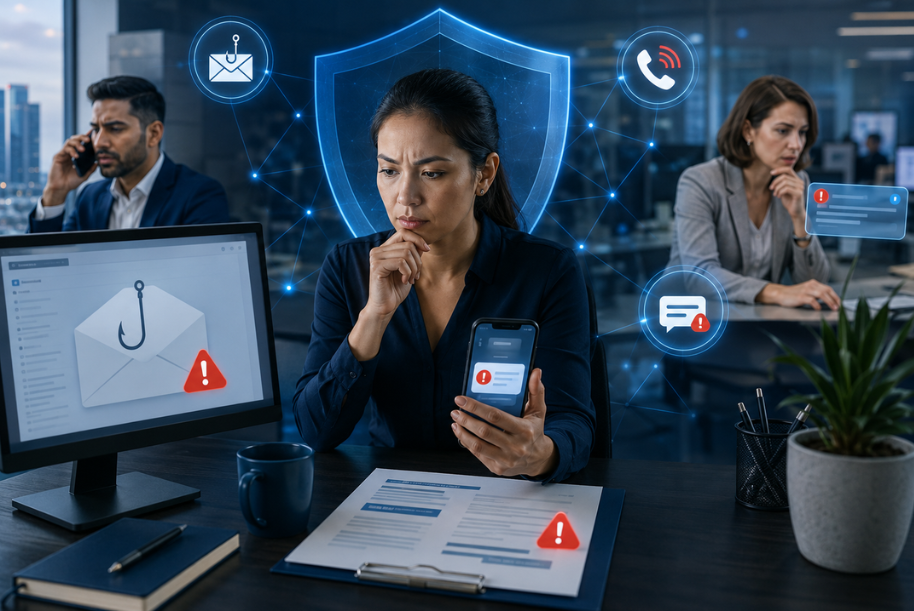
What is phishing?
It is deception in which an attacker impersonates a trusted person or organisation to obtain information, money or system access. It may arrive by email, text, telephone, social media or a collaboration platform.
Phishing is one category of social engineering. Other social engineering tactics include invented identities, fake support requests, fraudulent invoices and tempting downloads. The aim is usually to make someone act before checking.
Common social engineering examples include a supplier apparently changing bank details, an executive requesting an urgent transfer, an IT technician asking for a verification code or a courier message directing an employee to a false login page.
Types of Social Engineering Attacks Employees Should Recognise
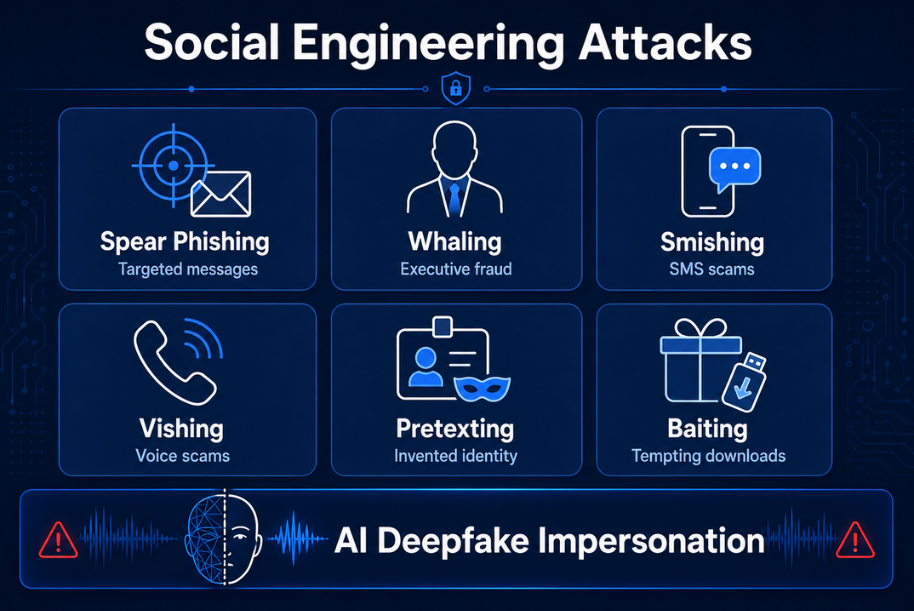
Effective training explains the main types of social engineering attacks in plain language and relates them to an employee’s role.
What Is Spear Phishing?
What is spear phishing? It is a targeted message tailored to a person, team or organisation using information gathered online or from previous breaches.
Whaling, Smishing and Vishing
A whaling attack cyber security scenario targets an executive or person with authority over payments or sensitive information.
Smishing (SMS phishing) uses texts, while common vishing (voice phishing) examples include callers impersonating banks or software providers to request credentials or remote access.
AI-generated voices and videos can make executive impersonation more convincing, increasing the need for employees to recognise deepfake and impersonation fraud.
Pretexting and Baiting
The pretexting attack meaning is that a scammer invents a believable situation or identity. A baiting attack cyber security scenario offers something attractive, such as a free download, that exposes the user or system.
How to Spot a Phishing Email: Red Flags and Examples?
Teaching staff how to spot a phishing email means asking them to pause and assess the full context.
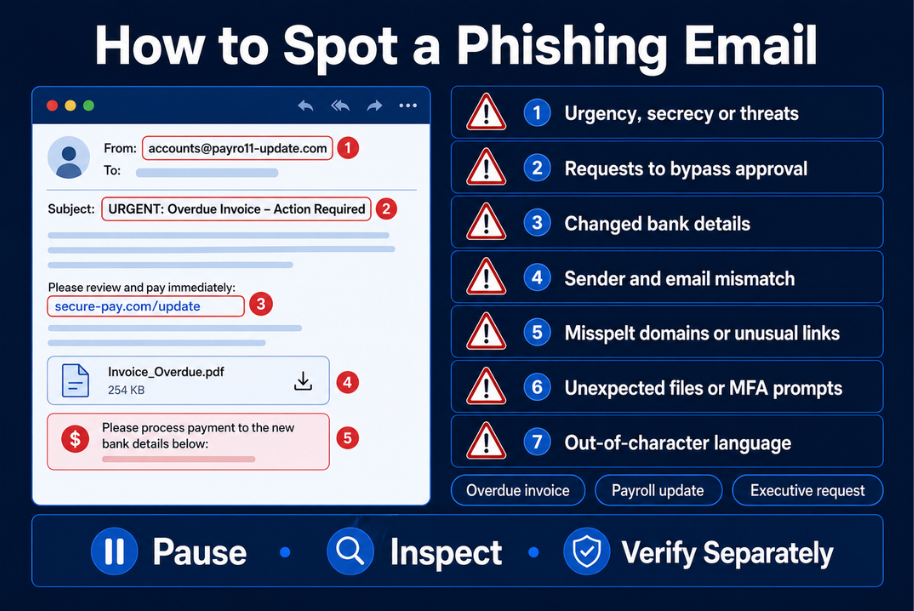
Important social engineering red flags include:
- Unexpected urgency, secrecy or threats
- Requests to bypass an approval process
- New or changed bank account details
- A sender name that does not match the actual email address
- Slightly misspelt domains or unusual links
- Unexpected attachments, login prompts or multi-factor authentication requests
- Language or behaviour inconsistent with the supposed sender
Useful phishing email examples should reflect real work: a fake overdue invoice, false payroll update or confidential executive request designed to discourage verification.
Employees should inspect links without opening them and confirm requests through a separately sourced contact method. A familiar display name, polished branding or correct personal details do not prove legitimacy.
Business Email Compromise, CEO Fraud and Invoice Fraud
Business email compromise (BEC) Australia incidents may involve criminals taking over or imitating a genuine mailbox, then intervening when a payment or sensitive exchange is expected.
A CEO fraud scam uses executive authority to pressure an employee into an urgent transfer. Invoice fraud redirects a legitimate payment. Invoice fraud prevention controls include verbal verification using a trusted number, dual approval for account changes and alerts for unusual transactions.
ASD advises businesses to train staff to question urgent payments, bank-detail changes, attachments, login requests and unexpected links, and to repeat training regularly. Read ASD’s business email compromise guidance.
How to Prevent Social Engineering Attacks in the Workplace
Phishing emails can also deliver malicious software, making employee training an important part of ransomware attack recovery and prevention.
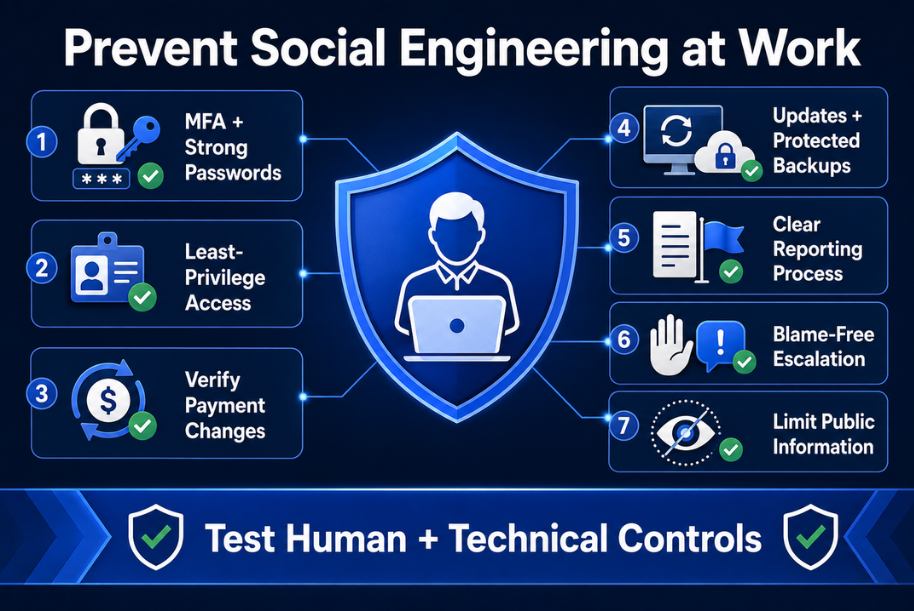
When considering how to prevent social engineering attacks, combine employee judgement with controls that limit mistakes. Start with these cyber fraud prevention tips:
- Use multi-factor authentication and strong, unique passwords.
- Apply least-privilege access so employees only reach the systems and data required for their roles.
- Require independent verification for payment, payroll and supplier-detail changes.
- Keep software updated and maintain tested, protected backups for ransomware attack prevention.
- Establish a clear process for reporting suspicious messages and potential incidents.
- Remove blame from reporting, as early escalation can limit damage.
- Review public information that attackers could use to build convincing pretexts.
These measures support identity theft prevention Australia efforts by reducing unnecessary access to personal information. Those exploring how to prevent cyber fraud in the workplace should test both human and technical controls.
Building a Security Awareness Training Program
The best cyber security training for employees is relevant, repeated and measurable. A security awareness training program should begin at induction and address passwords, phishing, information handling, payment fraud, remote work and incident reporting.
When deciding how to train employees to spot phishing, use:
- Short modules based on the organisation’s actual risks
- Regular reminders when threats or procedures change
- Role-specific employee phishing training courses for finance, payroll, IT and executives
- Tabletop exercises that test escalation and decision-making
- Controlled phishing simulations followed by immediate education
- Reporting metrics, simulation trends and remedial coaching
When comparing phishing simulation training Australia providers, assess privacy, customisation, reporting and support—not only price. Free cyber security training for staff is available through cyber.gov.au, but may require organisation-specific supplementation.
Good cyber security awareness training Australia programs build a “human firewall”: employees who recognise unusual activity, verify requests and report concerns. Training should educate, not embarrass.
Australian Standards, Privacy and Reporting Considerations
Training is one part of a wider framework. The ACSC Essential Eight comprises technical mitigation strategies designed to make systems harder to compromise. Australian Signals Directorate cyber guidelines recommend annual awareness training, with additional guidance for employees handling payments.
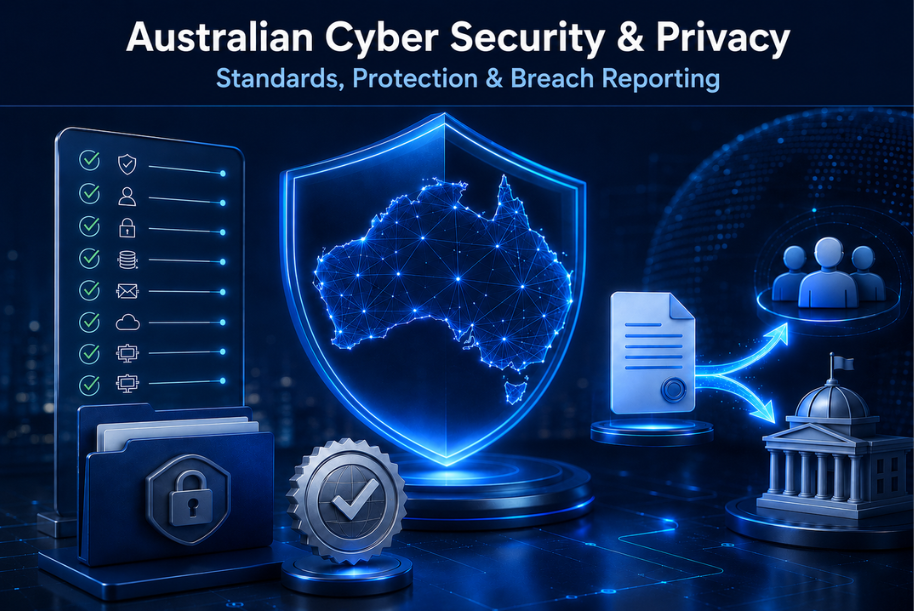
For organisations operating an information security management system, ISO 27001 security awareness training can support a risk-based approach to people, processes and technology.
Privacy Act cyber security obligations Australia vary by organisation and information. Australian Privacy Principle 11 requires covered entities to take reasonable steps to protect personal information. Under the notifiable data breaches scheme Australia, covered entities must notify affected individuals and the OAIC when an eligible breach is likely to cause serious harm.
Businesses should obtain legal and technical advice about their specific obligations. Read the OAIC’s Notifiable Data Breaches guidance.
Why Employee Training Matters to Cyber Risk?
Scamwatch phishing statistics show the wider financial impact: combined reported phishing losses reached $97.6 million in 2025.
Across all scam categories, combined reported losses were $2.18 billion. See the National Anti-Scam Centre’s 2025 report.
The cost of a data breach Australia businesses experience can include investigation, restoration, legal advice, notification and interruption.
The OAIC received a record 1,205 data breach notifications in 2025, with malicious or criminal activity responsible for most. View the OAIC’s 2025 statistics.
Businesses should also understand what cyber insurance covers and excludes, as cover varies between insurers and remains subject to policy terms and conditions.
GIS can help Australian businesses review their cyber exposures and compare suitable insurance options.
Frequently Asked Questions
Q1. What to Do if You Click a Phishing Link?
Ans 1. Every business should have a documented cyber incident response plan explaining who must be contacted and how affected systems, accounts and data should be contained. Report cybercrime through ReportCyber and scams to Scamwatch.
Q2. How Do You Report a Phishing Email?
Ans 2. If unsure how to report a phishing email, use your organisation’s reporting process without opening links or attachments. It may also require reporting to the relevant service provider, Scamwatch or ReportCyber.
Q3. How Often Should Security Awareness Training Happen?
Ans 3. Provide training at induction, at least annually and when risks or procedures change. Reinforce it with updates and simulations; higher-risk roles may need more frequent training.
Q4. Why Do Employees Fall for Phishing Scams?
Ans 4. Attackers exploit trust, helpfulness, curiosity and authority. Urgency or fear can make busy people act quickly. Training and verification procedures give them time to pause.
Q5. How Much Does a Phishing Attack Cost a Business?
Ans 5. There is no fixed amount. ASD reported an average self-reported cybercrime cost of $80,850 per business report in 2024–25, but individual incidents may be substantially higher or lower.
Q6. What Is the Human Firewall Concept?
Ans 6. The human firewall concept describes employees who recognise warning signs, verify requests and report concerns. It complements, rather than replaces, technical controls.
Q7. What Is the Difference Between Phishing and Social Engineering?
Ans 7. The difference between phishing and social engineering is scope: social engineering is the broader manipulation practice; phishing is one method delivered through deceptive communications.
Q8. What Does Security Awareness Training Cost?
Ans 8. Security awareness training cost depends on employee numbers, platform features, simulations and support. Assess value against risk and learning outcomes, not only the fee.
Q9. Can Cyber Insurance Cover Social Engineering Fraud?
Ans 9. Understanding the difference between first-party and third-party cyber insurance can help businesses identify how a cyber incident may create both direct losses and liability to others.
Some cyber or crime policies may provide cover for certain social engineering, data breach, business interruption or incident response losses. Cover varies significantly between insurers and remains subject to policy terms, sub-limits, conditions and exclusions. A broker can help determine whether your current insurance addresses the exposures relevant to your business.
Speak with Global Insurance Solutions to review your cyber risks and insurance arrangements.
Important notice
This article is of a general nature only and does not take into account your specific objectives, financial situation or needs. It is also not financial advice, nor complete, so please discuss the full details with your insurance broker as to whether these types of insurance are appropriate for you. Deductibles, exclusions and limits apply. You should consider any relevant Target Market Determination and Product Disclosure Statement in deciding whether to buy or renew these types of insurance. Various insurers issue these types of insurance and cover can differ between insurers.
This article provides information rather than financial product or other advice. The content of this article, including any information contained in it, has been prepared without taking into account your objectives, financial situation or needs. You should consider the appropriateness of the information, taking these matters into account, before you act on any information. In particular, you should review the product disclosure statement for any product that the information relates to it before acquiring the product.
Information is current as at the date the article is written as specified within it but is subject to change. Global Insurance Solutions Pty Ltd make no representation as to the accuracy or completeness of the information. Various third parties have contributed to the production of this content. All information is subject to copyright and may not be reproduced without the prior written consent of Global Insurance Solutions Pty Ltd.

Risk Advisor, Insurance Broker & Director
With around 15 years in insurance, Yuvi Singh is a passionate Risk Advisor, Director, and Insurance Broker at Global Insurance Solutions. Backed by a Commerce degree and ANZIIF diploma, Yuvi leads a team servicing SMEs across industries like manufacturing, logistics, fuel, IT, and more. At GIS, clients benefit from tailored, transparent advice, access to 150+ insurers, and end-to-end risk solutions. Recognised as a 2022 Insurance Magazine Rising Star and 2024 Top Insurance Broker by Insurance Business Australia, Yuvi delivers flexible, effective outcomes with integrity and innovation.