

Renewal notices have a habit of arriving at the worst possible time, right when you’re flat out running the business the policy is meant to protect. But if you renew your business interruption insurance without checking it against how your business looks today, you could be carrying a gap you won’t discover until you’re mid-claim.
A renewal is also a useful opportunity to review your broader business continuity insurance strategy, including how your business would continue operating during an extended disruption.
At Global Insurance Solutions, we review hundreds of renewals a year for Australian businesses, and the same issues come up again and again: sums insured that haven’t kept pace with revenue, indemnity periods that are too short, and exclusions nobody re-read since the policy was first taken out.
This guide walks through exactly what to check before you renew, so your business interruption insurance Australia policy still does its job when you need it most.
What Is Business Interruption Insurance?
Business interruption insurance (sometimes called business income insurance) replaces the profit and covers the fixed costs your business would have earned if a covered event fire, storm, flood, or major equipment breakdown forces you to stop trading or slows you down.

It doesn’t repair your building or replace your stock; that’s what commercial property insurance is for.
Business interruption cover works alongside it, protecting your cash flow, wages, rent, and loan repayments while you get back on your feet.
So how does business interruption insurance work in practice?
Cover is triggered by physical loss or damage to insured property.
If there’s no covered physical damage, most standard policies won’t respond, even if trading has been badly disrupted by something else entirely, which is exactly why the fine print matters so much at renewal time.
What Does Business Interruption Insurance Cover?
A typical business interruption insurance cover includes:
- Loss of net profit – the profit you would have earned had the interruption not occurred
- Fixed costs and standing charges – rent, wages, loan repayments, and other bills that don’t stop just because trading has
- Increased cost of working the extra cost of operating from a temporary site or expediting repairs to reduce downtime (an important add-on to check under any increased cost of working cover Australia clause)
- Contingent business interruption insurance – cover if a key supplier or customer’s premises is damaged, disrupting your operations even though your own site is untouched
- Supply chain interruption insurance – businesses increasingly add — relevant given how many companies rely on a small number of suppliers or a single distribution partner
- Notifiable disease cover business interruption extensions provide — limited cover for closures ordered due to a notifiable disease outbreak at your premises (usually capped and subject to specific policy wording)
Not every policy includes all of these as standard; some sit as optional extensions, which is precisely why a pre-renewal review matters more than a rubber stamp.
Why You Should Review Your Policy Before Renewal?
If you’re asking “do I need business interruption insurance in Australia,” the honest answer is: it depends on your exposure, but most businesses with premises, stock, or equipment carry meaningful risk without it.
It isn’t legally mandatory, but many commercial leases, franchise agreements, and lending covenants require it.
More importantly, your business today probably doesn’t look like it did at your last renewal. Revenue has likely shifted, you may have taken on new premises or staff, and your supply chain may look completely different.
An annual insurance review checklist for small business should sit alongside your renewal date every single year — not just when something changes dramatically.
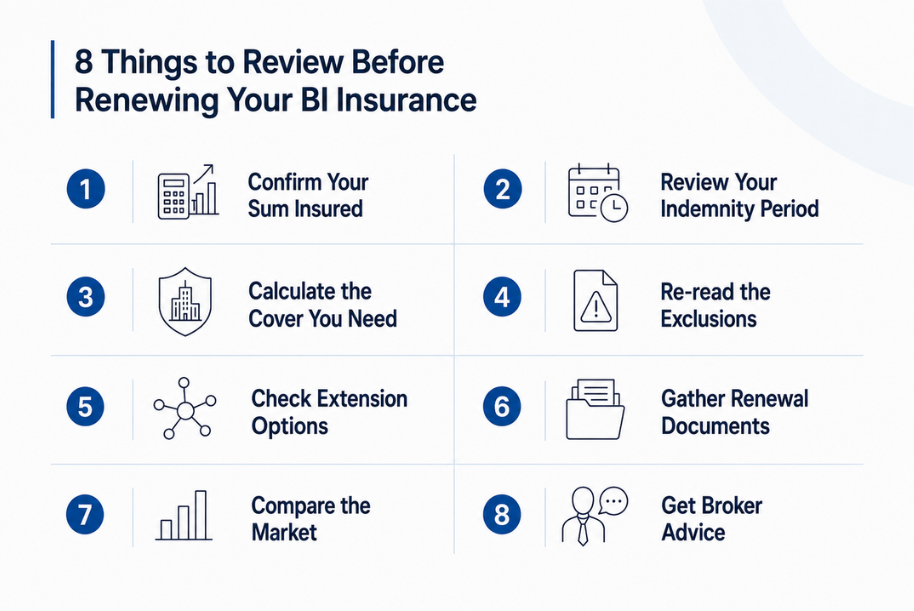
8 Things to Review Before Renewing Your BI Insurance
Here’s our working business interruption insurance renewal checklist, the same business interruption insurance review checklist brokers use, and what to check before renewing business insurance of any kind, not just this policy.
1. Confirm your sum insured is accurate
Run through a proper business interruption sum insured calculation checklist rather than rolling last year’s figure over.
Sum insured business interruption calculation starts with your gross profit (or gross revenue, depending on your policy basis more on that below) multiplied by your chosen indemnity period, then adjusted for growth, seasonality, and inflation.
Getting this wrong is the single biggest driver of underinsured business interruption claims, where insurers apply “average” clauses and pay out a reduced percentage of your claim because your sum insured didn’t reflect your real exposure.
A quick but important distinction: gross profit vs gross revenue business interruption policies calculate cover differently.
Gross profit policies (the more common basis) cover turnover less variable costs; gross revenue policies cover turnover with different cost treatment. Confirm which basis your policy uses before you recalculate anything.
For a more detailed explanation, read our guide to gross profit vs revenue in business interruption insurance before completing your renewal calculation.
2. Review your indemnity period
The indemnity period business interruption cover runs for is the maximum time the insurer will pay out following a loss, commonly 12 to 24 months in Australia.
If your last claim experience (yours or an industry peer’s) showed recovery taking longer than your current period, especially where council approvals, custom equipment lead times, or contractor availability could stretch things out, this is the year to extend it.
Our guide to choosing the right business interruption indemnity period explains why a standard 12-month period may not be enough for businesses with complex rebuilding or equipment requirements.
Check your business interruption insurance indemnity period clause specifically; it’s easy to overlook because it rarely changes automatically.
3. Work out how much cover you actually need
How much business interruption cover do I need is really a function of your worst realistic scenario, not your best-case one.
Model a full closure of your primary site and ask honestly how long recovery would take repairs, re-fitting, staff retraining, and rebuilding customer volume all factor in.
A major property loss can involve assessment, approvals, rebuilding, equipment replacement, and a gradual return to normal trading. Our commercial property fire insurance guide explains some of the property and recovery issues businesses should consider.
4. Re-read the exclusions
What’s excluded from business interruption insurance varies significantly between insurers. Common carve-outs include pandemics (outside specific notifiable disease extensions), flood in some standard packages, cyber-triggered outages, and any interruption without accompanying physical damage.
If your business relies heavily on digital systems, review whether you need a dedicated cyber insurance policy to address cyber-related interruption and recovery costs.
Property-related exclusions can also vary considerably, particularly for flood, storm and vacant premises. Learn more about commercial property insurance coverage and exclusions.
If your risk profile has changed new premises in a flood-prone area or greater reliance on digital operations check whether you need a cyber insurance policy or flood extension alongside your renewal.
5. Check your extension options
Revisit contingent business interruption, supply chain cover, and increased cost of working limits against your current supplier concentration and operating model.
If you’ve added a new critical supplier since your last renewal, ask your broker whether they should be named on your contingent business interruption schedule.
6. Gather your renewal documents
Documents needed for business interruption insurance renewal typically include 12–24 months of profit and loss statements, payroll reports, bank reconciliations, and any updated lease or supply agreements.
Having these ready before renewal negotiations start speeds up underwriting and avoids last-minute gaps in cover.
7. Compare your renewal quote against the market
Don’t assume your existing insurer’s renewal offer is competitive. It’s worth asking your broker to compare business interruption insurance quotes from two or three insurers, particularly if your risk profile, claims history, or industry pricing has shifted.
Getting a fresh business interruption insurance quote Australia-wide gives you a genuine benchmark, even if you ultimately stay put.
The review should consider your broader business insurance program as well, as changes to property, machinery, cyber or liability exposures may affect more than your BI section.
8. Get broker advice before you sign
A business insurance broker businesses trust can catch gaps a self-managed renewal often misses: under-declared sums insured, an indemnity period that’s crept out of step with your recovery timeline, or an exclusion that quietly appeared in a policy wording update.
If you’re wondering how to switch business interruption insurance providers without a coverage gap, this is exactly the conversation to have before, not after, your current policy lapses.
How Much Does Business Interruption Insurance Cost in Australia?
There’s no single figure for how much business interruption insurance costs Australia-wide; premiums are driven by your industry, location, sum insured, indemnity period, claims history, and chosen extensions.
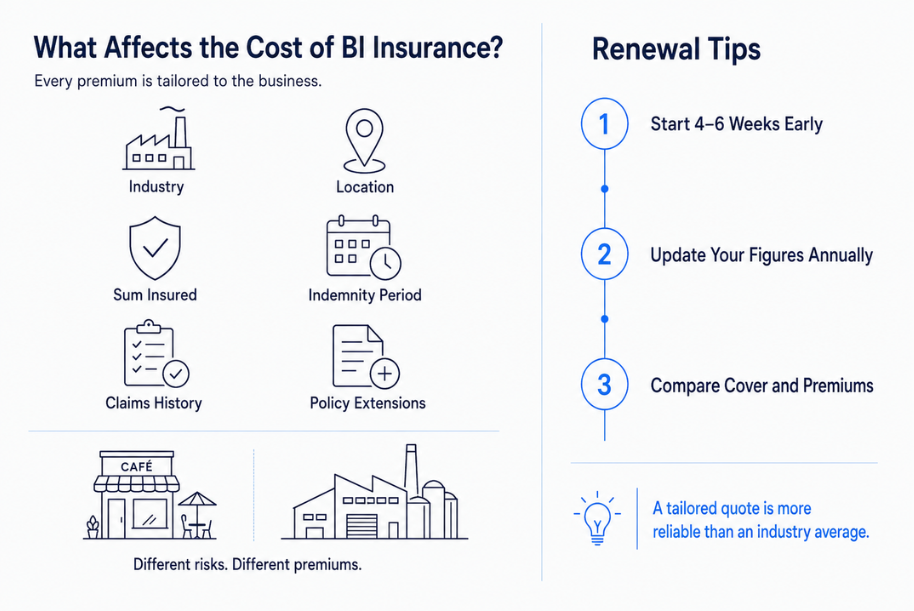
A café with a 12-month indemnity period will pay very differently to a manufacturer with complex machinery and a longer recovery timeline. The most reliable way to know your number is a tailored quote rather than an industry average.
Business Interruption Insurance Renewal Tips
Wondering how to prepare for insurance renewal without it eating your week?
A few practical business interruption insurance renewal tips: start the commercial insurance renewal process Australia insurers expect at least four to six weeks before expiry, not four to six days.
Update your figures annually rather than letting several years pass between reviews. And if you’re unsure where to start, our get a quote page is a fast way to benchmark your current policy against the market.
Talk to a Broker Before You Renew
Renewing your business insurance policy Australia-wide shouldn’t be a same-day decision. Work through this small business insurance renewal checklist — really, a business insurance renewal checklist Australia owners can lean on for any commercial policy — pull your financials together early, and get an independent set of eyes on your policy wording before you sign. Contact our brokers at Global Insurance Solutions for a no-obligation review of your renewal — we’ll tell you plainly whether your current cover still fits your business, and what it would take to fix it if it doesn’t.
Frequently Asked Questions
Q1. Is business interruption insurance compulsory in Australia?
Ans 1. No. It isn’t a legal requirement, but it’s often required under commercial leases, franchise agreements, or finance covenants, and it’s strongly recommended for any business with premises, stock, or equipment exposed to physical loss.
Q2. How often should I review my insurance policy?
Ans 2. At minimum, once a year at renewal, and again any time your revenue, premises, staffing, or supply chain changes materially.
Q3. When should I review my business interruption insurance?
Ans 3. Ideally, four to six weeks before your renewal date, giving enough time to gather documents, recalculate your sum insured, and compare quotes without rushing the decision.
Q4. What happens if I don't renew business interruption insurance?
Ans 4. Your cover lapses on the expiry date, leaving you personally exposed to lost profit and ongoing fixed costs if a covered event forces you to stop trading, with no ability to backdate a claim.
Q5. When does business insurance renew?
Ans 5. Business insurance renews annually on the policy anniversary date shown on your schedule, though insurers typically issue a renewal notice 30–45 days beforehand.
Important notice
This article is of a general nature only and does not take into account your specific objectives, financial situation or needs. It is also not financial advice, nor complete, so please discuss the full details with your insurance broker as to whether these types of insurance are appropriate for you. Deductibles, exclusions and limits apply. You should consider any relevant Target Market Determination and Product Disclosure Statement in deciding whether to buy or renew these types of insurance. Various insurers issue these types of insurance and cover can differ between insurers.
This article provides information rather than financial product or other advice. The content of this article, including any information contained in it, has been prepared without taking into account your objectives, financial situation or needs. You should consider the appropriateness of the information, taking these matters into account, before you act on any information. In particular, you should review the product disclosure statement for any product that the information relates to it before acquiring the product.
Information is current as at the date the article is written as specified within it but is subject to change. Global Insurance Solutions Pty Ltd make no representation as to the accuracy or completeness of the information. Various third parties have contributed to the production of this content. All information is subject to copyright and may not be reproduced without the prior written consent of Global Insurance Solutions Pty Ltd.

Risk Advisor, Insurance Broker & Director
With around 15 years in insurance, Yuvi Singh is a passionate Risk Advisor, Director, and Insurance Broker at Global Insurance Solutions. Backed by a Commerce degree and ANZIIF diploma, Yuvi leads a team servicing SMEs across industries like manufacturing, logistics, fuel, IT, and more. At GIS, clients benefit from tailored, transparent advice, access to 150+ insurers, and end-to-end risk solutions. Recognised as a 2022 Insurance Magazine Rising Star and 2024 Top Insurance Broker by Insurance Business Australia, Yuvi delivers flexible, effective outcomes with integrity and innovation.