
Commercial contents insurance may cover equipment you don’t own, but cover is not automatic. Hired, leased or borrowed equipment must fall within the policy’s insured property definition. The cause of damage, location, limits and exclusions also matter.
Think about the equipment keeping your business running: a leased printer, supplier-owned coffee machine or borrowed diagnostic tool. You may not own these assets, yet replacing them could become your responsibility.
At Global Insurance Solutions (GIS), we recommend looking beyond your asset register when reviewing business contents insurance in Australia. Start with what your business uses, what belongs to someone else and what your agreements require you to insure.
What is business contents insurance?
Business contents insurance helps protect eligible business assets against insured physical loss or damage.
A practical commercial contents insurance definition is cover for items such as business furniture and fittings, computers, tools and equipment, subject to the policy wording. Stock may be included or insured separately.
Ownership is not always essential for cover. Some commercial contents insurance policies may include equipment your business is legally responsible for, even if you don’t own it. Cover depends on the policy’s definitions, terms, limits and exclusions.
Does commercial contents insurance cover hired, leased or borrowed equipment?
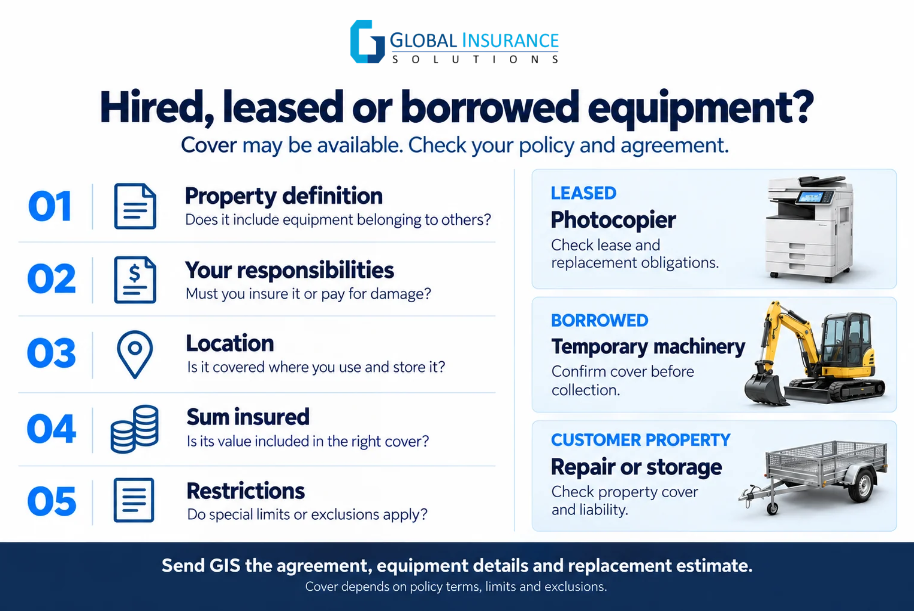
It can, provided the policy accepts that property and the circumstances of the loss.
Before relying on cover, ask:
- Does the contents definition include equipment belonging to others?
- Does your agreement make you responsible for damage or insurance?
- Is the equipment covered where you use and store it?
- Is its value included in the appropriate sum insured?
- Are there restrictions specific to hired or borrowed items?
Send your broker the agreement itself. A description such as “leased equipment” may leave important obligations unexplained.
Leased equipment used every day
A leased photocopier might look like ordinary office equipment, but the lease could contain separate requirements about insurance, replacement and ongoing payments.
For an office contents insurance review, give us the equipment description, replacement estimate and lease terms. We can then check whether the proposed cover addresses the exposure.
Borrowed equipment used temporarily
Temporary use deserves the same attention. Borrowing a machine for a busy fortnight does not establish whether your policy covers it.
Ask for the insurance position to be checked before collecting the item, especially if it is valuable or will travel between locations.
Customer equipment held for repair or storage
Customer property raises another question: are you insuring the item itself, your liability for damaging it, or both?
Explain whether you repair, service, store or transport customers’ goods. Each activity should form part of the insurance discussion.
What does commercial contents insurance cover?
Depending on the selected cover, eligible property may be protected against events such as fire, storm or burglary.
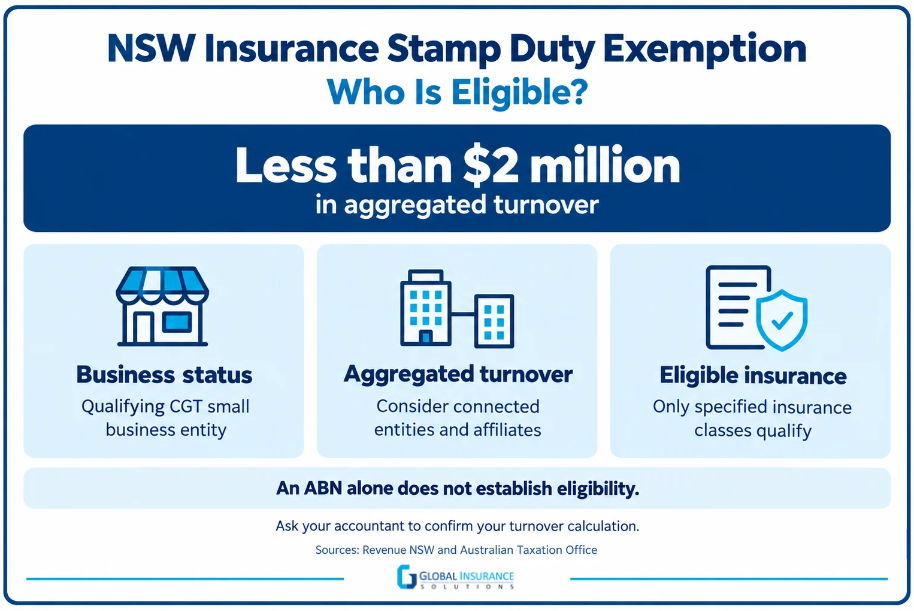
NSW Insurance Stamp Duty Exemption: Who Is Eligible?
The NSW small business insurance exemption applies to specified insurance held by a qualifying capital gains tax (CGT) small business entity.
The insurance stamp duty exemption turnover threshold is less than $2 million in aggregated turnover. Holding an ABN or describing your business as an SME does not establish eligibility.
Revenue NSW identifies carrying on a business, prior-year aggregated turnover and likely current-year aggregated turnover as relevant eligibility considerations. Confirm your position before declaring that you qualify. See its small business exemption guidance.
Source : Revenue NSW
The Australian Government’s business insurance guide distinguishes building and contents, burglary, machinery breakdown and goods in transit insurance. These covers address different exposures.
Source : business.gov.au
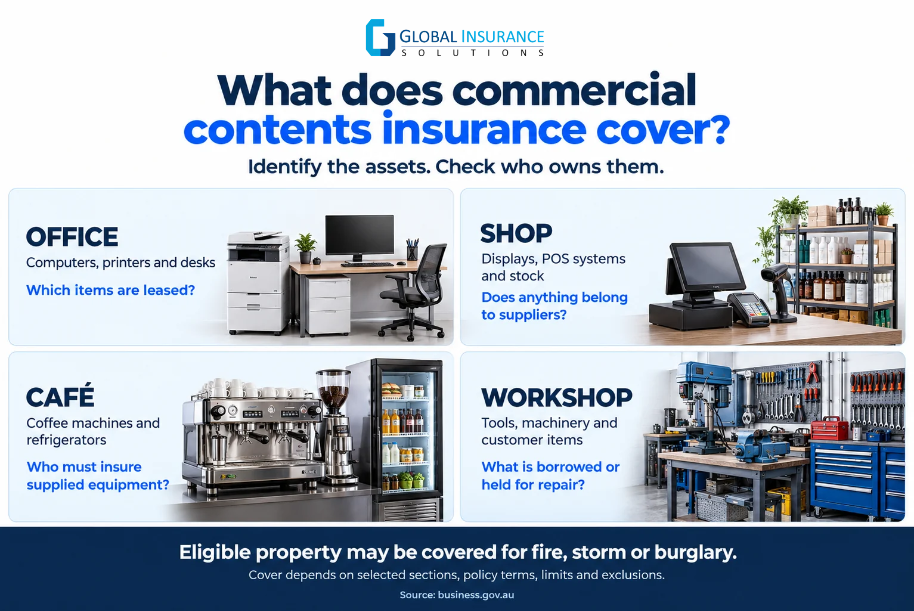
For a useful stock and equipment insurance review, group your assets by their role:
Business setting | Items to identify | Ownership question |
Office | Computers, printers and desks | Which items are leased? |
Shop | Displays, POS systems and stock | Does anything belong to suppliers? |
Café | Coffee machines and refrigerators | Who must insure supplied equipment? |
Workshop | Tools, machinery and customer items | What is borrowed or held for repair? |
Shop contents insurance and small business contents insurance should reflect the actual operation, including equipment absent from the purchase ledger.
Our commercial property insurance provides a starting point for discussing buildings, contents and equipment together.
Commercial contents insurance vs building insurance: what is the difference?
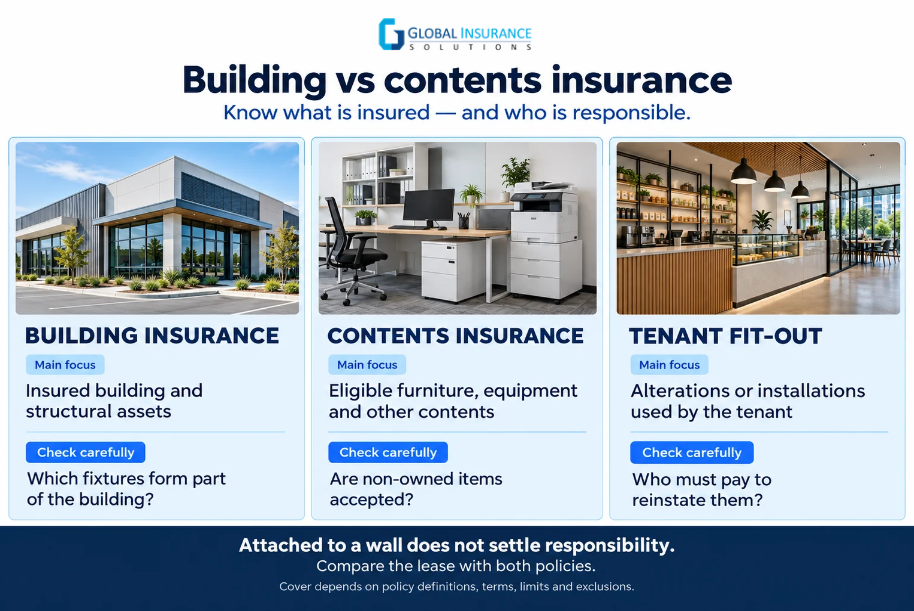
Building insurance concerns the premises and insured structural property. Contents insurance concerns eligible assets within the business. Fixtures and fit-out require closer attention because policy definitions and lease responsibilities can overlap.
Cover | Main focus | Check carefully |
Building insurance | Insured building and structural assets | Which fixtures form part of the building? |
Contents insurance | Eligible furniture, equipment and other contents | Are non-owned items accepted? |
Tenant improvements and fit-out | Alterations or installations used by the tenant | Who must pay to reinstate them? |
Avoid deciding responsibility simply by whether an item is attached to a wall. Compare the lease with both policies.
Do I need business contents insurance if I rent my premises?
Renting does not remove the need to consider contents cover.
Business contents insurance for renters should address your equipment, relevant fit-out and any property you must insure under the lease. Do not assume the landlord’s insurance covers everything inside.
Some policies may cover landlord-owned fittings and alterations that the tenant is responsible for insuring or reinstating under the lease. Cover depends on the policy wording and lease obligations.
At GIS, we recommend reviewing the premises lease alongside equipment leases. This helps identify responsibilities that an asset list alone could miss.
How do I calculate the value of my business contents?
Build an inventory and establish the valuation basis required by your policy.
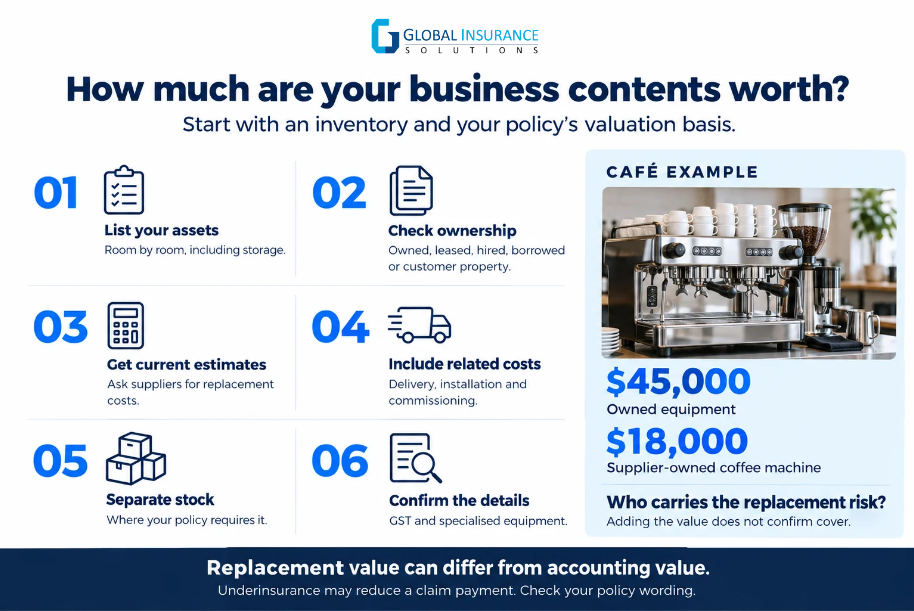
To assess your business contents sum insured:
- List assets room by room, including storage areas.
- Separate owned, leased, hired, borrowed and customer property.
- Obtain current supplier estimates for relevant replacements.
- Identify delivery, installation and commissioning costs.
- Record stock separately where the policy requires it.
- Confirm how GST and specialised equipment are treated.
The replacement value of business contents can differ from an accounting balance. A business contents insurance calculator may help organise estimates, but it cannot interpret ownership obligations or policy definitions.
Business contents underinsurance can leave your business paying part of a covered loss. If your sum insured is too low, an underinsurance clause may reduce your claim payment, even when only some items are damaged. The calculation depends on your policy wording.
Our guide explains how underinsurance can affect a claim when insured values are inadequate.
An illustrative café example
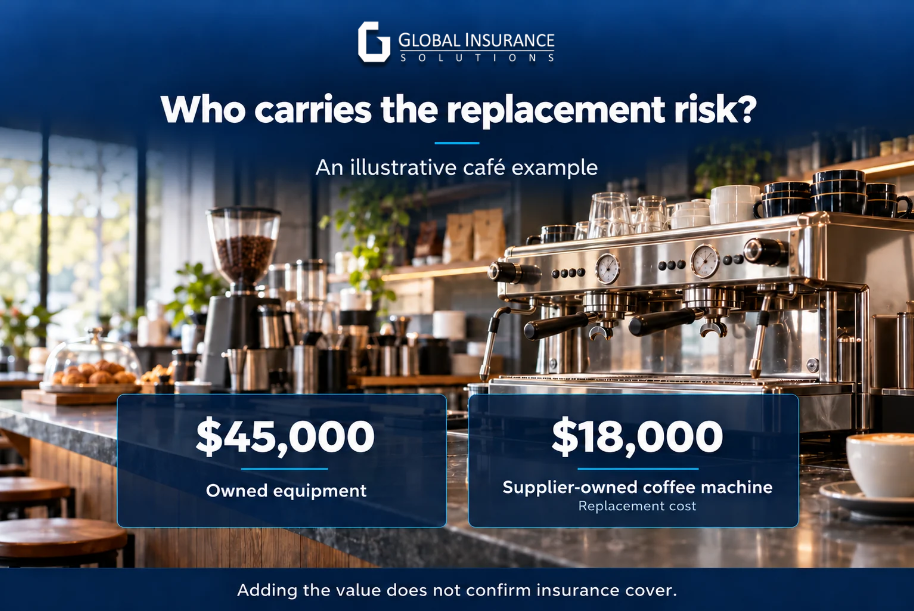
Suppose a café lists $45,000 of owned equipment but also uses a supplier-owned coffee machine costing $18,000 to replace.
That creates a question to resolve: who carries the replacement risk, and does the policy cover it? Adding $18,000 to a spreadsheet alone does not establish insurance protection.
For food businesses, our commercial kitchen insurance guide explores related equipment, stock and interruption exposures.
How much does business contents insurance cost in Australia?
There is no single reliable price for every business.
Business contents insurance cost varies depending on your business activities, location, sum insured, chosen excess, optional covers and claims history. At GIS, we consider these factors to help arrange cover suited to your business needs.
When asking “how much is business contents insurance?”, provide the same information to each insurer or broker. Include non-owned equipment and where it travels.
Comparing commercial contents insurance cost becomes more useful when the quotes address equivalent assets, events and responsibilities.
What commercial contents insurance exclusions should I check?
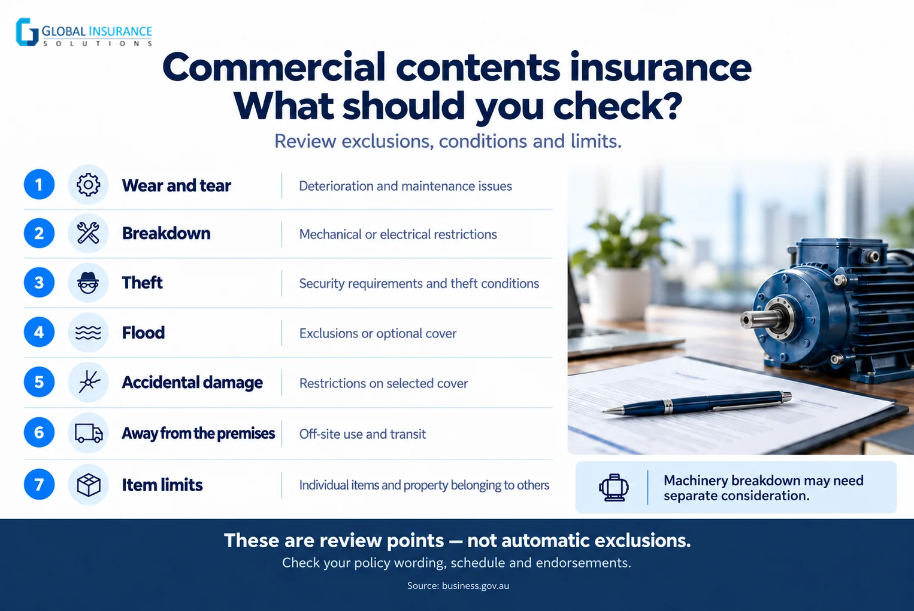
Check the policy for:
- Wear and tear, deterioration and maintenance issues.
- Mechanical or electrical breakdown restrictions.
- Theft conditions, including security requirements.
- Flood exclusions or optional flood cover.
- Restrictions on accidental damage.
- Property away from the premises or in transit.
- Limits for individual items or property belonging to others.
These are review points, rather than a statement that every policy excludes each risk. Business.gov.au recommends checking definitions, insured events, exclusions, settlement terms and excesses.
Source : business.gov.au
Equipment breakdown insurance may require separate consideration. Explore our machinery breakdown insurance if operational machinery is central to your business.
How to make a business contents insurance comparison
Compare how each policy would respond to the same realistic loss.
For example: a leased machine is stolen overnight. Check the property definition, burglary conditions, location, settlement basis and applicable business contents insurance excess.
Then ask what happens if that machine breaks down or is damaged during transport. Different scenarios expose different gaps.
For business contents insurance claims preparation, retain photographs, serial numbers, invoices, agreements and replacement estimates. Keep a copy of the inventory accessible away from the premises.
Our comparison of machinery breakdown versus property damage explains why the cause of loss matters.
Frequently asked questions
Q1. Can I buy business contents insurance without building insurance?
Ans 1. Business contents insurance only may be available, depending on the insurer and package. This can suit tenants who need protection for eligible contents but do not insure the building.
Q2. Does business contents insurance cover stock, computers and furniture?
Ans 2. These items may be insurable, but their classification matters. Confirm whether stock has a separate sum insured and whether computers or high-value items require specific listing.
Q3. Does commercial contents insurance cover equipment away from the premises?
Ans 3. Equipment taken away from your business premises may require portable business equipment insurance. Check whether your policy covers off-site use, whether individual items need to be listed and what limits or exclusions apply.
Q4. Does business contents insurance cover accidental damage, theft or flood?
Ans 4. Only where the selected policy provides that protection. Check each event separately, including conditions and exclusions. A reference to “contents cover” does not confirm all three.
Q5. Does business contents insurance include public liability or business interruption cover?
Ans 5. Not automatically. Business contents insurance and public liability address different risks. Review our liability insurance, particularly for property in your care.
Business interruption insurance addresses eligible financial losses following covered disruption, subject to its own triggers and terms.
Q6. Does home contents insurance cover equipment used for my business?
Ans 6. Check with your home insurer. Explain the equipment, business use and ownership arrangements before relying on household cover. A home business contents insurance review should also consider stock and customer property.
Q7. What information do I need for a business contents insurance quote?
Ans 7. Prepare your business activities, address, security details, claims history, inventory, values and relevant agreements. Identify equipment used elsewhere and any protection you specifically require.
Check your equipment responsibilities with GIS
Before renewing or signing another hire agreement, ask: “What equipment could we have to replace, even though we don’t own it?”
At GIS, we help Australian businesses assess their commercial insurance needs. Contact our team for a business contents insurance quote or call 1300 710 665 to arrange a review.
Important notice
This article is of a general nature only and does not take into account your specific objectives, financial situation or needs. It is also not financial advice, nor complete, so please discuss the full details with your insurance broker as to whether these types of insurance are appropriate for you. Deductibles, exclusions and limits apply. You should consider any relevant Target Market Determination and Product Disclosure Statement in deciding whether to buy or renew these types of insurance. Various insurers issue these types of insurance and cover can differ between insurers.
This article provides information rather than financial product or other advice. The content of this article, including any information contained in it, has been prepared without taking into account your objectives, financial situation or needs. You should consider the appropriateness of the information, taking these matters into account, before you act on any information. In particular, you should review the product disclosure statement for any product that the information relates to it before acquiring the product.
Information is current as at the date the article is written as specified within it but is subject to change. Global Insurance Solutions Pty Ltd make no representation as to the accuracy or completeness of the information. Various third parties have contributed to the production of this content. All information is subject to copyright and may not be reproduced without the prior written consent of Global Insurance Solutions Pty Ltd.

Risk Advisor, Insurance Broker & Director
With around 15 years in insurance, Yuvi Singh is a passionate Risk Advisor, Director, and Insurance Broker at Global Insurance Solutions. Backed by a Commerce degree and ANZIIF diploma, Yuvi leads a team servicing SMEs across industries like manufacturing, logistics, fuel, IT, and more. At GIS, clients benefit from tailored, transparent advice, access to 150+ insurers, and end-to-end risk solutions. Recognised as a 2022 Insurance Magazine Rising Star and 2024 Top Insurance Broker by Insurance Business Australia, Yuvi delivers flexible, effective outcomes with integrity and innovation.