
Your business may qualify for an insurance stamp duty exemption, depending on the insured risk’s location, your business’s eligibility and the type of cover. In NSW, eligible small businesses can claim an exemption on specified insurance classes. Different arrangements apply elsewhere, including Victoria’s gradual reduction in duty on qualifying business insurance.
At Global Insurance Solutions (GIS), we believe understanding your insurance costs should be part of reviewing your protection. That includes checking whether an available business insurance stamp duty exemption has been considered.
This guide explains insurance stamp duty exemption eligibility, the declaration process and the questions to ask before your next renewal.
What Is Insurance Stamp Duty?
Insurance stamp duty is a state or territory tax on insurance premiums. It is separate from the insurer’s premium and GST. Generally, the insurer pays the duty to the relevant revenue authority and passes the cost on through your insurance charges.
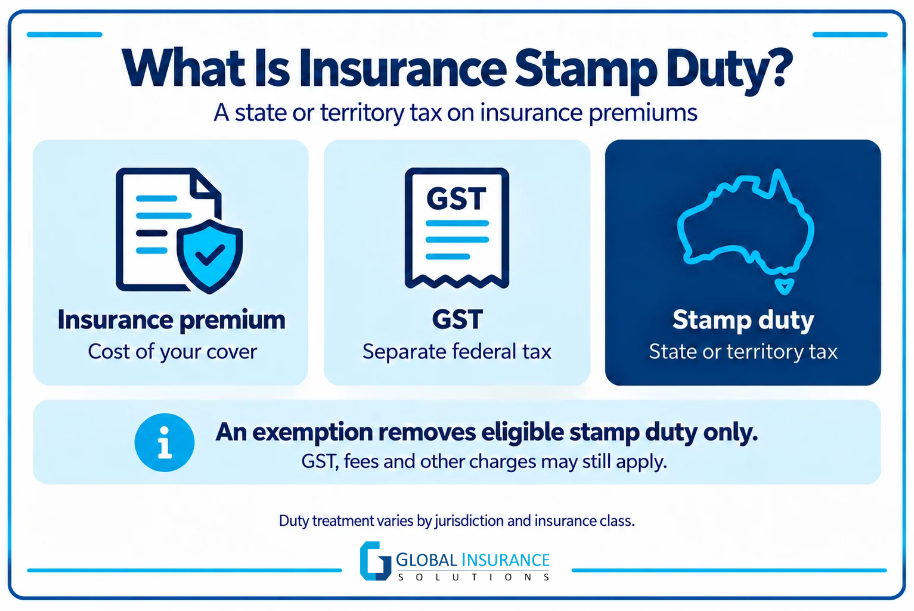
The treatment of stamp duty on business insurance depends on the jurisdiction and insurance classification. Revenue NSW’s insurance duty guidance explains the insurer’s obligations.
Source : Revenue NSW
An insurance duty exemption removes applicable duty from qualifying cover. It does not automatically remove GST, fees or other charges.
At GIS, we recommend reviewing the itemised charges alongside your business insurance cover, rather than comparing the final premium alone.
NSW Insurance Stamp Duty Exemption: Who Is Eligible?
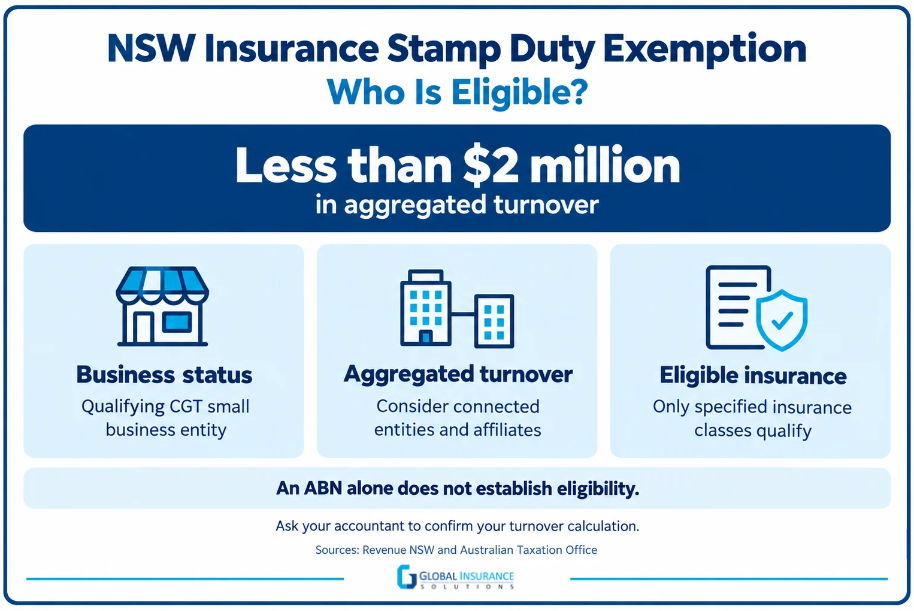
The NSW small business insurance exemption applies to specified insurance held by a qualifying capital gains tax (CGT) small business entity.
The insurance stamp duty exemption turnover threshold is less than $2 million in aggregated turnover. Holding an ABN or describing your business as an SME does not establish eligibility.
Revenue NSW identifies carrying on a business, prior-year aggregated turnover and likely current-year aggregated turnover as relevant eligibility considerations. Confirm your position before declaring that you qualify. See its small business exemption guidance.
Source : Revenue NSW
Understanding Aggregated Turnover
Aggregated turnover considers more than the sales recorded against one ABN. It broadly combines your annual business turnover with the relevant turnover of connected entities and affiliates, subject to exclusions.
For example, a business with turnover of $1.4 million should investigate whether another business under common control must be included. Looking only at its own sales could produce the wrong answer.
The Australian Taxation Office’s aggregated turnover guidance explains the relevance of connected entities and affiliates. Ask your accountant to confirm the calculation where ownership or control is complex.
Source : Legal database
Which Insurance Policies Are Exempt From Stamp Duty?
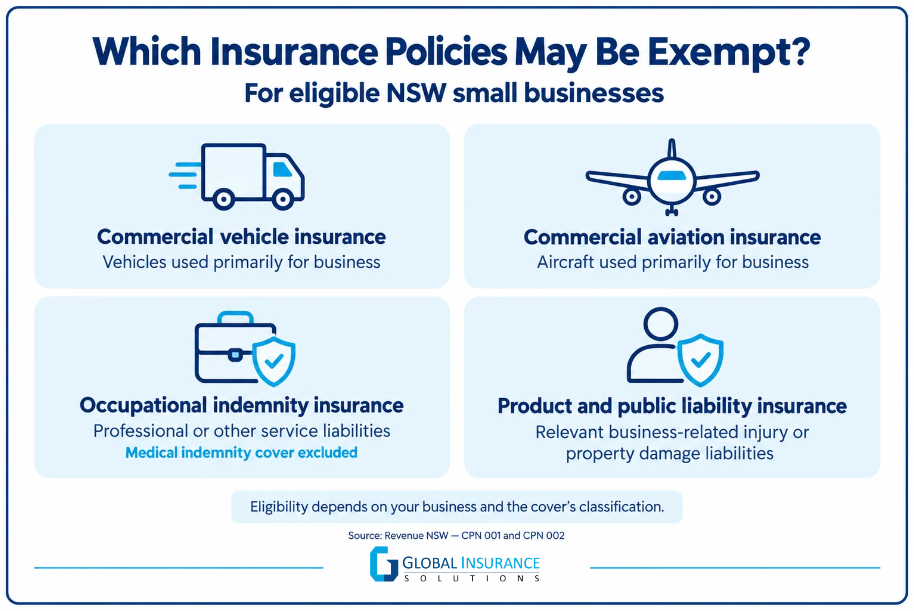
For eligible NSW small businesses, four insurance classes fall within the exemption:
Eligible insurance class | Key qualification |
Commercial vehicle insurance | The motor vehicle is used primarily for business purposes. |
Commercial aviation insurance | The aircraft is used primarily for business purposes. |
Occupational indemnity insurance | Covers liability arising from professional or other services, subject to the medical indemnity exclusion. |
Product and public liability insurance | Covers relevant business-related personal injury or property damage liabilities. |
These definitions appear in Revenue NSW’s practice note on the small business exemption. Eligibility depends on the cover’s classification and the insured entity’s circumstances.
Source : Revenue NSW
Public Liability and Commercial Vehicle Insurance
A public liability insurance stamp duty exemption may apply where both the business and cover qualify. Our liability insurance page explains the protection businesses commonly consider.
Likewise, a commercial vehicle insurance stamp duty exemption requires checking the vehicle’s use. When reviewing commercial motor insurance, provide accurate details about business and private use.
Professional Indemnity Requires a Classification Check
A professional indemnity insurance stamp duty exemption may apply where the cover meets the occupational indemnity definition.
However, medical indemnity cover within the relevant Commonwealth legislation is excluded. A healthcare business should not assume that a policy labelled “professional indemnity” qualifies. Revenue NSW explains this distinction in its medical indemnity practice note.
Source : Revenue NSW
GIS can help raise classification questions with the insurer when reviewing your professional indemnity insurance.
Does a Business Pack Insurance Stamp Duty Exemption Cover Every Section?
No. An eligible business does not automatically receive an exemption across its entire insurance package.
A package may combine liability, property, theft and other covers. The insurer must allocate the premium between insurance types and apply the appropriate treatment to each component.
For example, qualifying public liability cover may be exempt while other sections remain dutiable. Revenue NSW specifically requires premium apportionment for mixed-cover policies.
Source : Revenue NSW
Ask for a breakdown if the duty calculation is unclear. Removing useful protection simply to reduce the total price can create a different problem; our article on avoiding underinsurance in Australia explores that risk.
How to Claim Insurance Stamp Duty Exemption
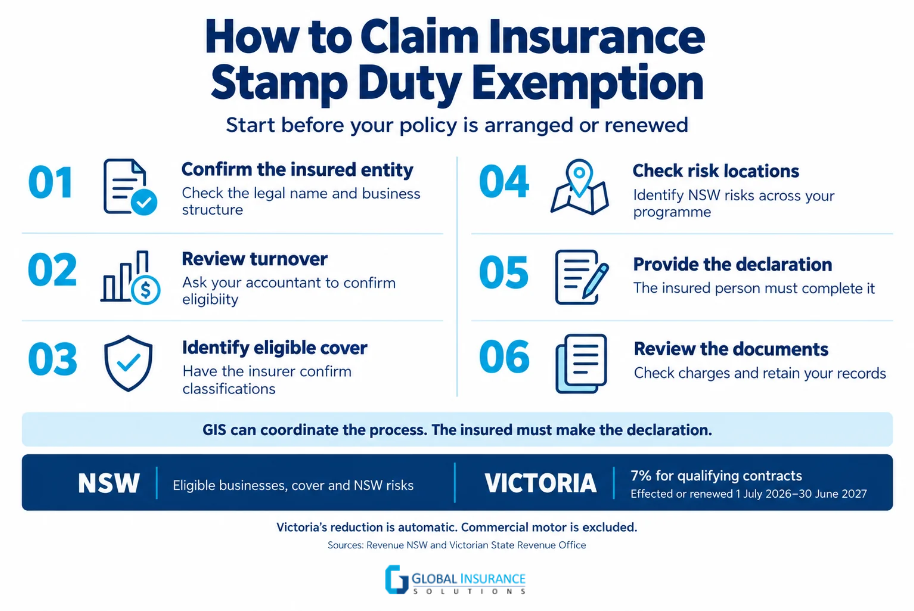
Start before your policy is arranged or renewed, allowing time to resolve eligibility questions.
- Confirm the insured entity. Check the legal name and business structure against your policy.
- Review turnover. Ask your accountant about the applicable CGT small business entity tests.
- Identify eligible cover. Have the insurer confirm the relevant insurance classifications.
- Check risk locations. Identify NSW exposures within any interstate insurance programme.
- Provide the declaration. Complete the insurer’s approved process accurately.
- Review the documents. Check that the resulting charges reflect the insurer’s assessment.
Completing an Insurance Stamp Duty Exemption Declaration
The insurance stamp duty exemption declaration confirms your small business status when the insurance is effected or renewed.
Revenue NSW accepts specified written, recorded oral and electronic declaration methods. The insured person must complete the declaration; a broker cannot make it on their behalf. We can help coordinate the process and clarify what the insurer requires.
Source : Revenue NSW
Keep a copy with your renewal records, financial information and insurer correspondence. Check details carefully: wrongly claiming an exemption can leave the insured responsible for duty and associated charges.
Source : legislation.nsw.gov.au
Insurance Stamp Duty Exemption Australia: Why Location Matters
There is no single nationwide small business insurance stamp duty exemption. A multi-state business needs its insurance reviewed by jurisdiction.
For NSW, being registered interstate does not necessarily prevent relief on qualifying NSW risks. Premiums may need allocation between jurisdictions.
Source : Revenue NSW
Victoria Business Insurance Duty Reduction
Victoria’s arrangement is a phased reduction for specified business insurance classes. It applies automatically, without a small business exemption application.
For qualifying contracts effected or renewed from 1 July 2026 to 30 June 2027, the duty rate is 7%. The scheduled rate reaches zero from 1 July 2033.
Classification remains important. Commercial motor insurance is excluded from this particular reduction, and packaged policies may require premium apportionment.
See :
Victorian State Revenue Office’s business insurance duty guidance
Frequently Asked Questions About Insurance Stamp Duty Exemption
Q1. What Is Insurance Stamp Duty?
Ans 1. It is a state or territory tax on insurance premiums, generally passed on by the insurer. The premium, duty, GST and fees are distinct items when reviewing your insurance costs.
Q2. Who Qualifies for an Insurance Stamp Duty Exemption?
Ans 2. For the NSW small business exemption, the insured must meet the relevant CGT small business entity requirements, hold qualifying insurance and provide the required declaration. Other exemptions have their own criteria.
Q3. Is the Small Business Insurance Exemption Available Across Australia?
Ans 3. No. NSW’s small business exemption does not create eligibility in other states or territories. Each jurisdiction’s rules must be considered separately.
Q4. What Is Aggregated Turnover for the NSW Insurance Exemption?
Ans 4. It broadly includes your business’s annual turnover plus relevant turnover from connected entities and affiliates, with applicable exclusions. Your accountant can check which entities and amounts belong in the calculation.
Q5. Which Insurance Policies Qualify for the NSW Exemption?
Ans 5. The eligible classes are commercial vehicle, commercial aviation, occupational indemnity, and product and public liability insurance. Each has specific definitions, including the exclusion of relevant medical indemnity cover.
Q6. Is My Entire Business Insurance Package Exempt From Stamp Duty?
Ans 6. Not necessarily. Different sections can receive different treatment. Ask your broker to obtain confirmation of the insurer’s premium allocation and which components qualify.
Q7. How Do I Complete an Insurance Stamp Duty Exemption Declaration?
Ans 7. Use your insurer’s approved process, confirm the insured entity and verify eligibility before submitting it. Provide the declaration before issue or renewal wherever possible.
Q8. Does Having an ABN Automatically Make My Business Eligible?
Ans 8. No. An ABN identifies your business registration. It does not establish the required turnover position, insurance classification or entitlement to an exemption.
Q9. Can a Business Based Outside NSW Qualify for NSW Insurance Duty Relief?
Ans 9. Yes, potentially, where qualifying insurance covers NSW risks. The insurer must consider the location of those risks and any allocation across jurisdictions.
Q10. Do I Need to Provide Another Declaration at Renewal?
Ans 10. Revenue NSW states that declarations are valid for a financial year and should be provided for each policy renewal. Include this in your renewal checklist.
Source : Revenue NSW
Q11. Can I Request a Refund if I Paid Insurance Duty Unnecessarily?
Ans 11. Potentially. Revenue NSW directs eligible businesses charged duty on exempt insurance to contact their insurer. Ask about evidence, the refund process and applicable time limits; avoid assuming reimbursement is automatic.
Source : Revenue NSW
Q12. What Happens if My Turnover or Business Structure Changes?
Ans 12. Reassess eligibility before making another declaration. Acquisitions, ownership changes and new connected entities can affect the calculation. Tell your accountant and broker about these changes.
Q13. Is Victoria’s Insurance Duty Reduction the Same as the NSW Exemption?
Ans 13. No. Victoria reduces duty on specified insurance classes over time. NSW’s small business exemption depends on business eligibility, eligible insurance and a declaration.
Q14. Can GIS Help Me Check Insurance Duty on My Policy?
Ans 14. Yes. At GIS, we can review policy charges, identify questions about classification and Ask GIS to Review Your Business coordinate enquiries with your insurer. Your accountant should confirm tax eligibility where necessary.
Ask GIS to Review Your Business Insurance Charges
Before renewing, bring together your policy schedule, renewal invoice and current business details. Ask us to review the cover, risk locations and duty treatment together.
Call GIS on 1300 710 665 or request a business insurance review. We can help you understand the next steps and the information your insurer needs.
Important notice
This article is of a general nature only and does not take into account your specific objectives, financial situation or needs. It is also not financial advice, nor complete, so please discuss the full details with your insurance broker as to whether these types of insurance are appropriate for you. Deductibles, exclusions and limits apply. You should consider any relevant Target Market Determination and Product Disclosure Statement in deciding whether to buy or renew these types of insurance. Various insurers issue these types of insurance and cover can differ between insurers.
This article provides information rather than financial product or other advice. The content of this article, including any information contained in it, has been prepared without taking into account your objectives, financial situation or needs. You should consider the appropriateness of the information, taking these matters into account, before you act on any information. In particular, you should review the product disclosure statement for any product that the information relates to it before acquiring the product.
Information is current as at the date the article is written as specified within it but is subject to change. Global Insurance Solutions Pty Ltd make no representation as to the accuracy or completeness of the information. Various third parties have contributed to the production of this content. All information is subject to copyright and may not be reproduced without the prior written consent of Global Insurance Solutions Pty Ltd.

Risk Advisor, Insurance Broker & Director
With around 15 years in insurance, Yuvi Singh is a passionate Risk Advisor, Director, and Insurance Broker at Global Insurance Solutions. Backed by a Commerce degree and ANZIIF diploma, Yuvi leads a team servicing SMEs across industries like manufacturing, logistics, fuel, IT, and more. At GIS, clients benefit from tailored, transparent advice, access to 150+ insurers, and end-to-end risk solutions. Recognised as a 2022 Insurance Magazine Rising Star and 2024 Top Insurance Broker by Insurance Business Australia, Yuvi delivers flexible, effective outcomes with integrity and innovation.