
Protecting customer information is only one part of managing an online business. Harmful content, abusive interactions and unsafe AI features can create exposures even when no data breach occurs.
Australia’s proposed digital duty of care places greater emphasis on preventing online harm. For businesses operating digital services, it is a reason to review how their platforms work, who manages safety and whether their insurance reflects their activities.
At GIS, we recommend reviewing these areas together, starting with your actual business exposure.
Digital Duty of Care in Australia: What Is Changing?
The Online Safety Amendment (Digital Duty of Care) Bill 2026 was introduced into Parliament on 15 October 2026. As at 27 October 2026, the Government describes the reforms as proposed legislation.
The Australian Government’s digital duty of care overview explains that providers would need to take reasonable steps to protect Australian users, with additional protections for children and stronger enforcement powers for the eSafety Commissioner.
Source : infrastructure.gov.au
The proposal builds on the Online Safety Act framework. Businesses should monitor its progress and seek legal advice about their specific obligations.
Digital Duty of Care for Businesses: Review Your Responsibilities
Start by identifying the services your business operates, supplies or controls.
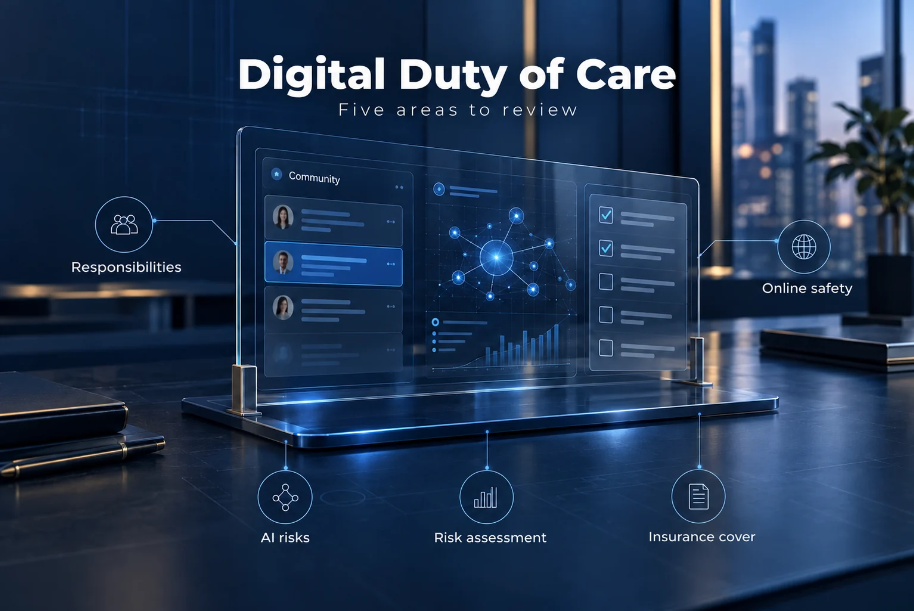
Do you manage an app, online community, gaming service or AI chatbot? The Government’s announcement on the proposed reforms identifies games, apps and AI chatbots among the relevant online services.
Source : minister.infrastructure.gov.au
Review your online service provider responsibilities, including who:
- Controls platform features and safety settings.
- Receives and investigates user complaints.
- Removes harmful content or restricts accounts.
- Approves changes made by external developers.
For technology businesses, supplier contracts should clearly allocate these tasks. Outsourcing a platform does not, by itself, establish where every responsibility sits.
Online Safety Risks for Businesses: Look Beyond Cyberattacks
An online service can function as intended while still exposing users to harm.
Consider a community platform that protects account information but provides no clear way to report threatening messages. Its cybersecurity controls do not resolve that safety gap.
Review online safety risks for businesses across user-generated content, messaging, recommendation features and complaint handling. Where children may access the service, consider whether age assurance measures and safeguards are appropriate.
Test reporting tools from the user’s perspective: can someone find them, explain the problem and receive a timely response?
Generative AI Risks and AI Liability
If your platform includes AI, review what it generates and how people may misuse it.
Generative AI risks can include harmful outputs, inappropriate interactions and safeguards that users can bypass. Assess testing, monitoring, escalation procedures and who can disable unsafe functionality.
Treat AI liability as a specific risk question. Your exposure may depend on the service supplied, contracts, alleged harm and applicable law. Avoid assuming the AI provider accepts every consequence of its technology’s use.
Prepare an Online Safety Risk Assessment
An online safety risk assessment should identify potential harm, affected users, existing controls and further action.
Record who owns each action and when it will be reviewed. Reassess risks before introducing features or changing suppliers.
Keep evidence of testing, complaints, decisions and improvements. This helps management understand whether controls work in practice and gives advisers a clearer picture of the business.
Digital Duty of Care and Insurance
Treat digital duty of care insurance as a discussion about your existing programme, rather than assuming it is a standard policy category.
Review:
- Cyber insurance: Check the events and allegations that trigger cover.
- IT liability insurance: Review claims arising from your technology products, services or advice.
- Defence costs: Examine investigation cover, consent requirements and notification deadlines.
- Exclusions and limits: Check restrictions relevant to your activities and contractual responsibilities.
Insurance does not replace safety controls. Regulatory penalties, compliance upgrades and online harm allegations should never be assumed covered.
Digital Duty of Care FAQs
Q1. Is digital duty of care already law in Australia?
Ans 1. As at 27 October 2026, the Government describes the reforms as proposed. Confirm the latest legislative status before relying on commencement dates. infrastructure.gov.au
Q2. Does cyber insurance automatically cover online safety complaints?
Ans 2. No. Cover depends on the allegation, policy terms, exclusions and circumstances.
Q3. How can GIS help review digital business risks?
Ans 3. GIS can review your declared activities and insurance arrangements, explain relevant policy provisions and discuss potential gaps. Speak to a Specialist to arrange a review.
Q4. What is the digital duty of care?
Ans 4. Digital duty of care is a proposed obligation requiring online service providers to take reasonable steps to protect users from online harm, including risks arising from content, conduct and platform features.
Q5. Which businesses could be affected by digital duty of care?
Ans 5. Businesses operating online services, including apps, gaming platforms, online communities and certain AI services, should assess whether the proposed requirements apply to their activities.
Q6. Does digital duty of care apply to small businesses?
Ans 6. Business size alone should not determine your assessment. Review the service you provide, your control over it and the scope of the final legislation.
Q7. Is digital duty of care the same as cybersecurity?
Ans 7. No. Cybersecurity focuses on protecting systems and information, while digital duty of care concerns user safety, including harmful content, interactions and service features.
Q8. What should an online safety risk assessment include?
Ans 8. Identify potential harms, affected users, existing safeguards and further action required. Record who is responsible and review the assessment when your service changes.
Q9. Could digital duty of care apply to AI chatbots?
Ans 9. The proposed reforms expressly address AI chatbots and other relevant online services. Businesses should review harmful outputs, user interactions and the effectiveness of safeguards.
Q10. Does using a third-party platform remove our responsibilities?
Ans 10. Not necessarily. Your responsibilities depend on your role, control over the service, contractual arrangements and applicable law; outsourcing does not automatically transfer every obligation.
Q11. Is IT liability insurance the same as cyber insurance?
Ans 11. No. IT liability insurance generally addresses claims arising from technology products, services or advice, while cyber insurance addresses specified cyber and privacy exposures. Policy wording determines the response.
Q12. Will insurance cover digital duty of care penalties?
Ans 12. Do not assume penalties are covered. Any potential response depends on the policy wording, applicable exclusions and whether the penalty can legally be insured.
Q13. Should businesses tell their broker when adding AI features?
Ans 13. Yes. Tell GIS about material changes to your products, services or activities so we can review your declared business description and discuss any implications for cover.
Q14. What should we do after receiving an online safety complaint?
Important notice
This article is of a general nature only and does not take into account your specific objectives, financial situation or needs. It is also not financial advice, nor complete, so please discuss the full details with your insurance broker as to whether these types of insurance are appropriate for you. Deductibles, exclusions and limits apply. You should consider any relevant Target Market Determination and Product Disclosure Statement in deciding whether to buy or renew these types of insurance. Various insurers issue these types of insurance and cover can differ between insurers.
This article provides information rather than financial product or other advice. The content of this article, including any information contained in it, has been prepared without taking into account your objectives, financial situation or needs. You should consider the appropriateness of the information, taking these matters into account, before you act on any information. In particular, you should review the product disclosure statement for any product that the information relates to it before acquiring the product.
Information is current as at the date the article is written as specified within it but is subject to change. Global Insurance Solutions Pty Ltd make no representation as to the accuracy or completeness of the information. Various third parties have contributed to the production of this content. All information is subject to copyright and may not be reproduced without the prior written consent of Global Insurance Solutions Pty Ltd.

Risk Advisor, Insurance Broker & Director
With around 15 years in insurance, Yuvi Singh is a passionate Risk Advisor, Director, and Insurance Broker at Global Insurance Solutions. Backed by a Commerce degree and ANZIIF diploma, Yuvi leads a team servicing SMEs across industries like manufacturing, logistics, fuel, IT, and more. At GIS, clients benefit from tailored, transparent advice, access to 150+ insurers, and end-to-end risk solutions. Recognised as a 2022 Insurance Magazine Rising Star and 2024 Top Insurance Broker by Insurance Business Australia, Yuvi delivers flexible, effective outcomes with integrity and innovation.