
Your insurance certificate shows a $20 million liability limit. But does that mean $20 million for every claim, every incident, or all claims combined during the policy year?
Commercial casualty insurance can have a per claim or per occurrence limit, an aggregate limit, or a combination of these. The amount shown on your certificate does not, by itself, explain how much cover remains after a claim.
At Global Insurance Solutions, we encourage businesses to look beyond the headline figure. Understanding how your liability insurance limits operate can help you assess contracts, compare policies and identify gaps before an incident occurs.
What Is Commercial Casualty Insurance?
Commercial casualty insurance is a broad term associated with business liability risks. Depending on the policy, it may include public liability, products liability and other specified liability exposures.
In Australia, you will also encounter terms such as general liability insurance, public and products liability insurance, and commercial general liability insurance. QBE, for example, describes its general liability insurance as public and product liability cover for specified third-party injury and damage claims.
Source : QBE AU
However, product names are only a starting point. The schedule, wording and endorsements establish the insured activities, exclusions and applicable limits.
Two businesses holding policies with the same headline limit may therefore have different protection.
For a broader introduction to the cover, read our guide to business liability insurance.
Per Claim vs Per Occurrence vs Aggregate: What Is the Difference?
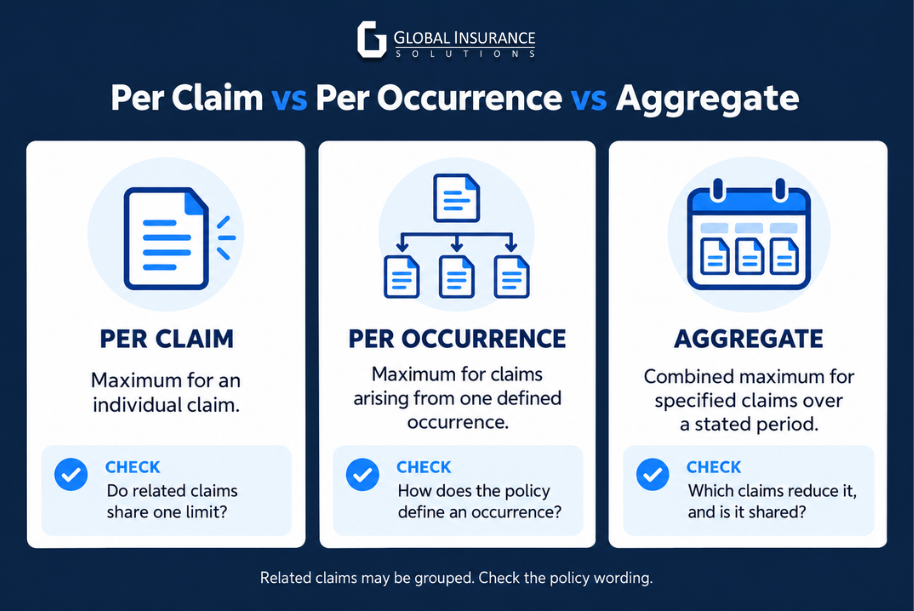
These terms describe different ways an insurer’s payment obligation may be limited.
Limit structure | What it generally means | What to check |
Per claim limit | A maximum applies to an individual claim, subject to provisions grouping related claims. | Whether related claims share one limit. |
Per occurrence limit | A maximum applies to claims arising from one defined occurrence. | How the policy defines an occurrence. |
Aggregate limit | A combined maximum applies to specified claims over a stated period. | Which claims reduce the aggregate and whether it is shared. |
A policy can apply more than one of these restrictions simultaneously.
For example, products liability cover might have both a limit for any one occurrence and an aggregate limit for the period of insurance.
Per Claim vs Per Occurrence Insurance
A claim and an occurrence are not necessarily the same thing.
Suppose a contractor accidentally damages a building’s fire sprinkler system. Water affects three neighbouring tenancies, and each tenant makes a separate claim.
There may be several claimants, but the policy could treat the damage as arising from one occurrence. Those claims may then share a single per occurrence limit.
The outcome depends on the facts and wording. Three claims do not automatically create three separate limits.
For businesses combining workshop production with onsite installation, our metal fabrication insurance guide explores the broader exposures to review.
What Does an Annual Aggregate Limit Mean?
An annual aggregate limit generally caps the insurer’s total payments for the claims or cover sections to which it applies during an annual policy period.
The relevant period is usually the period of insurance, rather than the calendar year. Check the actual dates and wording, particularly for shorter or extended policies.
When researching aggregate limit insurance, the practical question is:
“Which payments reduce this pool, and how much remains available?”
Public Liability Insurance Limits and Product Liability Aggregate Limits
Public liability and product liability can sit within the same policy but have different limit structures.
Public liability cover may apply a limit to any one occurrence. Product liability cover may also have an aggregate limit, which caps the total amount payable for covered product liability claims during the policy period.
This means a payment for one product liability claim could reduce the aggregate amount available for subsequent claims during that period.
The structure depends on the policy wording. Check the schedule and endorsements for applicable occurrence limits, aggregate limits, restrictions and sub-limits.
At Global Insurance Solutions, we recommend checking each relevant section, including:
- Public liability
- Product liability
- Any pollution extension
- Property in your care, custody or control.
- Other insured extensions carry separate limits.
A larger overall limit does not automatically increase every sub-limit. Where pollution is a material exposure, discuss whether separate environmental impairment liability insurance is appropriate alongside your liability cover.
Does a Liability Claim Reduce My Remaining Cover?
It can, where the payment falls within an applicable aggregate limit.
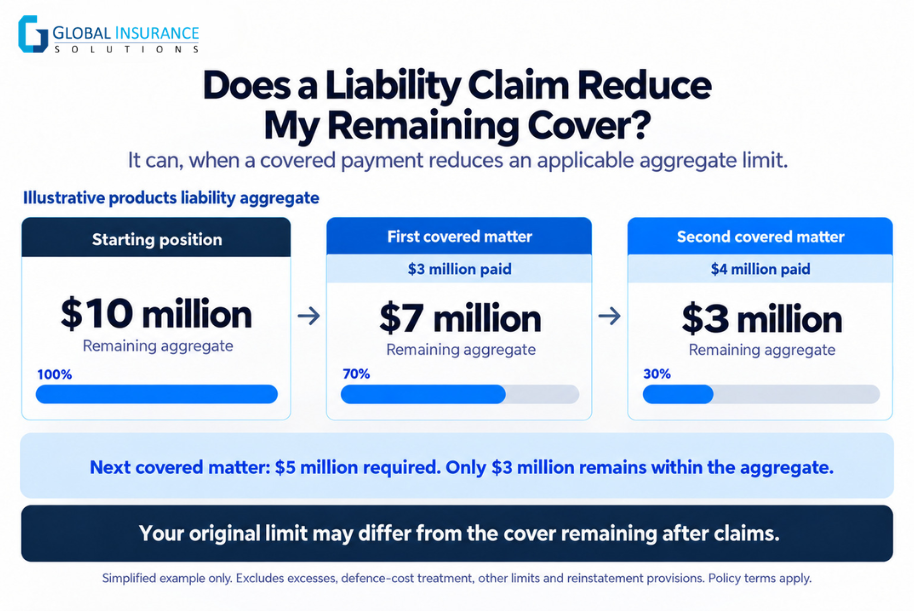
Consider an illustrative manufacturer with a $10 million products liability aggregate. Assume the following amounts are covered payments that reduce that aggregate:
Position during the policy period | Payment reducing the aggregate | Remaining aggregate |
Starting position | — | $10 million |
First covered matter | $3 million | $7 million |
Second covered matter | $4 million | $3 million |
If a further covered matter requires $5 million, only $3 million remains within that aggregate, before considering other applicable terms.
This simplified example excludes excesses, defence-cost treatment, other limits and reinstatement provisions.
The lesson is straightforward: the original sum shown on the schedule may differ from the amount remaining after claims.
Do Defence Costs Reduce the Liability Limit?
Legal defence costs may be payable within the liability limit, in addition to it, or under a separate arrangement.
Where defence costs sit within the limit, legal expenses can reduce the amount available for compensation. Where they are additional, conditions may still restrict payment.
Ask:
- Does the insurer need to approve lawyers and expenses?
- Are defence costs subject to a separate cap?
- Do they reduce an aggregate?
- What happens when a settlement exceeds the liability limit?
- Does a particular jurisdiction change the treatment?
A statement that a policy “covers legal costs” does not answer these questions.
Is the Insurance Aggregate Limit Shared Across Businesses or Locations?
A policy covering multiple entities, premises or business divisions may provide a shared aggregate.
For example, a group operating several sites should not assume each location receives its own annual pool simply because every address appears on the schedule.
Similarly, adding another insured party does not automatically create an additional limit.
Check whether the limit applies across:
- All named insured entities.
- All insured locations.
- Different product lines.
- Particular extensions.
- Additional insured parties.
Businesses acquiring another company or expanding into new activities should review whether their existing shared limit remains suitable.
How Much Public Liability Insurance Do I Need?
Choosing between $10 million public liability insurance and $20 million public liability insurance involves more than comparing premiums.
Consider the potential severity of an incident, the people and property exposed, contractual obligations and the policy’s limit structure.
A contractor working inside an occupied commercial building may face different exposures from a business undertaking low-risk work in controlled premises. A manufacturer supplying widely distributed products may also need to consider several losses affecting the same aggregate.
Contract requirements matter, but satisfying a minimum insurance clause does not establish that your cover suits every exposure.
Our guide to public liability insurance for traffic controllers explores how declared activities and contract requirements can influence the cover required.
At GIS, we review the business activities, proposed work, contracts and available policy terms together.
Where Should You Check Your Limit of Indemnity?
Read the schedule, policy wording and endorsements together.
Look for phrases such as:
- “Any one claim.”
- “Any one occurrence.”
- “In the aggregate.”
- “During any one period of insurance.”
- “Inclusive of defence costs.”
- “In addition to the limit.”
A certificate of currency can confirm selected insurance details, but it does not replace the complete contract or reliably establish the remaining aggregate after claims.
Before accepting a contract, ask your broker to explain how the relevant limit responds to the proposed activities.
Commercial Casualty Insurance FAQs
Q1. What Is Aggregate Limit Insurance?
Ans 1. An aggregate limit is a combined payment cap applying to specified insured claims over a stated period. Check the relevant cover section to establish which payments count towards it.
Q2. What Is an Aggregate Limit of Indemnity?
Ans 2. It generally means the maximum combined amount payable for the matters covered by that aggregate. The policy determines the period, including costs and affected claims.
Q3. Does a $20 Million Liability Policy Provide $20 Million for Every Claim?
Ans 3. Not necessarily. Multiple claims may share an occurrence limit, while an aggregate can restrict the combined amount available across specified claims during the policy period.
Q4. What Does “Unlimited in the Aggregate” Mean?
Ans 4. For the cover concerned, it generally means there is no combined aggregate cap across separate covered occurrences. Each occurrence remains subject to its applicable limit, exclusions and conditions.
Q5. Does the Aggregate Limit Reset When the Policy Renews?
Ans 5. A new policy period may provide a fresh aggregate for matters attaching to that period. Renewal does not automatically replenish the previous period’s limit for earlier occurrences or claims.
Q6. What Happens When an Aggregate Limit Is Exhausted?
Ans 6. Further payments subject to that exhausted aggregate may be unavailable. Contact your broker promptly to assess remaining cover, any reinstatement provisions and possible options.
Q7. Can I Increase My Liability Insurance Limit Mid-Policy?
Ans 7. You can request an increase, but insurer agreement, underwriting and additional premium may be required. An increase should not be assumed to cover an existing incident or known circumstance.
Q8. Can an Exhausted Aggregate Limit Be Reinstated?
Ans 8. Only where the policy provides for reinstatement or the insurer agrees to an arrangement. Check the number of reinstatements, conditions and whether earlier matters can access the restored cover.
Ask GIS to Review Your Liability Insurance Limits
Before relying on a headline figure, establish what the limit applies to, who shares it and what reduces it.
Send GIS your schedule, wording, endorsements and relevant contract requirements. We can help you understand the structure and assess whether it remains suitable for your business.
Important notice
This article is of a general nature only and does not take into account your specific objectives, financial situation or needs. It is also not financial advice, nor complete, so please discuss the full details with your insurance broker as to whether these types of insurance are appropriate for you. Deductibles, exclusions and limits apply. You should consider any relevant Target Market Determination and Product Disclosure Statement in deciding whether to buy or renew these types of insurance. Various insurers issue these types of insurance and cover can differ between insurers.
This article provides information rather than financial product or other advice. The content of this article, including any information contained in it, has been prepared without taking into account your objectives, financial situation or needs. You should consider the appropriateness of the information, taking these matters into account, before you act on any information. In particular, you should review the product disclosure statement for any product that the information relates to it before acquiring the product.
Information is current as at the date the article is written as specified within it but is subject to change. Global Insurance Solutions Pty Ltd make no representation as to the accuracy or completeness of the information. Various third parties have contributed to the production of this content. All information is subject to copyright and may not be reproduced without the prior written consent of Global Insurance Solutions Pty Ltd.

Risk Advisor, Insurance Broker & Director
With around 15 years in insurance, Yuvi Singh is a passionate Risk Advisor, Director, and Insurance Broker at Global Insurance Solutions. Backed by a Commerce degree and ANZIIF diploma, Yuvi leads a team servicing SMEs across industries like manufacturing, logistics, fuel, IT, and more. At GIS, clients benefit from tailored, transparent advice, access to 150+ insurers, and end-to-end risk solutions. Recognised as a 2022 Insurance Magazine Rising Star and 2024 Top Insurance Broker by Insurance Business Australia, Yuvi delivers flexible, effective outcomes with integrity and innovation.