
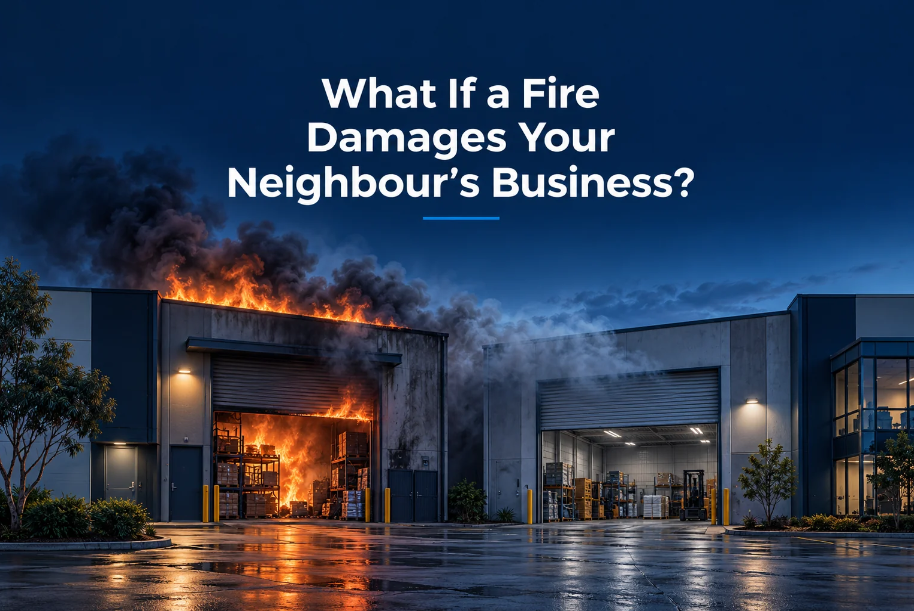
A fire at your premises can quickly become a problem for the businesses around you. Flames may spread through adjoining buildings, smoke can contaminate stock, and firefighting water may damage equipment next door.
Fire damage to neighbouring property may be covered under your public liability insurance if your business is legally liable and the claim meets the policy terms. Your commercial property insurance generally addresses your own insured assets. A fire starting at your premises does not automatically make you responsible for every neighbouring loss.
At Global Insurance Solutions (GIS), we help Australian businesses review how their property, liability and business interruption cover work together, including the exposures beyond their own boundary.
Fire Damage to Neighbouring Property: One Incident, Several Claims
Consider an illustrative scenario: a fire breaks out in a workshop beside a food wholesaler. The workshop’s machinery is damaged, smoke enters the wholesaler’s storage area, and both businesses temporarily close.
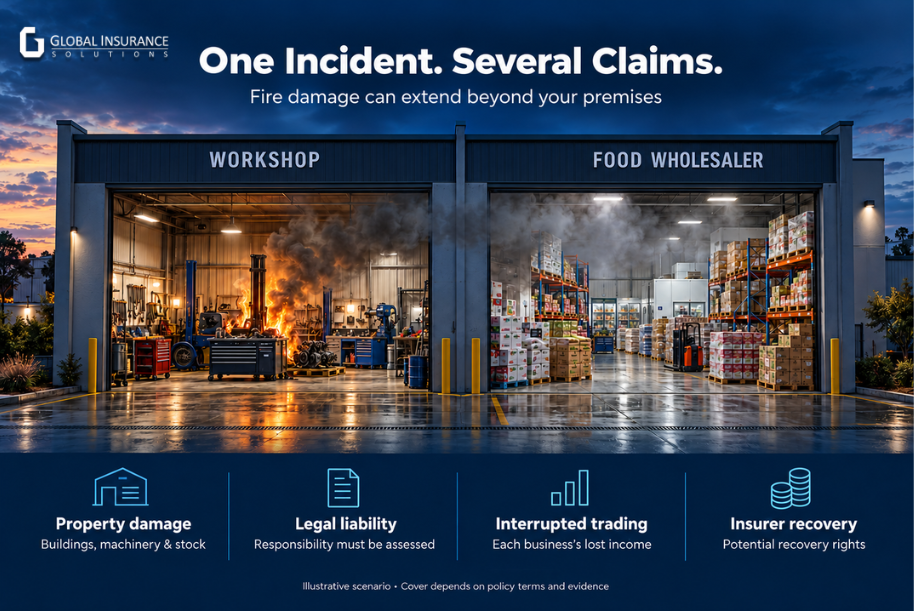
The incident raises separate questions:
- Who insures the workshop’s building, equipment and stock?
- Is the workshop legally responsible for the wholesaler’s damage?
- Which policy addresses each business’s interrupted trading?
- Could either insurer seek recovery from another responsible party?
A fire spreading to a neighbouring business can therefore involve several policies, investigations and claimants. Each loss needs assessment against the relevant cover and evidence.
Commercial Property Insurance vs Public Liability Insurance
Commercial property and casualty insurance describes different areas of protection. In Australia, these may sit within a business package or separate policies; the phrase does not establish what a particular contract covers.
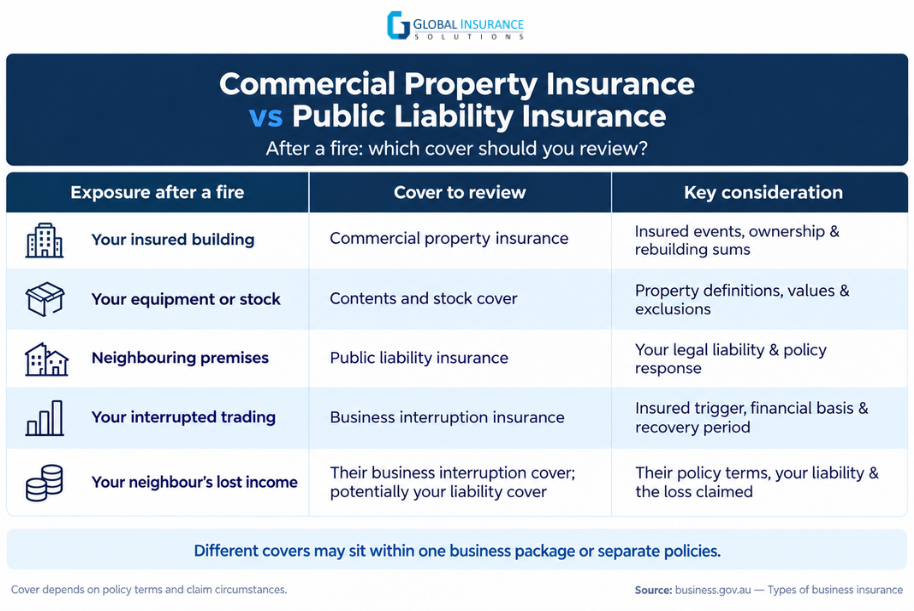
Exposure after a fire | Cover to review | Key consideration |
Damage to your insured building | Commercial property insurance | Insured events, ownership and rebuilding sums |
Damage to your equipment or stock | Contents and stock cover | Property definitions, values and exclusions |
Damage to neighbouring premises | Public liability insurance | Your legal liability and policy response |
Your interrupted trading | Business interruption insurance | Insured trigger, financial basis and recovery period |
Your neighbour’s lost income | Their business interruption cover and potentially your liability cover | Their policy terms, your liability and the loss claimed |
Business.gov.au’s insurance guide distinguishes asset protection, business interruption and liability cover, including potential liability for fire damage and consequential losses.
What Does Commercial Property Insurance Cover?
Commercial property insurance can insure buildings and selected assets against covered events such as fire. Business fire insurance may also be arranged through a package with separate sections for contents, stock and interruption.
Check who owns each asset. A tenant’s equipment, landlord’s building and tenant-funded fit-out may require different arrangements. Being inside an insured building does not automatically mean every item is insured.
Our commercial property fire insurance guide explores these property considerations.
Does Public Liability Insurance Cover Fire Damage?
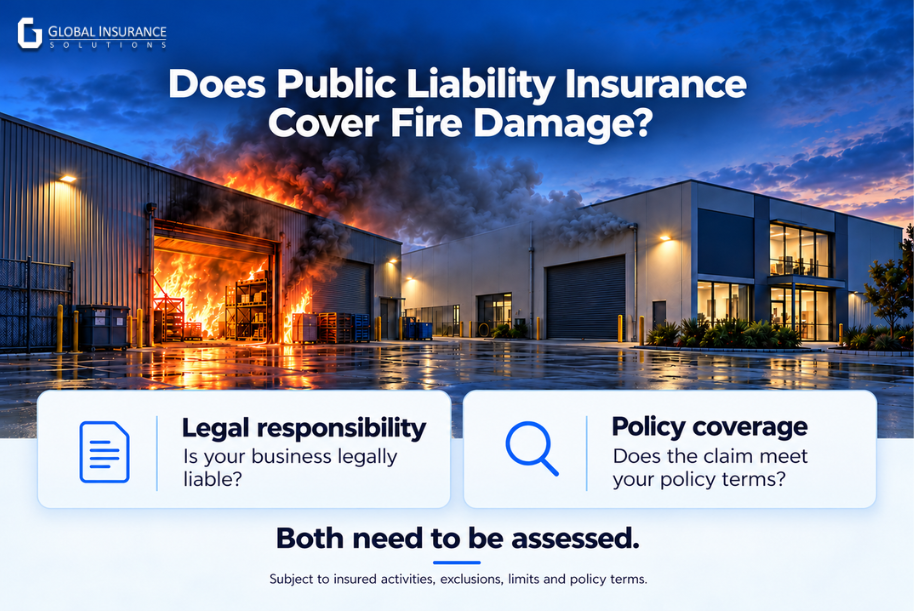
Public liability insurance can cover legal liability for fire damage to someone else’s property, subject to the insured activities, exclusions, limits and other policy terms.
What is public liability insurance? Broadly, it addresses certain liabilities to third parties for injury or property damage arising from your business.
For neighbouring premises, the insurer needs to assess both responsibility and coverage. These are separate questions: a business may face a valid liability claim that falls outside its insurance.
Review your public liability insurance against your actual operations, including hot work, cooking, manufacturing, storage and contractor activities. Third-party property damage insurance should reflect the work you perform and the risks around it.
Liability for Fire Damage to Neighbouring Property
The fire’s starting point alone does not establish legal liability
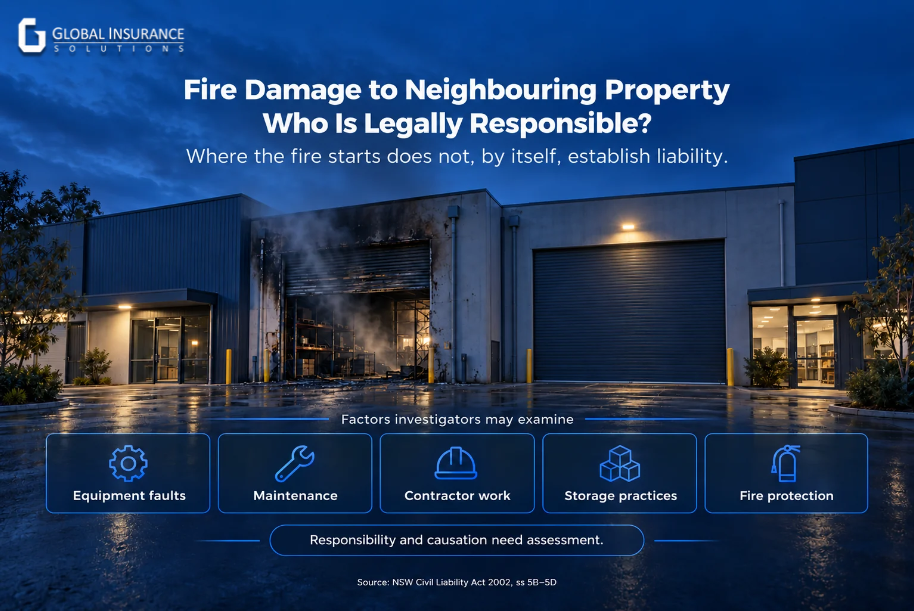
Investigators may examine equipment faults, maintenance, contractor work, storage practices and fire protection systems. Responsibility could involve an occupier, landlord, contractor, supplier or several parties.
For negligence claims, questions commonly include whether reasonable care was taken and whether a breach caused the claimed damage. For example, NSW’s Civil Liability Act addresses precautions against foreseeable risks and causation in sections 5B and 5D. Applicable law and other potential grounds of liability require assessment for the circumstances and jurisdiction.
Source: NSW Civil Liability Act 2002. legislation.nsw.gov.au
An accidental fire can still result in liability. Equally, an unexplained fire should not prompt an immediate admission of fault.
Can Your Neighbour Claim for Lost Income After a Fire?
A neighbouring business may claim more than repair costs. Damaged stock, smoke contamination or unusable equipment could interrupt trading.
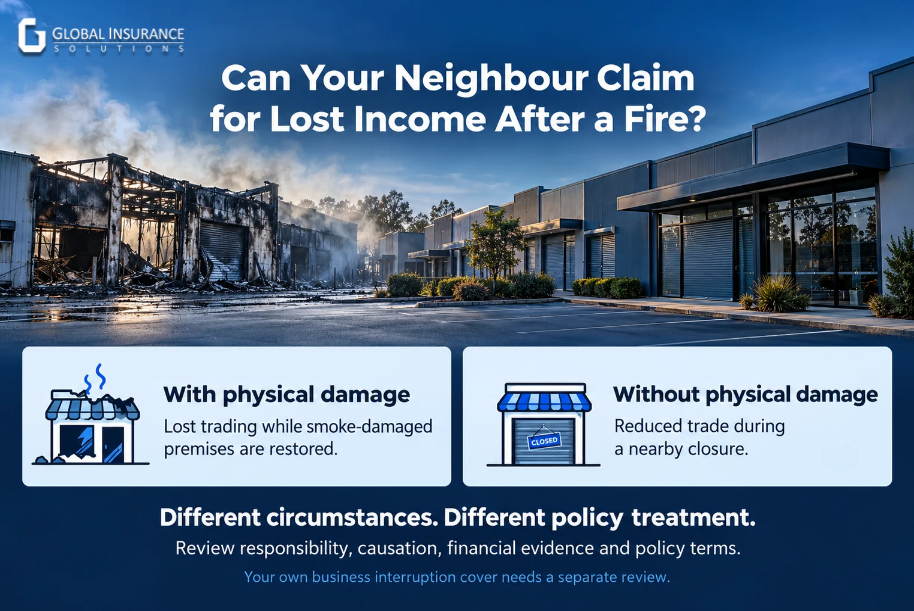
However, a demand for lost income does not establish the amount recoverable. Responsibility, causation, supporting financial evidence and policy terms need examination.
Distinguish between:
- Financial loss following physical damage: for example, lost trading while smoke-damaged premises are restored.
- Financial loss without physical damage: for example, reduced trade during a nearby closure.
These situations can receive different treatment. Do not assume your liability policy covers every financial consequence of a fire.
Your own business interruption after fire also needs separate attention. Review the insured financial measure, extra expenses, applicable extensions and indemnity period. Repairs finishing does not always mean turnover immediately returns to normal.
Business Fire Insurance Claim: What Should You Do First?
Your fire damage insurance claim process should protect people, preserve evidence and give insurers timely information.
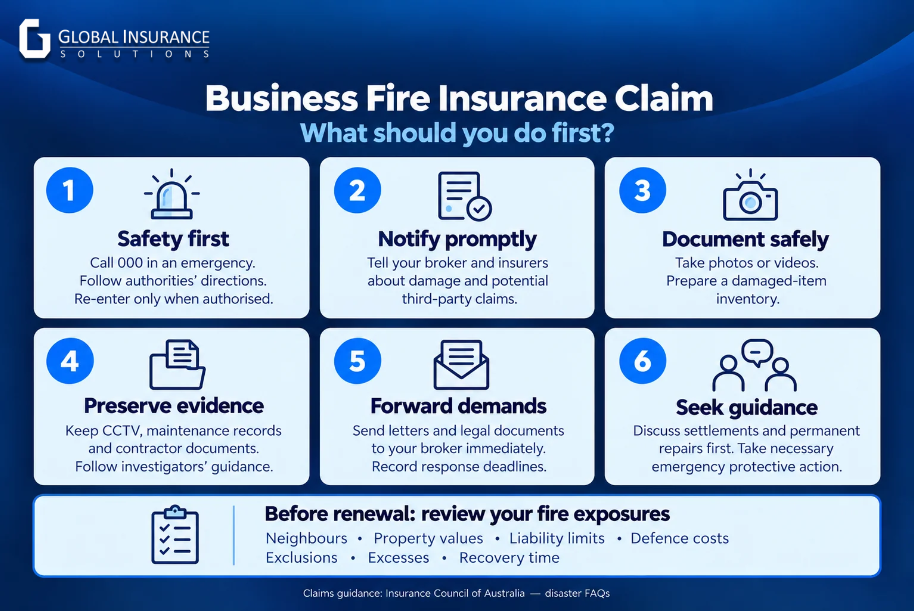
- Put safety first. Call 000 in an emergency and follow authorities’ directions. Re-enter only when authorised.
- Notify your broker and insurers promptly. Report your own damage and potential third-party claims, even while losses remain uncertain.
- Document the damage safely. Photograph affected areas and prepare an inventory. The Insurance Council recommends photos or videos and detailed records to support claims.
- Preserve relevant evidence. Retain maintenance records, CCTV, contractor documents and correspondence. Coordinate disposal or disturbance of potential ignition evidence with investigators, subject to safety directions.
- Forward demands immediately. Send letters, emails and legal documents from neighbours or their insurers to your broker. Record response deadlines.
- Discuss expenditure and communications. Seek guidance before agreeing settlements or permanent repairs. Take necessary emergency action to protect people and prevent further damage.
Source: Insurance Council of Australia — frequently asked questions after a disaster.
Review Public Liability Insurance Limits and Fire Exposures
At GIS, we recommend looking beyond the value of your own premises when assessing fire exposure.
A modest workshop could sit beside expensive machinery, temperature-sensitive stock or several businesses sharing one building.
Before renewal, review:
- Neighbouring exposures: adjoining occupancies, shared roofs, access and fire separation.
- Property values: rebuilding, equipment replacement, stock peaks and debris removal.
- Liability limits: the potential for several affected businesses from one occurrence.
- Defence costs: whether they sit within or outside the liability limit.
- Commercial insurance exclusions: relevant restrictions for activities, pollution, contractual liabilities or property in your care.
- Excesses: both your commercial property insurance excess and applicable liability excesses.
- Recovery time: approvals, specialist equipment lead times and customer recovery.
For substantial assets or complex operations, we can also review whether Industrial Special Risks insurance is appropriate. Liability remains a separate consideration.
Our guide to liability limits per claim versus annual aggregates explains why the headline limit needs closer examination.
Frequently Asked Questions
Q1. What is commercial property and casualty insurance?
Ans 1. It broadly describes cover for property losses and liability exposures. Check the individual policy sections: the label does not guarantee that buildings, contents, business interruption and liability are all included.
Q2. Does commercial property insurance cover damage to a neighbouring business?
Ans 2. Your property section generally covers your insured assets. A claim alleging responsibility for neighbouring damage normally requires assessment under liability cover, even where both sections share one package.
Q3. Does public liability insurance cover fire damage to a neighbour’s property?
Ans 3. It may, where your business has legal liability and the claim falls within cover. Notify your insurer promptly so responsibility, damage and the policy response can be investigated.
Q4. Am I automatically liable if a fire spreads from my business?
Ans 4. No. Liability depends on the evidence, applicable law and circumstances. The location where the fire began does not, by itself, determine who must pay.
Q5. What is the difference between property insurance and public liability insurance after a fire?
Ans 5. Property insurance concerns your insured assets. Public liability concerns covered legal liabilities to others. Neither automatically replaces business interruption insurance for your own trading losses.
Q6. What should I do if a neighbouring business makes a claim against me?
Ans 6. Forward the demand to your broker or insurer immediately. Preserve evidence, provide factual information and seek guidance before admitting liability, promising payment or negotiating a settlement.
Q7. Can a neighbouring business claim for lost income after a fire?
Ans 7. Potentially. It may claim under its own business interruption policy or pursue a responsible party. Recovery depends on the loss, evidence, legal entitlement and relevant insurance terms.
Q8. Does insurance cover smoke damage to neighbouring premises?
Ans 8. Potentially. Smoke contamination may constitute property damage, but the nature of the damage, your liability and applicable cover must be assessed. Direct flame contact is not the only concern.
Q9. What happens if the cause of a business fire is unknown?
Ans 9. Notify insurers without waiting for a final cause report. An unknown cause does not automatically establish fault or defeat a property claim; investigation and policy assessment remain necessary.
Q10. Can my neighbour’s insurer seek recovery from my business?
Ans 10. Potentially. Insurance subrogation after fire allows an insurer, subject to applicable rights and restrictions, to pursue recovery against a responsible party after paying its insured. Payment does not itself prove your liability.
Q11. Does business interruption insurance cover my losses after a fire?
Ans 11. It may respond where an insured trigger and the policy conditions are satisfied. Check the financial basis, waiting periods, exclusions, extensions and maximum indemnity period.
Q12. What liability limit should I review for fire spreading to nearby businesses?
Ans 12. Consider the potential combined damage, interruption claims and defence costs arising from one incident. We assess neighbouring occupancies and your operations when helping you review an appropriate limit.
Review Your Fire Cover With GIS
Fire damage to neighbouring property can turn one incident into several connected claims. At GIS, we help you review commercial property and casualty insurance around your assets, activities and surrounding exposures.
Speak to our team on 1300 710 665 to arrange a review before your next renewal.
Important notice
This article is of a general nature only and does not take into account your specific objectives, financial situation or needs. It is also not financial advice, nor complete, so please discuss the full details with your insurance broker as to whether these types of insurance are appropriate for you. Deductibles, exclusions and limits apply. You should consider any relevant Target Market Determination and Product Disclosure Statement in deciding whether to buy or renew these types of insurance. Various insurers issue these types of insurance and cover can differ between insurers.
This article provides information rather than financial product or other advice. The content of this article, including any information contained in it, has been prepared without taking into account your objectives, financial situation or needs. You should consider the appropriateness of the information, taking these matters into account, before you act on any information. In particular, you should review the product disclosure statement for any product that the information relates to it before acquiring the product.
Information is current as at the date the article is written as specified within it but is subject to change. Global Insurance Solutions Pty Ltd make no representation as to the accuracy or completeness of the information. Various third parties have contributed to the production of this content. All information is subject to copyright and may not be reproduced without the prior written consent of Global Insurance Solutions Pty Ltd.

Risk Advisor, Insurance Broker & Director
With around 15 years in insurance, Yuvi Singh is a passionate Risk Advisor, Director, and Insurance Broker at Global Insurance Solutions. Backed by a Commerce degree and ANZIIF diploma, Yuvi leads a team servicing SMEs across industries like manufacturing, logistics, fuel, IT, and more. At GIS, clients benefit from tailored, transparent advice, access to 150+ insurers, and end-to-end risk solutions. Recognised as a 2022 Insurance Magazine Rising Star and 2024 Top Insurance Broker by Insurance Business Australia, Yuvi delivers flexible, effective outcomes with integrity and innovation.