

Motor trade insurance is a specialised type of business insurance, not a competing product. It’s built for businesses that work on, sell, store or drive vehicles that don’t belong to them.
Most automotive businesses in Australia need motor trade insurance in addition to, or instead of, a generic business insurance package, because standard business insurance package Australia policies typically exclude customer vehicles and road risk exposure altogether.
If you run a car dealership, workshop or mobile mechanic business, this is the single most important insurance decision you’ll make. Get it wrong, and a routine test drive, a damaged customer vehicle, or an uninsured tow could cost you tens of thousands of dollars out of pocket.
Below, we break down exactly how motor trade insurance Australia policies differ from general business insurance, who needs which, and how to make sure you’re not paying for cover you don’t need or worse, missing cover you do.
What Is Motor Trade Insurance?
Motor trade insurance is a specialised motor trade insurance policy designed for businesses whose day-to-day operations involve other people’s vehicles.

Rather than protecting the physical premises and general operations of a business the way a standard package does, it’s built around road risk and care, custody and control, the two exposures a generic business policy seldom covers properly.
In practice, this means motor trade insurance typically covers:
- Road risk cover for vehicles driven on public roads as part of the business, including test drive insurance scenarios and vehicle transport
- Customer vehicle insurance while a car is in your care, custody or control (for example, sitting in your workshop bay or dealership lot)
- Trade plate insurance for unregistered vehicles moved under dealer or repairer trade plates
- Cover for third-party property damage and third-party personal injury caused during the operation of a covered vehicle
- Optional add-ons such as tools and equipment insurance and material damage insurance for stock vehicles or premises
Businesses often bundle this into a combined motor trade insurance policy, which packages road risk, liability and material damage together under one certificate of currency, simpler to manage and often cheaper than buying each cover separately.
What Is Standard Business Insurance?
General business insurance, sometimes called a business insurance package, is a broader, less specialised product designed to cover the everyday risks that almost any business faces: property damage, theft, equipment breakdown, and liability arising from your general operations.

A typical business insurance package Australia policy bundles together:
- Public liability insurance for injury or property damage caused to a third party at your premises
- Professional indemnity insurance for financial loss caused by advice or services you’ve provided
- Material damage insurance for your building, fixtures, stock and equipment
- Business interruption insurance to cover lost income if you can’t trade after an insured event
- Worker’s compensation insurance obligations (state-mandated, not optional)
This is solid, necessary cover for most businesses — but it’s built around fixed premises and general commercial activity. It generally isn’t underwritten with vehicles in mind, and that’s where the gap opens up for anyone in the motor trade.
Motor Trade Insurance vs Business Insurance: Key Differences
The clearest way to see the difference between motor trade insurance and business insurance is side by side. Here’s what’s typically covered and what isn’t under each.
Coverage | Standard Business Insurance | Motor Trade Insurance |
Public liability at premises | ✅ Included | ✅ Usually included |
Customer vehicles in your care, custody or control | ❌ Excluded | ✅ Included |
Road risk cover (test drives, transport, tow) | ❌ Excluded | ✅ Included |
Trade plates | ❌ Not applicable | ✅ Included |
Your own business premises and stock | ✅ Included | ✅ Often included as an add-on |
Professional indemnity / faulty workmanship | ✅ Often included | ⚠️ Sometimes as an add-on |
Business interruption | ✅ Often included | ⚠️ Sometimes as an add-on |
Legal defence costs for vehicle-related claims | ❌ Excluded | ✅ Included |
The pattern is consistent: standard business insurance protects your premises, your customers on your property, and your general liability.
Motor trade insurance protects vehicles that aren’t yours the moment they leave a car park space and enter the road, your workshop bay, or your custody more broadly.
Note also that policy exclusions differ significantly between insurers, so always check the product disclosure statement rather than assuming either policy covers a specific scenario.
Do You Need Both Motor Trade Insurance and Business Insurance?
For most automotive businesses, yes. Motor trade insurance and business insurance aren’t a straight either/or choice — they cover different exposures, and a comprehensive risk picture usually means running both, either as separate policies or combined under one broker relationship.

A useful way to think about it: business insurance protects your building and your general commercial liability. Motor trade insurance protects the vehicles passing through your hands.
If your business only ever deals with its own assets and never touches a customer’s car, standard business insurance may be enough. The moment a customer’s vehicle enters your care — even briefly, for a valuation, a test drive, or a tow — you’re carrying road risk exposure that a general policy won’t cover.
Worked example: A mechanic takes a customer’s car for a five-minute test drive after a service, to confirm the repair. Another driver runs a red light and collides with the vehicle. Under a standard business insurance package, this loss typically falls outside cover entirely; the policy wasn’t written with road risk in mind.
Under a motor trade insurance policy with road risk and customer vehicle cover, the claim is handled as intended, including third-party property damage, third-party personal injury exposure and legal defence costs. This single scenario is why properly comparing the two products before you need to claim matters so much.
Which Businesses Need Motor Trade Insurance?
Motor trade insurance is built for what insurers classify as “motor trade” occupations — broadly, any business that buys, sells, stores, services, repairs, values, tests or transports vehicles it doesn’t own.
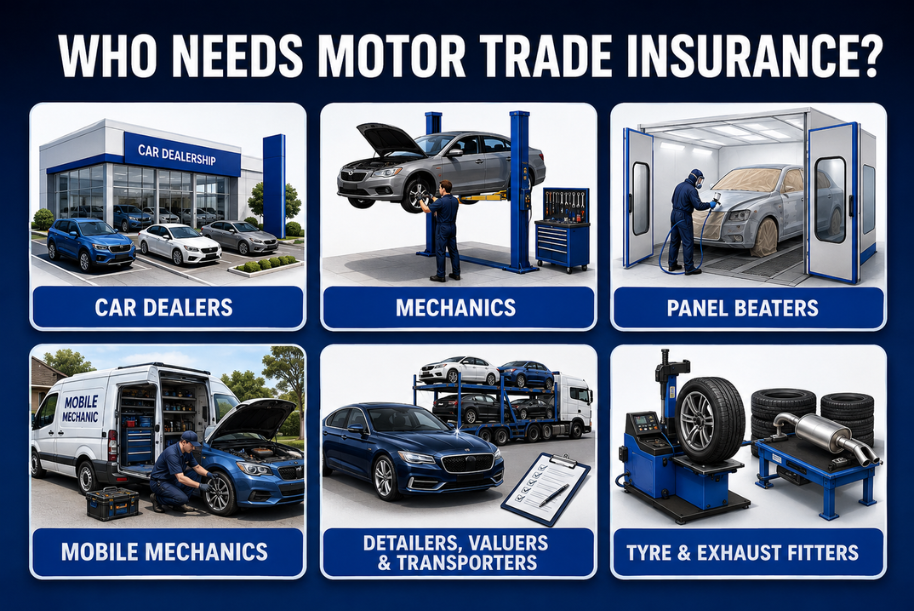
That includes:
- Car dealership insurance Australia — new and used vehicle dealers holding stock and taking trade-ins
- Mechanic insurance Australia — independent workshops and service centres
- Panel beater insurance — smash repairers and vehicle body shops
- Mobile mechanic insurance — sole traders working at a customer’s home or roadside, often without fixed premises
- Vehicle detailers, valuers, auctioneers and transporters
- Tyre and exhaust fitters who move customer vehicles as part of the job
If your business fits any of these categories and you’re currently relying solely on a general business insurance package, it’s worth getting a proper comparison before renewal.
How Much Does Each Type of Insurance Cost?
There’s no single motor trade insurance cost figure that applies across the board; premiums for both products are underwritten individually based on risk factors, not a flat rate.
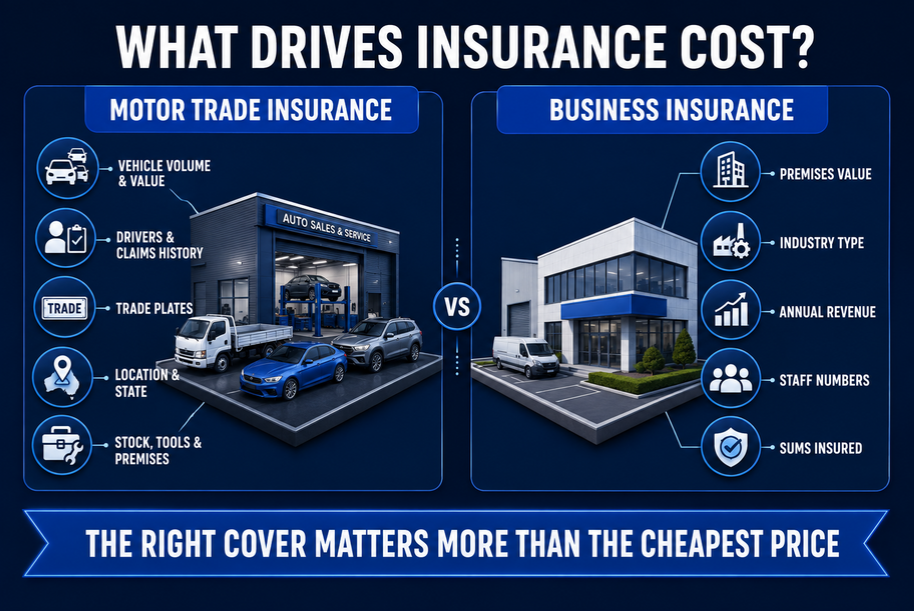
For motor trade insurance, insurers typically weigh:
- Number of vehicles handled and their average value
- Number of staff who drive customer vehicles, and their claims history
- Whether the business holds trade plates
- Location and state-specific risk factors (motor trade insurance NSW, VIC, QLD, WA and SA all carry different average claims costs and regulatory settings)
- Sum insured for stock, tools and premises
For general business insurance, cost drivers are more about premises value, industry classification, revenue and staff numbers rather than vehicle throughput.
As a rule of thumb, a business with genuine motor trade exposure will usually find that a combined motor trade insurance policy is more cost-effective than trying to force road risk cover into a generic business insurance policy in Australia, where it’s unlikely to be available at all, cheap or otherwise.
If cost is the deciding factor, the better question isn’t “which is cheaper” but “which one actually pays out on the claim I’m most likely to have.”
Getting the Right Cover in Place
Compare motor trade insurance options against your current business insurance package before you assume either one has you covered.
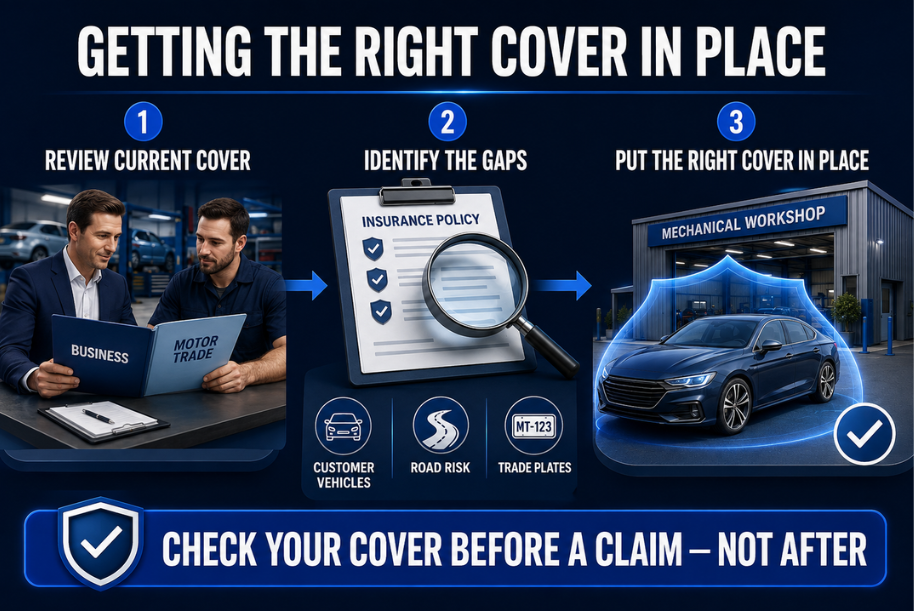
A broker who works across both product types can review your actual operations, not just your business category, and confirm exactly where your cover starts and stops.
Speak to a Motor Trade Insurance Broker to get a tailored comparison of your current policy against a dedicated motor trade insurance quote, and make sure customer vehicles, road risk and trade plates are properly covered before your next claim, not after.
Frequently Asked Questions
Q1. What is the difference between motor trade insurance and business insurance?
Ans 1. Business insurance covers your premises, stock and general liability. Motor trade insurance adds road risk and customer vehicle cover for businesses that handle vehicles they don’t own — cover a standard policy generally excludes.
Q2. Do I need motor trade insurance if I already have business insurance?
Ans 2. Almost certainly, if your business drives, stores, services or sells customer vehicles. Business insurance alone typically won’t cover a customer’s car once it’s in your care, custody or control.
Q3. Is motor trade insurance the same as commercial motor insurance?
Ans 3. No, commercial motor insurance covers vehicles your business owns and uses. Motor trade insurance covers vehicles you don’t own, but that pass through your hands as part of the job.
Q4. Does standard business insurance cover customer vehicles in my care?
Ans 4. Generally no. This is one of the most common — and expensive — gaps automotive businesses discover only after a claim is declined.
Q5. Do car dealers need business insurance or motor trade insurance?
Ans 5. Both. Dealerships need business insurance for premises and general liability, and motor trade insurance for stock vehicles, test drives and trade plates.
Q6. Can I combine motor trade insurance and business insurance in one policy?
Ans 6. Some insurers offer combined or add-on structures, but they’re usually still two distinct products underwritten separately. A broker can confirm what’s genuinely bundled versus sold together.
Q7. What does motor trade insurance cover that business insurance doesn't?
Ans 7. Road risk cover, customer vehicle cover, trade plate cover and vehicle-related legal defence costs are the core gaps motor trade insurance fills.
Q8. Is public liability insurance included in motor trade insurance?
Ans 8. It’s often bundled into combined motor trade insurance policies, but this varies by insurer — always confirm on the certificate of currency rather than assuming.
Q9. Do mobile mechanics need motor trade insurance?
Ans 9. Yes. Mobile mechanic insurance is particularly important since these businesses regularly work on customer vehicles away from fixed premises, with no dealership or workshop cover to fall back on.
Q10. How much does motor trade insurance cost compared to a standard business policy?
Ans 10. There’s no fixed comparison — pricing depends on vehicle throughput, staff, location and claims history. A tailored motor trade insurance quote alongside your business insurance quote is the only reliable way to compare.
Important notice
This article is of a general nature only and does not take into account your specific objectives, financial situation or needs. It is also not financial advice, nor complete, so please discuss the full details with your insurance broker as to whether these types of insurance are appropriate for you. Deductibles, exclusions and limits apply. You should consider any relevant Target Market Determination and Product Disclosure Statement in deciding whether to buy or renew these types of insurance. Various insurers issue these types of insurance and cover can differ between insurers.
This article provides information rather than financial product or other advice. The content of this article, including any information contained in it, has been prepared without taking into account your objectives, financial situation or needs. You should consider the appropriateness of the information, taking these matters into account, before you act on any information. In particular, you should review the product disclosure statement for any product that the information relates to it before acquiring the product.
Information is current as at the date the article is written as specified within it but is subject to change. Global Insurance Solutions Pty Ltd make no representation as to the accuracy or completeness of the information. Various third parties have contributed to the production of this content. All information is subject to copyright and may not be reproduced without the prior written consent of Global Insurance Solutions Pty Ltd.

Risk Advisor, Insurance Broker & Director
With around 15 years in insurance, Yuvi Singh is a passionate Risk Advisor, Director, and Insurance Broker at Global Insurance Solutions. Backed by a Commerce degree and ANZIIF diploma, Yuvi leads a team servicing SMEs across industries like manufacturing, logistics, fuel, IT, and more. At GIS, clients benefit from tailored, transparent advice, access to 150+ insurers, and end-to-end risk solutions. Recognised as a 2022 Insurance Magazine Rising Star and 2024 Top Insurance Broker by Insurance Business Australia, Yuvi delivers flexible, effective outcomes with integrity and innovation.