
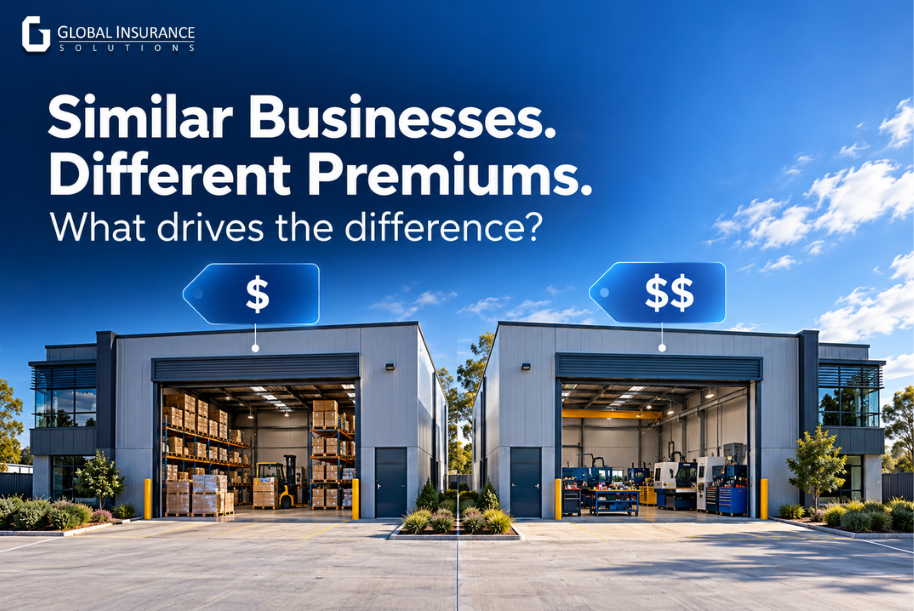
Two businesses operate in the same industry, employ similar numbers of people and generate comparable revenue. Yet one pays considerably more for insurance.
Does that mean the more expensive policy is overpriced? Or that the cheaper business has secured a better deal?
Similar businesses can pay different insurance premiums because insurers assess their individual activities, exposures, claims history and cover requirements. Different policy terms and insurers’ pricing approaches can also affect the result.
At Global Insurance Solutions (GIS), we recommend looking beyond the annual premium. Before comparing prices, establish whether you are comparing the same risks, information and protection.
How Are Business Insurance Premiums Calculated?
A business insurance premium is the amount charged for insurance protection over the policy period. Insurers assess the likelihood of a loss and its potential cost through underwriting. The Insurance Council of Australia identifies this risk assessment as a fundamental part of insurance pricing. insurancecouncil.com.au
However, there is no single pricing formula that applies across every business and insurance product.
Your business insurance cost depends on what you do, what could go wrong and what you ask the insurer to cover. The price also reflects the insurer’s assessment of those exposures.
Two businesses sharing an industry label may therefore present quite different insurance risks.
What Affects Business Insurance Premiums?

Your Actual Activities Matter More Than Your Business Label
“Manufacturer”, “consultant” or “contractor” provides only a starting point.
A metal fabrication business making indoor furniture has different exposures from one manufacturing structural components and completing installation work at height.
Similarly, an IT consultant providing advice may have different responsibilities from a provider hosting client systems.
For technology businesses, review how IT liability insurance aligns with the services you provide.
At Global Insurance Solutions, we encourage businesses to describe their complete operations. Include installation, maintenance, imports, exports, subcontracting and any specialist work.
A brief description may miss the activities that explain the difference between two quotes.
Does Turnover Affect Business Insurance Premiums?
Turnover can affect business insurance premiums, particularly for public and products liability insurance. However, insurers also consider your business activities and the level of cover required.
Two businesses each generating $2 million annually may have different exposures. One might sell office supplies, while another installs machinery at industrial sites. Similar revenue does not mean the same likelihood or potential cost of a claim.
At GIS, we recommend providing an accurate annual turnover estimate and explaining how revenue is divided between activities. If installation work becomes a larger part of your operations, tell us—even if your total turnover remains unchanged.
Does Business Location Affect Insurance Premiums?
Your business location can influence insurance premiums, particularly for commercial property insurance cover.
Insurers may consider the premises’ exposure to risks such as flood, bushfire, storm and theft, alongside building construction, security and neighbouring activities.
Two warehouses in the same suburb may present different risks. One might have stronger security or a different building structure, while the other could be located near a waterway or a higher-risk neighbouring business.
At GIS, we recommend disclosing every operating location, including storage premises. Explain where stock and equipment are kept and whether work takes place elsewhere, so your insurance can be assessed against your actual operations.
Does Claims History Affect Business Insurance Premiums?
Previous claims and incident history can influence an insurer’s assessment. They are among the premium factors listed by the Insurance Council of Australia.
Source : Insurance Council of Australia
For your insurance review, provide context alongside the claims figures.
Was an incident isolated? What caused it? What has changed since?
For example, after a water-damage claim, a business might relocate vulnerable stock and introduce documented inspections. Those details help explain the present situation.
Risk improvements do not guarantee a discount, but they give the insurer more useful information than a claims total alone.
Similar Businesses May Be Buying Different Cover
Two businesses may pay different premiums because their policies cover different risks.
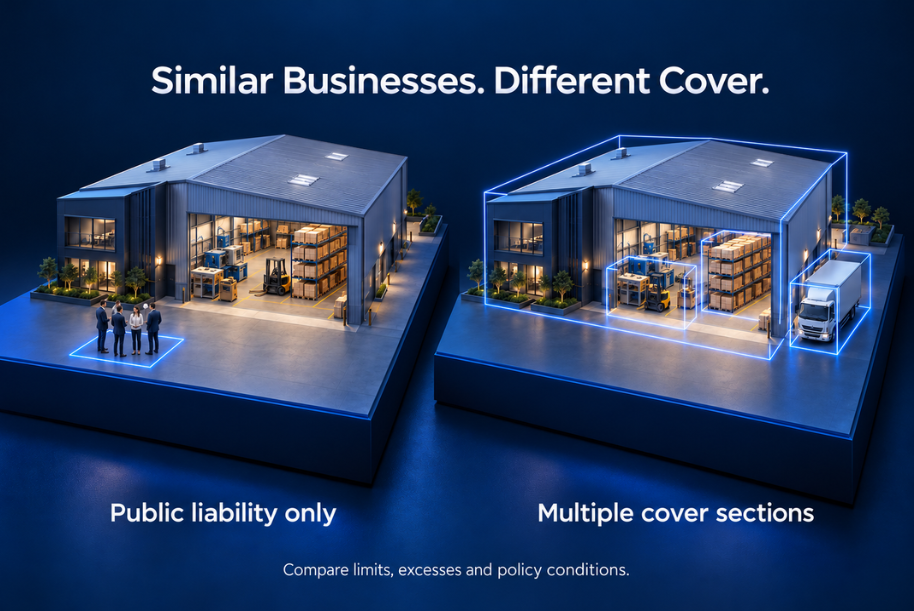
One business might hold public liability insurance alone, while another also insures its property, machinery, business interruption and goods in transit. Comparing their total premiums without checking these differences can be misleading.
At GIS, we recommend comparing the cover sections, insured values, limits, excesses and exclusions together. A lower premium may reflect less cover or a greater financial contribution from your business when a claim occurs.
Check Limits, Excesses and Policy Conditions
Even where the cover names match, the details may differ.
Review:
- Sums insured and liability limits.
- Sub-limits for particular losses.
- Excesses applying to different claims.
- Exclusions and endorsements.
- Business interruption indemnity periods.
- Conditions relevant to your activities.
How Does an Insurance Excess Affect the Premium?
An insurance excess is the amount your business contributes towards a covered claim, as specified in the policy.
Choosing a higher excess may reduce your business insurance premium where that option is available. However, your business will need to fund a larger contribution when the excess applies.
At GIS, we recommend comparing any premium saving against your available cash reserves and potential claim costs. The excess should be an amount your business can comfortably afford.
An Illustrative Comparison Between Two Fabricators
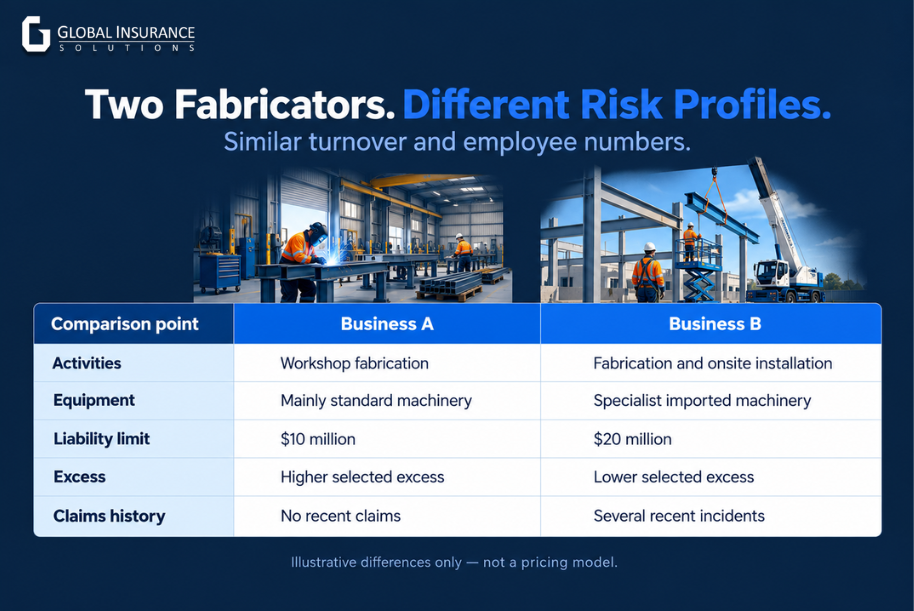
Consider two fabrication businesses with similar turnover and employee numbers.
Comparison point | Business A | Business B |
Activities | Workshop fabrication | Fabrication and onsite installation |
Equipment | Mainly standard machinery | Specialist imported machinery |
Liability limit | $10 million | $20 million |
Excess | Higher selected excess | Lower selected excess |
Claims history | No recent claims | Several recent incidents |
These are illustrative differences, not a pricing model. They show why matching turnover and employee numbers is insufficient to establish that two premiums should match.
Our metal fabrication insurance guide explains the cover considerations behind workshop and installation activities.
What Should You Compare First?
Start with the activities insured and the scope of cover. Then examine the price.
How Much Does Business Insurance Cost?
There is no single figure that reliably answers “how much will business insurance cost?” for every Australian business.
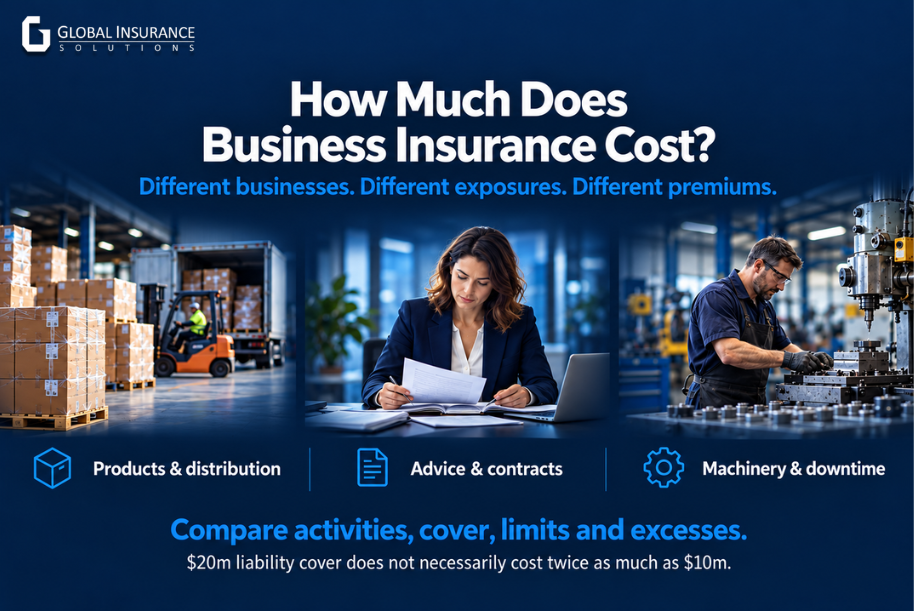
An average business insurance cost can provide background, but it needs context. Ask which businesses, cover sections, limits and policy periods were included.
For GIS, the more useful question is: what protection does your business need, and what are insurers charging for that particular combination?
Why Small Business Insurance Cost Varies?
A small business can still have substantial exposures.
A small importer may distribute products widely. A specialist consultant may accept significant contractual responsibilities. A workshop may depend on one difficult-to-replace machine.
Where production depends on critical equipment, consider whether machinery breakdown insurance forms part of your requirements.
When assessing small business insurance costs, consider potential losses and obligations alongside employee numbers.
A modest workforce does not necessarily mean modest insurance requirements.
Public Liability Insurance Cost in Australia
If you are researching “how much does public liability insurance cost?”, compare the proposed activities and policy terms before comparing premiums.
An average public liability insurance cost may be a poor benchmark for a business undertaking specialist or hazardous work.
Likewise, a $10 million public liability insurance cost comparison only makes sense when the other relevant details match. Moving to $20 million does not necessarily double the premium; request actual quotations.
Choose the limit with reference to your exposures and contractual requirements.
Why Do Business Insurance Quotes Vary Between Insurers?
Different insurers may reach different pricing decisions for the same business.
Their assessment of an industry, previous claims experience and willingness to accept particular exposures can differ. Policy wording and available extensions may also vary.
This makes a complete, consistent presentation of your business important.
At GIS, we recommend checking whether competing insurers received the same information. A lower quote based on an incomplete description may not provide a meaningful comparison.
Why Has My Business Insurance Premium Increased?
Your business insurance premium can increase at renewal even if you have made no claims.
Higher repair and replacement costs, inflation, government charges and reinsurance costs can influence pricing. Reinsurance is insurance purchased by insurers to help manage the financial impact of major losses.
For property-related examples, read our guide to rising commercial property insurance costs.
Changes within your business may also affect the premium, including increased turnover, updated asset values, new activities or different cover requirements.
At Global Insurance Solutions, we recommend reviewing these factors alongside your renewal terms. We can help investigate the increase, explain identified changes and assess available options.
How to Compare Business Insurance Quotes?
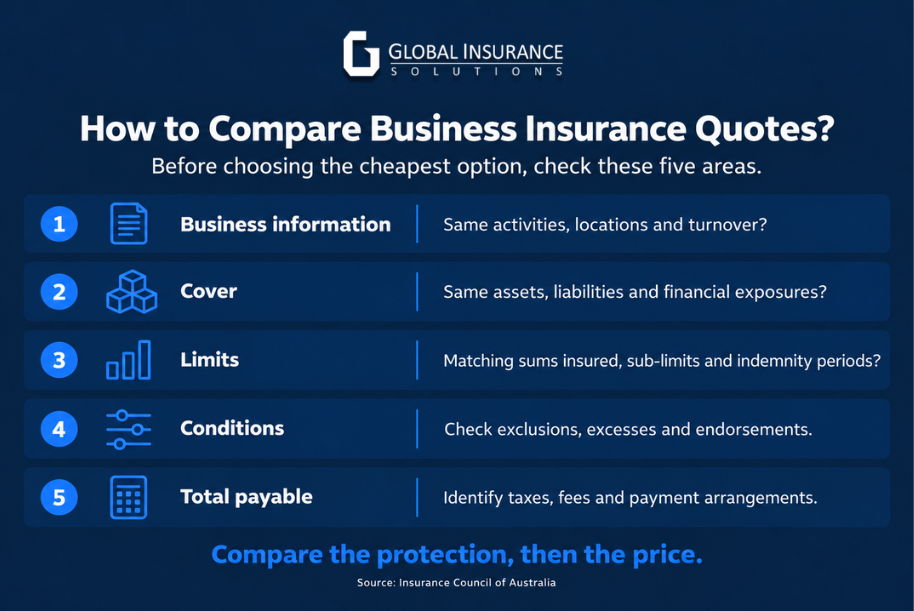
Before accepting the cheapest option, check:
- Business information: Do the quotes use the same activities, locations and turnover?
- Cover: Are the same assets, liabilities and financial exposures included?
- Limits: Do sums insured, sub-limits and indemnity periods match?
- Conditions: What exclusions, excesses and endorsements apply?
- Total payable: Are taxes, fees and payment arrangements clearly identified?
The Insurance Council notes that payment frequency, government charges, selected cover and excesses can all influence premiums.
Source : Insurance Council of Australia
How to Reduce Business Insurance Premiums?
Start with accurate information and a review of your requirements.
Update turnover estimates, remove assets you no longer own and document changes to your operations. Discuss risk improvements and affordable excess options with GIS.
Avoid reducing insured values simply to achieve a cheaper price. Ask what financial exposure any proposed reduction leaves with your business.
Reducing sums insured below appropriate values can create underinsurance risks.
The aim is to understand the cost and protection together.
Frequently Asked Questions About Business Insurance Premiums
Q1. Why Do Similar Businesses Pay Different Insurance Premiums?
Ans 1. Similar businesses may have different activities, locations, claims histories and cover requirements. At GIS, we compare these details alongside policy terms to help explain premium differences.
Q2. Does Higher Turnover Always Mean a Higher Insurance Premium?
Ans 2. Not always. Turnover can influence pricing, but insurers also consider your activities, exposures and selected cover. We recommend explaining how revenue is divided between different operations.
Q3. Can My Business Insurance Premium Increase Without a Claim?
Ans 3. Yes. Changes in repair costs, reinsurance costs, insurer pricing or your business circumstances can affect renewal premiums. GIS can help investigate the increase and review available options.
Q4. Is the Cheapest Business Insurance Quote the Best Option?
Ans 4. A cheaper quote may include lower limits, higher excesses or narrower cover. At GIS, we recommend comparing what each policy covers and what your business would need to fund itself.
Q5. How Can I Reduce Business Insurance Costs Without Losing Important Cover?
Ans 5. Keep business details accurate, document risk improvements and review affordable excess options. GIS can assess available alternatives and explain any changes to protection before you decide.
Q6. Will Increasing My Excess Reduce My Premium?
Ans 6. It may, where the insurer offers that option. We recommend weighing the premium saving against the amount your business would need to contribute towards a covered claim.
Q7. Can Better Security or Safety Procedures Lower My Premium?
Ans 7. They may support the insurer’s assessment, but a discount is not guaranteed. Share documented improvements with GIS so we can present your current risk controls accurately.
Q8. What Information Should I Provide for a Business Insurance Review?
Ans 8. Provide your policy documents, renewal notice, turnover, activities, locations, asset values and claims history. Tell GIS about operational changes so we can assess whether your cover still suits your business.
Understand What Your Business Insurance Premium Includes
Before deciding that another business has a better deal, find out what sits behind both premiums.
At GIS, we can review your operations, policy documents and available options to help explain the differences.

Risk Advisor, Insurance Broker & Director
With around 15 years in insurance, Yuvi Singh is a passionate Risk Advisor, Director, and Insurance Broker at Global Insurance Solutions. Backed by a Commerce degree and ANZIIF diploma, Yuvi leads a team servicing SMEs across industries like manufacturing, logistics, fuel, IT, and more. At GIS, clients benefit from tailored, transparent advice, access to 150+ insurers, and end-to-end risk solutions. Recognised as a 2022 Insurance Magazine Rising Star and 2024 Top Insurance Broker by Insurance Business Australia, Yuvi delivers flexible, effective outcomes with integrity and innovation.