
Your fabrication business has maintained industrial sites for years. Now, a client wants your team to repair steelwork on an offshore installation. The work feels familiar, the contract looks attractive, and your public liability policy has a substantial limit.
Before accepting, ask: does your insurance cover this work, at this location, under these contractual conditions?
Offshore liability insurance deserves attention before your first offshore job. Moving from an onshore workshop to an offshore platform can introduce exposures that your existing insurer has not assessed.
At Global Insurance Solutions, we recommend reviewing your scope of work, proposed contract and current policy together. A certificate showing that you hold liability insurance is only the starting point.
What Is Offshore Liability Insurance?
Offshore liability insurance addresses specified liabilities associated with work on offshore structures and installations, subject to the policy’s terms.
Lloyd’s describes this insurance class as addressing liabilities of offshore operators and contractors, including pollution-related liabilities. Here, “offshore” means work on offshore facilities, rather than outsourcing services overseas.
Source : Lloyd’s
For Australian maintenance, engineering, fabrication and specialist contractors, offshore contractor insurance may involve an extension to existing cover or a separate specialist placement. The appropriate approach depends on the activities, location and insurer’s appetite.
There is no universal package that automatically covers every offshore exposure. Offshore platform contractor insurance should be assessed against the actual assignment: welding structural supports presents different considerations from engineering inspections or equipment installation.
Offshore Liability Insurance vs Marine Liability Insurance
Offshore liability insurance focuses on liabilities associated with offshore structures and installations. Marine liability insurance encompasses a wider range of maritime activities, but does not automatically cover offshore installation work.
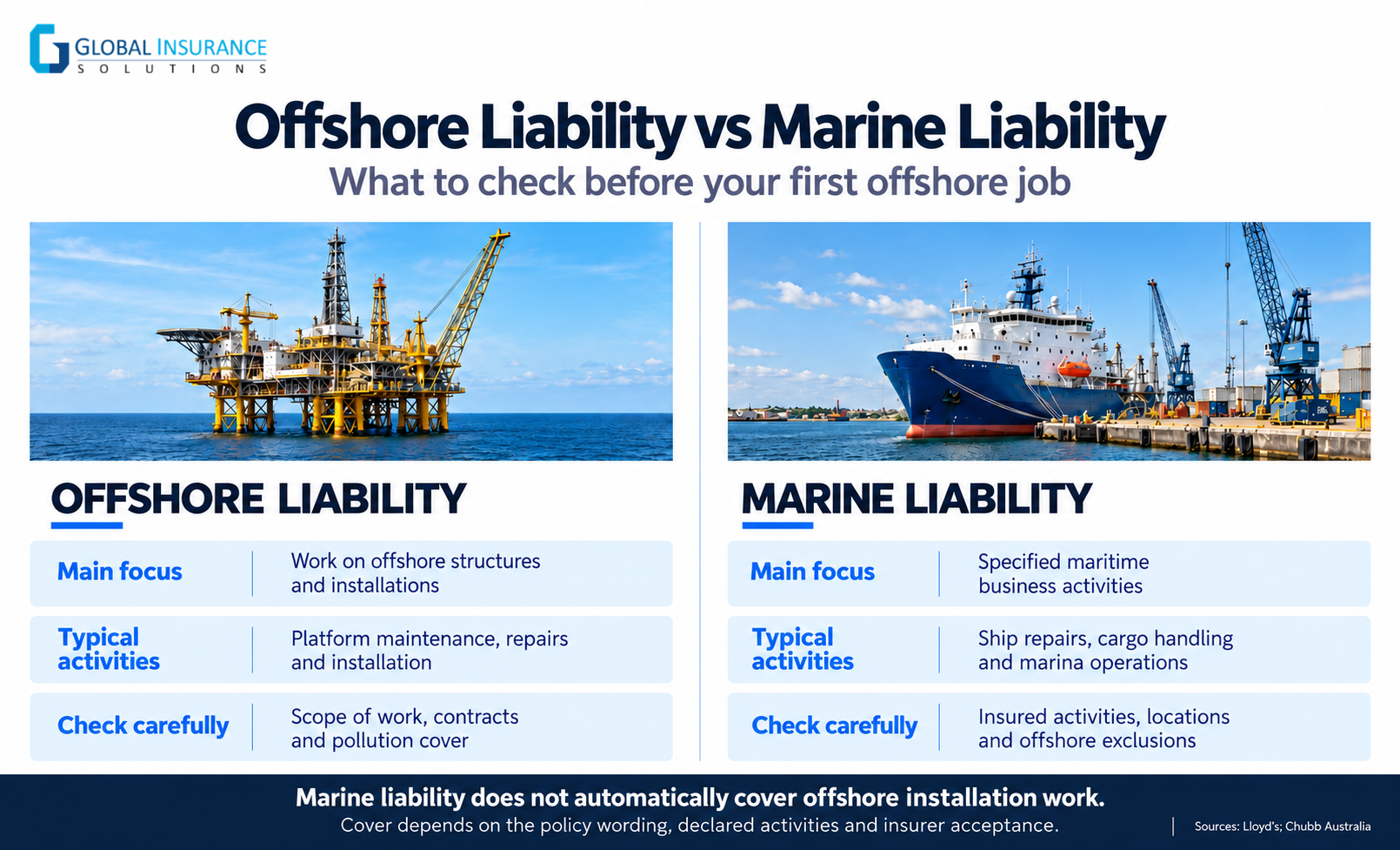
Lloyd’s describes offshore liability insurance as addressing liabilities of offshore operators and contractors, including pollution-related liabilities. Chubb’s Australian marine fact sheet illustrates the broader marine category through specialist liability solutions for ship repairers, stevedores, marina operators, port authorities and terminal operators.
Source : Lloyd’s
For an Australian contractor considering its first offshore project, the following comparison highlights what to discuss with Global Insurance Solutions:
Comparison point | Offshore liability insurance | Marine liability insurance |
Main focus | Specified liabilities arising from operations or contracted work on offshore structures and installations. | Specified liabilities arising from maritime business activities. The scope varies significantly between policy types. |
Relevant businesses | Offshore operators and maintenance, engineering, fabrication, installation and specialist contractors, subject to insurer acceptance. | Businesses such as ship repairers, stevedores, marina operators, port authorities and terminal operators, depending on the cover arranged. |
Activities to disclose | Platform maintenance, structural repairs, welding, lifting, equipment installation, inspections and any design responsibilities. | Vessel repairs, cargo handling, terminal operations, marina services and any work involving offshore facilities. |
Third-party injury and property damage | Check whether the policy addresses liabilities arising from your specific offshore work, including damage to the installation or surrounding equipment. | Check which maritime operations and third-party exposures are insured. Cover for one marine activity does not establish cover for another. |
Property being worked on | Review restrictions affecting the component under repair, existing structures and property in your care, custody or control. | Review equivalent restrictions affecting vessels, equipment, cargo or other property entrusted to your business. |
Contractual liability | Assess project indemnities, hold-harmless obligations, additional insured requirements and waivers of subrogation against the wording. | Assess the liabilities accepted under repair, handling, terminal or other maritime contracts. Contractual obligations are not automatically insured. |
Pollution exposures | Confirm the pollution liabilities, clean-up costs and contractual responsibilities the policy addresses, together with exclusions and sub-limits. | Confirm whether pollution cover is included and whether it applies to the activities, substances and locations involved. |
Location and jurisdiction | Check the installation’s location, territorial limits and the contract’s governing law against the policy. | Check the relevant ports, waters, operating areas and jurisdictions against the policy. |
Vessel-related activities | Do not assume that offshore installation cover includes vessel ownership, operation or chartering liabilities. These require separate assessment. | Some marine liability policies address specified vessel-related exposures; others focus on shoreside businesses. Check the particular policy. |
Potential need for additional cover | Discuss employee injury arrangements, professional indemnity, tools and equipment, transit and project works where relevant. | Discuss these covers where relevant, and specialist offshore extensions if the assignment includes installation work offshore. |
Key question before accepting the job | “Does this policy address our offshore scope of work and the liabilities we are accepting?” | “Does our marine policy expressly accommodate this offshore assignment, or do we need different cover?” |
Does Your Existing Public Liability Insurance Cover Offshore Work?
Possibly, but offshore work should never be assumed covered simply because your business already holds public liability insurance.
Public liability generally addresses legal liability for specified third-party injury or property damage. Allianz’s Australian explanation distinguishes these exposures from professional negligence, which requires separate consideration.
Source : allianz.com.au
The key question is whether your particular policy responds to your proposed offshore activities.
For public liability insurance for offshore contractors, GIS would review:
- Business description: Does it accurately include the proposed maintenance, fabrication, installation or inspection work?
- Offshore work exclusions: Does the wording restrict offshore platforms, installations, oil and gas activities or associated operations?
- Territorial limits: Is the project location within the policy’s geographical scope?
- Jurisdiction: Are the contract’s governing law and potential claims proceedings compatible with the policy?
- Operational restrictions: Are hot works, diving, lifting, vessel use or other specialist activities restricted?
- Property exclusions: How does the policy treat property being worked on or held in your care, custody or control?
A broad territorial clause does not override an offshore exclusion. Likewise, adding an offshore activity to the business description does not necessarily remove other restrictions.
Where changes are needed, obtain the insurer’s written agreement and relevant endorsements before work starts.
What Should You Check in an Offshore Contract Before Signing?
Check both the required insurance and the liabilities your business agrees to accept. They are related, but they are not identical.
An offshore contract may require specified liability limits, principal’s indemnity, additional insured status or a waiver of subrogation. Subrogation concerns an insurer’s ability to recover a payment from another responsible party.
These requirements need to be checked against what your insurer will actually provide.
Offshore Contractual Liability: Read Beyond the Insurance Schedule
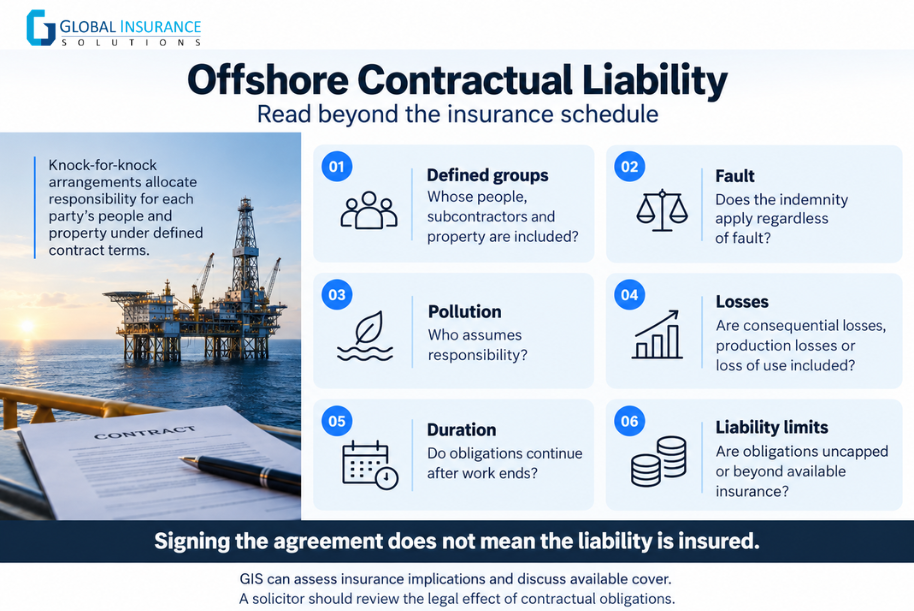
Pay particular attention to indemnity and hold-harmless clauses. Some offshore agreements use “knock-for-knock” arrangements, allocating responsibility for each party’s people and property under defined contractual terms.
Ask:
- Whose employees, subcontractors and property fall within each party’s defined group?
- Does an indemnity apply regardless of fault?
- Who assumes responsibility for pollution?
- Are consequential losses, production losses or loss of use included?
- Do obligations continue after the work ends?
- Are there uncapped liabilities or obligations exceeding available insurance?
Do not assume offshore contractual liability is insured simply because you have signed the agreement.
Global Insurance Solutions can assess insurance implications and discuss available cover. A solicitor should review the legal effect of contractual obligations, particularly where significant indemnities or unusual liability allocations arise.
How Does Offshore Liability Insurance Address Injury, Property Damage and Pollution?
These exposures require separate examination. A policy that addresses one may restrict another.
The review should also distinguish liability to others from damage to your own equipment or financial losses suffered by your business.
Public Liability Insurance for Offshore Workers: Third Parties and Employees
A dropped component could injure another contractor’s worker. An injury to your own employee raises different insurance questions.
Public liability insurance for offshore workers should therefore be understood in the context of third-party liability, rather than treated as a substitute for workers’ compensation.
Confirm the applicable workers’ compensation arrangements for the employees, location and activities involved. Safe Work Australia identifies Seacare as a Commonwealth scheme applying to defined seafaring employees; working offshore does not, by itself, establish that the scheme applies.
Source : Safe Work Australia
Offshore Maintenance Contractor Insurance: Property Damage
Consider damage to the installation, adjacent equipment and the specific component under repair.
Ask how the policy treats property being worked on, defective workmanship and resulting damage. Repairing your own faulty work may be treated differently from damage that work causes elsewhere.
If the assignment includes engineering advice, designs or certification, discuss offshore professional indemnity insurance as well. Do not assume public liability addresses professional services exposures.
Offshore Pollution Liability Insurance: Check the Detail
Ask whether environmental liability insurance cover addresses sudden incidents, gradual releases, clean-up costs and contractual obligations.
Chubb’s Australian contractors pollution liability information recognises that pollution exposures can arise suddenly or develop over time, and describes cover for certain third-party clean-up claims. That does not establish offshore cover under any particular policy.
Source : Chubb
NOPSEMA also requires petroleum titleholders to demonstrate financial assurance for relevant marine oil pollution exposures. These titleholder obligations should not be mistaken for insurance protecting an individual contractor.
Source : NOPSEMA
Does the Project Operator’s Offshore Insurance Extend to Your Business?
Only if the relevant arrangements actually include your business and the exposure in question. Obtain documentary confirmation.
An operator may have substantial offshore energy insurance or offshore oil and gas insurance. That alone does not establish your entitlement to protection.

Request the relevant policy provisions or endorsements and clarify:
- Whether your legal entity is insured.
- Which activities and liabilities are included.
- Whether subcontractors are included.
- Which exclusions and deductibles apply.
- Whether limits are shared with other insured parties.
- Whether the insurer retains recovery rights against your business.
Being named as an additional insured may provide limited protection. The operator’s insurance may also leave obligations under your contract uninsured.
An offshore insurance certificate of currency is useful evidence, but it does not reproduce every condition or prove that a particular claim will be paid.
Offshore Contractor Insurance Scenario: A Fabricator’s First Maintenance Job
Consider an illustrative fabrication business engaged to replace access-platform steelwork on an offshore installation.
Its existing policy describes workshop fabrication and onshore installation. The offshore contract introduces hot works, lifting near operating equipment and indemnities benefiting the operator.
During planning, the business also engages a subcontractor to assist with installation.
The review must connect four things: activities, location, contract and policy wording.
Global Insurance Solutions would ask whether the insurer accepts the offshore scope, how exclusions affect the work, whether contractual indemnities are insurable and how offshore subcontractor insurance arrangements interact.
Suppose a lifted section later damages nearby equipment. There is no automatic coverage conclusion: liability, circumstances, exclusions and endorsements would all matter.
The practical lesson is to resolve insurance questions before accepting obligations that your current policy may not support.
What Information Does Your Broker Need for Offshore Liability Insurance?
Provide enough detail for the insurer to assess the actual project, rather than a general description such as “maintenance work”.
Before mobilising, provide Global Insurance Solutions with the following information:
- The scope of work and proposed contract.
- Installation details, location and operator.
- Project dates, contract value and offshore revenue.
- Employee numbers and subcontractor arrangements.
- Details of welding, lifting, diving, design or inspection activities.
- Equipment used, hired or transported.
- Required insurance limits and endorsements.
- Current schedules, wordings and claims history.
Identify whether the assignment involves maintenance, offshore construction insurance requirements or professional services. Scope changes should be communicated promptly so any insurance implications can be assessed.
If your offshore assignment includes construction or installation, ask Global Insurance Solutions whether contract works insurance is needed to cover physical loss or damage to the project works, and whether the proposed policy accepts offshore activities.
Your First Offshore Job: An Offshore Insurance Review Checklist
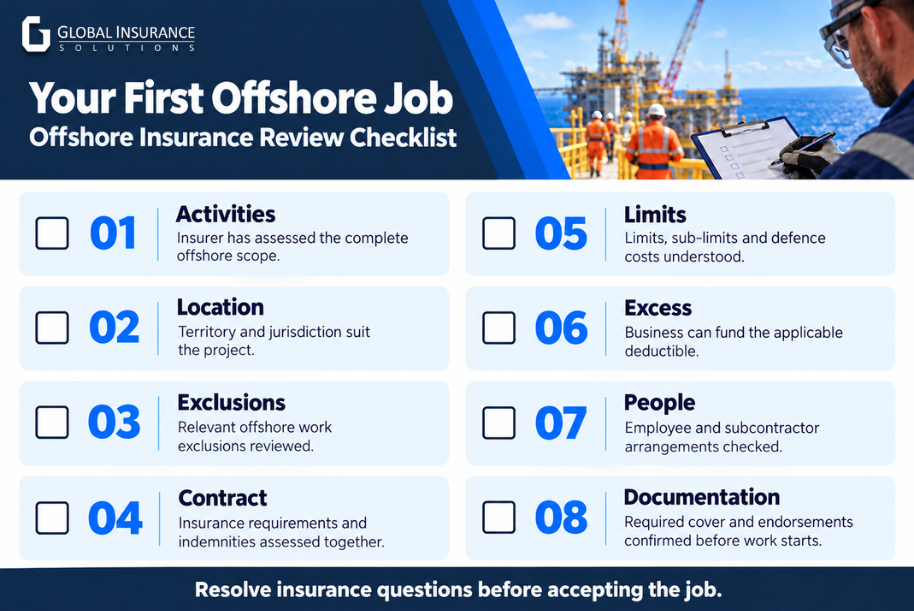
Before accepting the job, confirm:
- Activities: The insurer has assessed your complete offshore scope.
- Location: Territorial and jurisdiction provisions suit the project.
- Exclusions: Relevant offshore work exclusions have been reviewed.
- Contract: Insurance requirements and indemnities have been assessed together.
- Limits: Offshore liability insurance limits, sub-limits and defence costs are understood.
- Excess: Your business can fund the applicable deductible.
- People: Employee and subcontractor arrangements have been checked.
- Documentation: Required cover and endorsements are confirmed before commencement.
Offshore Liability Insurance FAQs
Q1. What is offshore liability insurance?
Ans 1. Offshore liability insurance can address specified liabilities arising from work on offshore structures, including certain pollution exposures. At GIS, we assess the cover against your activities, location and contract. Lloyd’s
Q2. Does my public liability insurance cover offshore work?
Ans 2. Not automatically. At GIS, we check your declared activities, offshore exclusions and endorsements before you rely on an existing policy for offshore work.
Q3. Is offshore liability insurance the same as marine liability insurance?
Ans 3. No. These policies can address different activities and exposures; GIS can review whether your particular marine policy accommodates the proposed offshore assignment.
Q4. Will the project operator’s insurance cover my business?
Ans 4. Only where the relevant policy arrangements include your business and the exposure involved. We recommend obtaining the applicable provisions or endorsements before relying on the operator’s insurance.
Q5. Does offshore liability insurance cover employee injuries?
Ans 5. Public liability generally addresses injury to third parties rather than your own employees. GIS can help identify the workers’ compensation arrangements requiring separate assessment.
Q6. Does Seacare apply to everyone working offshore?
Ans 6. No. Seacare applies to defined employment and vessel circumstances; working offshore alone does not establish eligibility. We recommend confirming the applicable scheme for your workforce.
Source : seacare.gov.au
Q7. Are offshore subcontractors covered under my insurance?
Ans 7. Not automatically. At GIS, we review your liability arising from subcontracted work and whether subcontractors themselves are insured under the proposed arrangements.
Q8. Does offshore liability insurance cover pollution and clean-up costs?
Ans 8. It depends on the wording. We check whether cover addresses the relevant offshore activities, sudden or gradual pollution, clean-up costs, exclusions and sub-limits.
Q9. Does offshore liability insurance cover contractual indemnities?
Ans 9. Not necessarily. GIS can assess the insurance implications of indemnities and hold-harmless clauses, while a solicitor should review their legal effect.
Q10. Is damage to the offshore equipment I am repairing covered?
Ans 10. Cover may be restricted for property being worked on or in your care, custody or control. We review these restrictions alongside the treatment of faulty workmanship and resulting damage.
Q11. Do offshore contractors need professional indemnity insurance?
Ans 11. It may be relevant where your work includes engineering advice, design, inspection or certification. GIS can assess these professional services exposures separately from public liability.
Q12. How much does offshore liability insurance cost?
Ans 12. Pricing depends on your activities, project location, revenue, contractual obligations, claims history and required cover. GIS needs project details before seeking terms from insurers.
Q13. How much offshore liability cover does my business need?
Ans 13. The appropriate limit depends on potential losses, contractual requirements and available insurance. We also review sub-limits, defence costs and deductibles, rather than considering the headline limit alone.
Q14. Is a certificate of currency enough to confirm offshore cover?
Ans 14. No. A certificate provides evidence of insurance but does not reproduce every policy condition; GIS recommends checking the relevant wording and endorsements for the actual assignment.
Q15. What information does GIS need to review my offshore insurance?
Ans 15. Send us your scope of work, proposed contract, project location, dates, workforce details and current insurance documents. Include any welding, lifting, diving, design or subcontracted activities.
Q16. When should I arrange an offshore insurance review?
Ans 16. Contact GIS before accepting the contract or mobilising your team. This allows time to clarify insurer acceptance, exclusions and required endorsements before work begins.
Planning Your First Offshore Job? Speak to GIS About Offshore Liability Insurance
Bring your scope of work, proposed contract and current policy to Global Insurance Solutions. We can help identify insurance gaps and discuss suitable options before you commit.
Planning Your First Offshore Job? Speak to Global Insurance Solutions About Your Insurance Requirements.
Request a Call Back or call 1300 710 665.

Risk Advisor, Insurance Broker & Director
With around 15 years in insurance, Yuvi Singh is a passionate Risk Advisor, Director, and Insurance Broker at Global Insurance Solutions. Backed by a Commerce degree and ANZIIF diploma, Yuvi leads a team servicing SMEs across industries like manufacturing, logistics, fuel, IT, and more. At GIS, clients benefit from tailored, transparent advice, access to 150+ insurers, and end-to-end risk solutions. Recognised as a 2022 Insurance Magazine Rising Star and 2024 Top Insurance Broker by Insurance Business Australia, Yuvi delivers flexible, effective outcomes with integrity and innovation.