
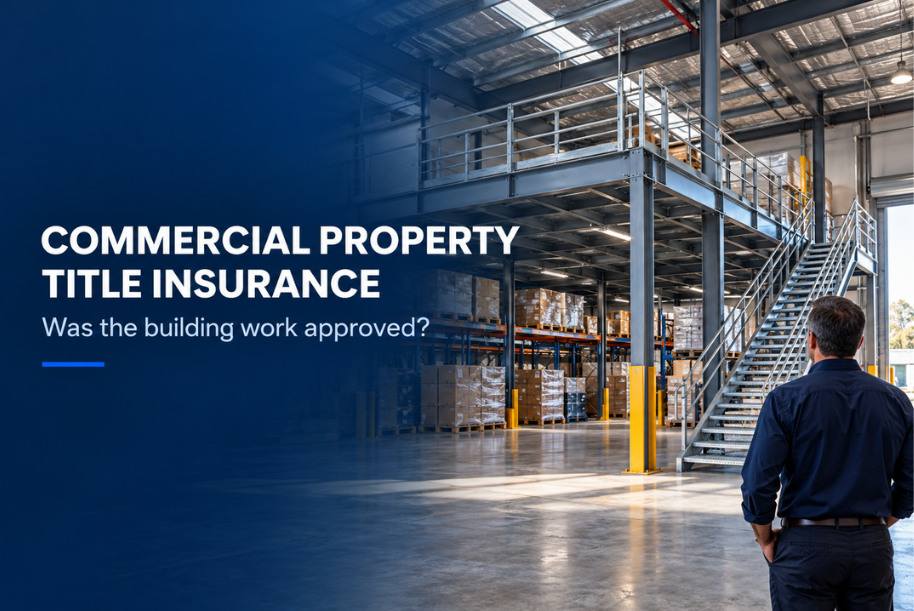
You purchase a warehouse with an existing mezzanine, additional storage space and room for your business to grow. Several months after settlement, you discover that approval records for the mezzanine cannot be located.
The structure looks permanent. The previous owner used it for years. However, neither observation establishes whether the required approvals were obtained.
Certain commercial title insurance policies may address specified losses arising from unknown, pre-existing unapproved building work. Whether cover applies depends on the issued policy, its exclusions and the circumstances of the claim.
At Global Insurance Solutions, we encourage buyers to consider ownership risks alongside their commercial property insurance requirements. Understanding the difference before settlement can help you ask better questions about the premises you are buying.
What Is Title Insurance for Commercial Property?
Title insurance for commercial property addresses specified risks affecting ownership or property interests. It should not be confused with insurance for physical damage to buildings.
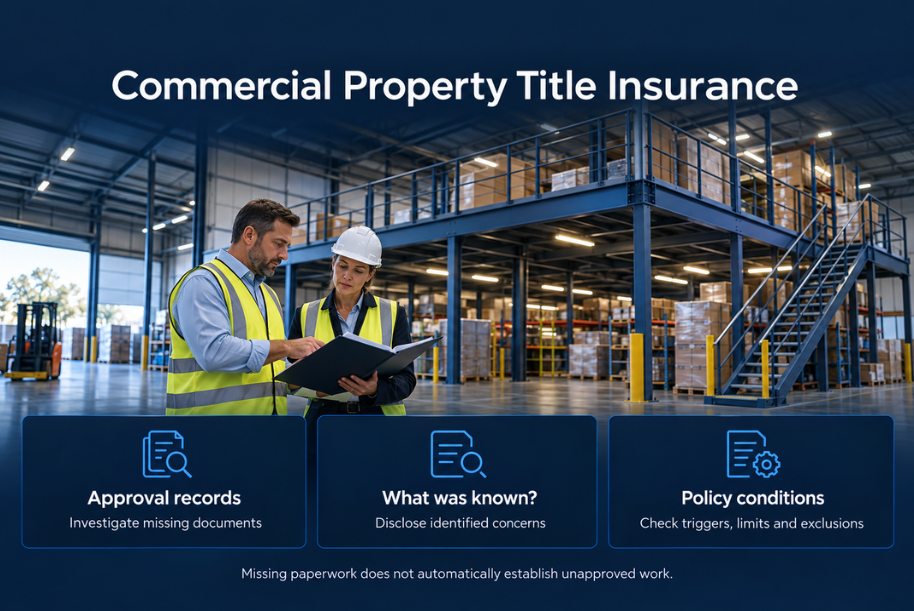
When considering property title insurance, focus on the risks described in the commercial policy rather than assuming every title-related problem is covered.
Depending on the product, matters requiring consideration may include historical approval issues, boundaries, access rights, competing property interests and errors affecting the transaction.
For our warehouse buyer, the practical questions are:
- Does the policy address the existing mezzanine?
- Must the issue have been unknown before insurance commenced?
- Is local-authority enforcement required before cover responds?
- What limits and exclusions apply?
At Global Insurance Solutions, we recommend assessing these questions separately from the building’s replacement value and physical damage protection.
Does Missing Paperwork Mean Building Work Was Unapproved?
Not necessarily. Missing records require investigation; they do not, by themselves, establish that work was unlawful or that insurance will respond.
First, establish what approvals were required when the work occurred and whether available documents relate to the structure as built.
Australian approval requirements depend on the jurisdiction and circumstances. For example, NSW Planning explains that some minor work may be exempt from planning or building approval where all applicable development standards are satisfied. That does not establish an exemption for a particular warehouse mezzanine.
Source : Planning
Ask an appropriately qualified adviser to investigate the structure’s history. An agent’s description, old photograph or previous owner’s assurance should not replace that assessment.
Your intended use also matters. Explain whether the mezzanine will hold stock, accommodate staff or support production equipment.
Can Title Insurance Cover Previously Unapproved Building Work?
Potentially. The relevant commercial policy must expressly accommodate the circumstances, and the claim must satisfy its requirements.
If you are researching what title insurance cover, distinguish an approval concern from an insured loss.
A missing permit, an engineer’s recommendation and a formal enforcement order are different events. The policy may treat them differently.
How Might the Warehouse Scenario Develop?
The insurance assessment depends on what happened, what was known and what the policy actually insures.
Consider this illustrative sequence:
- A business purchases a warehouse containing an existing mezzanine.
- A commercial title insurance policy is arranged without the buyer knowing of an approval issue.
- After settlement, the local authority identifies a problem.
- The authority requires specified action concerning the structure.
- The owner notifies the insurer for assessment.
The insurer would need to consider the policy date, historical circumstances, claim trigger, exclusions and relevant limits.
This scenario is not a guarantee of payment. The purpose is to show why “the mezzanine was already there” is insufficient to establish title insurance coverage.
What Happens If the Issue Was Known Before Purchase?
Disclose the concern before applying and obtain written confirmation of how the insurer will treat it. Do not assume standard cover includes a known problem.
Suppose the inspection report states that approval for the mezzanine has not been verified. Alternatively, the seller discloses an outstanding notice.
Those circumstances require specific discussion before the buyer relies on insurance.
Ask:
- Has the insurer received the complete information?
- Is the issue excluded?
- Is individual underwriting available?
- Does any proposed endorsement address the identified risk?
- Are there conditions restricting the protection?
At GIS, we recommend providing documents rather than summarising a concern as “a minor paperwork issue”.
Your solicitor or conveyancer should also explain the purchase implications, including any contractual options. Insurance assessment and legal advice serve different purposes.
What Does Title Insurance Not Cover?
A title insurance policy does not automatically fund every repair, approval application or financial consequence associated with a property problem.
Separate the following issues before comparing protection:
Issue | Question to investigate |
Approval status | Were the necessary permissions obtained? |
Structural condition | Is the structure damaged, deteriorated or unsafe? |
Workmanship | Was the work properly designed and constructed? |
Intended use | Can the premises lawfully accommodate your activities? |
Financial consequences | Which expenses or losses does the policy address? |
Our warehouse mezzanine could lack approval and also require structural repairs. Potential protection for one issue does not establish protection for the other.
Review title insurance exclusions concerning known matters, physical condition, workmanship, work undertaken after the policy date and consequential losses.
Ask whether assessment costs, professional fees, rectification expenses or business income losses are included, restricted or excluded. Obtain answers against the wording.
How Does Title Insurance Differ From Building Insurance?
Title insurance and commercial building insurance address different exposures. Holding one does not establish that the other is unnecessary.
Comparison | Commercial title insurance | Commercial building insurance |
Main focus | Specified ownership and property-related risks | Physical loss or damage covered by the policy |
Example to assess | Historical unapproved work and qualifying enforcement | Fire or storm damage to insured premises |
Important documents | Wording, schedule and endorsements | Wording, schedule, declared values and endorsements |
Practical question | Does this historical issue satisfy an insured risk? | Does this damage arise from an insured event? |
GIS can review your commercial property insurance requirements, including building construction, occupancy, insured values and business activities.
Raise title-related suitability and approval issues with your solicitor or conveyancer and the relevant title insurer.
Neither policy should be treated as evidence that a structure is approved or safe.
Our guide explains why building insurance claims can fail, including issues involving insured values, property use and policy conditions.
What Should Buyers Discuss Before Settlement?
Discuss the property’s approval history, intended use, unresolved concerns and insurance arrangements before relying on the premises for your business.
Australian Government guidance recommends assessing business-location requirements, including relevant permits and approvals. This makes the intended operation an important part of the purchase discussion.
Source : business.gov.au
Which Records Should Be Checked?
Ask your advisers which records are required for the property and jurisdiction.
Relevant documents may include:
- Approved plans and available building permits.
- Planning decisions and occupancy documentation.
- Records for extensions, mezzanines and changes of use.
- Notices, orders and disclosed disputes.
- Inspection reports and engineering assessments.
- Information about easements, access and restrictions.
Ask whether the documents correspond with what physically exists.
For our warehouse buyer, an approved ground-floor layout may not answer questions about a later mezzanine. Equally, approval for storage does not establish suitability for every proposed operation.
What Insurance Details Should Be Confirmed?
Confirm the correct insured entity, property, policy date, covered risks and treatment of disclosed matters.
Review any specific limit for historical building work separately from the overall policy amount.
Ask about notification requirements and whether expenses require prior insurer consent.
Keep the final wording, schedule, endorsements and application information together. These documents provide a stronger basis for understanding cover than a brief quotation summary.
Are Title Insurance Policies Available for Existing Owners?
Some products accommodate existing owners, but availability does not establish cover for a problem already discovered.
When researching title insurance policies for existing owners, explain when the property was purchased, when the concern arose and what investigations have occurred.
The distinction between an undiscovered historical risk and an identified problem remains important.
At GIS, we recommend obtaining a specific eligibility assessment rather than assuming insurance purchased after settlement will resolve an existing approval dispute.
How Much Does Commercial Title Insurance Cost?
Request a quotation for the particular transaction and proposed protection. A generic title insurance cost figure may not represent your commercial property.
Compare the premium alongside:
- Eligibility and property-value requirements.
- Relevant insured risks.
- Specific limits.
- Exclusions and endorsements.
- Any conditions affecting the concern you want addressed.
The benefits of title insurance depend on the protection available, not simply whether the premium appears inexpensive.
Frequently Asked Questions
Q1. Does title insurance cover unapproved building work on commercial property?
Ans 1. Certain commercial policies may address specified losses arising from unknown, pre-existing unapproved work. At GIS, we recommend checking the relevant policy’s eligibility, claim triggers, limits and exclusions before relying on cover.
Q2. Can title insurance cover an unapproved warehouse mezzanine or extension?
Ans 2. Potentially, depending on the structure’s history, what was known before the policy commenced and the circumstances of the claim. We recommend obtaining confirmation for the particular structure rather than assuming all existing additions are insured.
Q3. Does missing council paperwork mean a building is illegal?
Ans 3. Not necessarily. Approval requirements and exemptions depend on the work and jurisdiction; GIS recommends having the records assessed by an appropriately qualified adviser. NSW guidance, for example, identifies exemptions for certain work meeting specified standards.
Source : planning.nsw.gov.au
Q4. Can I get title insurance if I already know building work was unapproved?
Ans 4. Do not assume the issue will be covered. We recommend disclosing all available information and obtaining written confirmation of any acceptance, exclusion or special conditions before proceeding.
Q5. Does discovering unapproved work automatically trigger a title insurance claim?
Ans 5. No automatic conclusion follows from discovery alone. We recommend checking whether the policy requires a particular event, such as qualifying enforcement action, and whether the resulting loss falls within cover.
Q6. Does title insurance retrospectively approve building work?
Ans 6. No. Insurance does not issue planning or building approval. We recommend obtaining separate advice about the approvals, certification or rectification process relevant to your property.
Q7. Is title insurance the same as commercial building insurance?
Ans 7. No. Title insurance addresses specified ownership and property-related risks, while building insurance addresses physical loss or damage covered by its wording. GIS recommends reviewing these exposures separately.
Q8. Does title insurance cover defective workmanship or structural repairs?
Ans 8. Do not assume so. We recommend distinguishing the approval issue from the building’s condition and checking whether workmanship, deterioration or structural defects are excluded.
Q9. Can I purchase title insurance after settlement?
Ans 9. Some commercial products accommodate existing owners, subject to eligibility and underwriting. We recommend confirming how the policy treats any approval concern already identified before you apply.
Q10. Will title insurance cover lost rent or business income during rectification?
Ans 10. Do not assume these losses are included. Global Insurance Solutions recommends checking the relevant title and business insurance wordings, including their claim triggers, exclusions and financial limits.
For interruption following an insured event, our guide to business interruption indemnity periods explains why the recovery timeframe also matters.
Q11. How much does commercial title insurance cost in Australia?
Ans 11. Request a quotation for the property and transaction involved. We recommend comparing the premium alongside the insured risks, specific limits and exclusions rather than relying on residential pricing examples.
Q12. Is title insurance worth considering if I have a building inspection?
Ans 12. An inspection and insurance serve different purposes. We recommend asking what the inspection establishes about condition and approvals, then discussing any remaining ownership risks with your solicitor or conveyancer.
Q13. What should I ask my solicitor or conveyancer before buying commercial premises?
Ans 13. Ask about approval records, intended use, outstanding notices, title restrictions and unresolved inspection findings. GIS recommends identifying these issues before settlement so legal, building and insurance advice can be considered together.
Q14. What information should I provide to GIS when buying a warehouse?
Ans 14. Provide the property address, construction details, intended activities, building values and available inspection information. Tell us about mezzanines, extensions and known concerns so we can assess your commercial property insurance requirements.
Buying Commercial Premises? Speak to GIS About Your Property Insurance Requirements.
A warehouse purchase involves more than insuring walls and a roof.
Bring Global Insurance Solutions the property details, intended activities and available building information. We can discuss your commercial property insurance requirements while your legal and building advisers investigate approval and ownership concerns.
Request a Call Back or call 1300 710 665.

Risk Advisor, Insurance Broker & Director
With around 15 years in insurance, Yuvi Singh is a passionate Risk Advisor, Director, and Insurance Broker at Global Insurance Solutions. Backed by a Commerce degree and ANZIIF diploma, Yuvi leads a team servicing SMEs across industries like manufacturing, logistics, fuel, IT, and more. At GIS, clients benefit from tailored, transparent advice, access to 150+ insurers, and end-to-end risk solutions. Recognised as a 2022 Insurance Magazine Rising Star and 2024 Top Insurance Broker by Insurance Business Australia, Yuvi delivers flexible, effective outcomes with integrity and innovation.