

In today’s digital-first economy, having a data breach response plan, data breach response process, and data breach incident response plan is no longer optional for Australian businesses. With cyber threats rising and regulatory pressure increasing, organisations must be prepared to act fast when a breach occurs.
At Global Insurance Solutions, we work with businesses across Australia that underestimate the real cost and complexity of a data breach response. From legal obligations to reputational damage, a poorly handled incident can escalate quickly.
According to the IBM Cost of a Data Breach Report 2023, the global average cost of a data breach reached USD $4.45 million, highlighting the financial severity of cyber incidents.
What Is a Data Breach Response Plan?
A data breach response plan is a structured framework that outlines how your business identifies, manages, and recovers from a data breach.
It typically includes:
- Detection and identification of breaches
- Immediate containment actions
- Risk assessment and impact analysis
- Notification procedures
- Recovery and prevention strategies
In Australia, the Office of the Australian Information Commissioner (OAIC) strongly recommends that all businesses have a documented response plan.

You can refer to their official guidance here:
https://www.oaic.gov.au/about-the-OAIC/our-corporate-information/plans-policies-and-procedures/data-breach-response-plan
Why Every Australian Business Needs a Data Breach Response Plan?
Cyber incidents are no longer limited to large corporations. SMEs are increasingly targeted due to weaker security systems.
Key reasons your business needs a plan:
- Compliance with the Notifiable Data Breaches (NDB) scheme
- A faster response reduces financial losses
- Protects customer trust and brand reputation
- Minimises operational downtime
According to the OAIC, human error and phishing attacks are among the leading causes of data breaches in Australia, making preparation critical.
Who Is Responsible for a Data Breach?
One of the most searched questions is: Who is responsible for a data breach?
The answer depends on the situation:
Organisational Responsibility
- The business that collects and manages customer data is primarily responsible
- This includes ensuring compliance with the Privacy Act 1988 (Cth).
Individual Responsibility
- Employees or contractors may be held responsible if negligence is involved
- Example: falling for phishing emails or mishandling sensitive data
Third-Party Responsibility
- Cloud providers, IT vendors, or outsourced services may share liability
- However, accountability often still sits with your business
This highlights why a strong data breach response policy and governance framework is essential.

What Causes Most Data Breaches?
Understanding the causes helps improve your data breach preparation and response strategy.
Common causes include:
- Phishing attacks (the most frequent cause)
- Weak passwords and poor authentication controls
- Human error (sending data to the wrong recipient)
- Ransomware attacks
- Insider threats
Phishing alone accounts for a significant share of breaches globally, underscoring the need for staff training and awareness.
Step-by-Step Data Breach Response Process
A well-defined data breach response procedure ensures your team knows exactly what to do.
1. Identify the Breach
- Detect unusual activity
- Confirm if sensitive data is compromised
2. Contain the Incident
- Isolate affected systems
- Prevent further data loss
3. Assess the Impact
- Determine what data was affected
- Evaluate potential harm to individuals
4. Notify Stakeholders
- Inform affected individuals
- Report to the OAIC if required
5. Review and Improve
- Conduct a post-incident review
- Strengthen security controls
This structured data breach response checklist is critical for reducing long-term damage.
How to Develop a Data Breach Incident Response Plan?
Building an effective data breach incident response plan requires both technical and strategic input.
Key Components
- Incident response team roles and responsibilities
- Communication protocols
- Legal and compliance requirements
- Cybersecurity tools and monitoring systems
- Regular testing and training
Best Practice Tip
At Global Insurance Solutions, we recommend aligning your response plan with your cyber insurance policy to ensure coverage aligns with real-world scenarios.
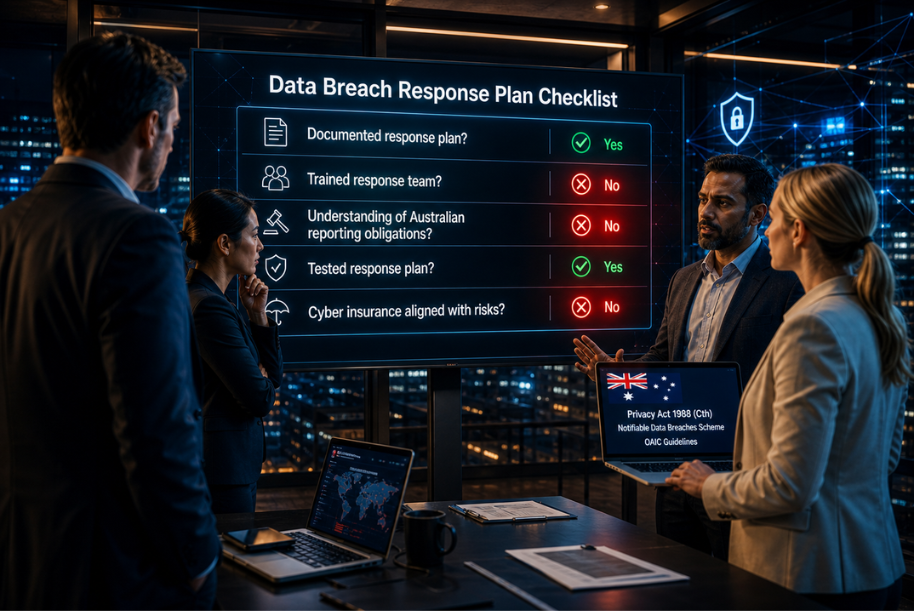
Data Breach Response Plan Checklist
Use this quick checklist to assess your readiness:
- Do you have a documented response plan?
- Is your team trained on response procedures?
- Do you know your reporting obligations under Australian law?
- Have you tested your response plan?
- Is your cyber insurance aligned with your risks?
If you answered “no” to any of these, your business may be exposed.
Real Example: Lessons from the Optus Data Breach
The Optus data breach highlighted the importance of having a robust response plan.
Key takeaways:
- Delayed communication increases reputational damage
- Transparency is critical
- Regulatory scrutiny can escalate quickly
This case reinforced why businesses must not only have a plan but also execute it effectively.
Source: Wikipedia
How Cyber Insurance Supports Data Breach Response?
A data breach response plan alone is not enough. You also need financial protection.
What Cyber Insurance Covers?
- Forensic investigation costs
- Legal and regulatory expenses
- Customer notification costs
- Business interruption losses
- Ransomware payments and recovery
At Global Insurance Solutions, we help Australian businesses structure cyber insurance for data breaches that respond when it matters most.
Without insurance, many businesses struggle to recover financially after a breach.
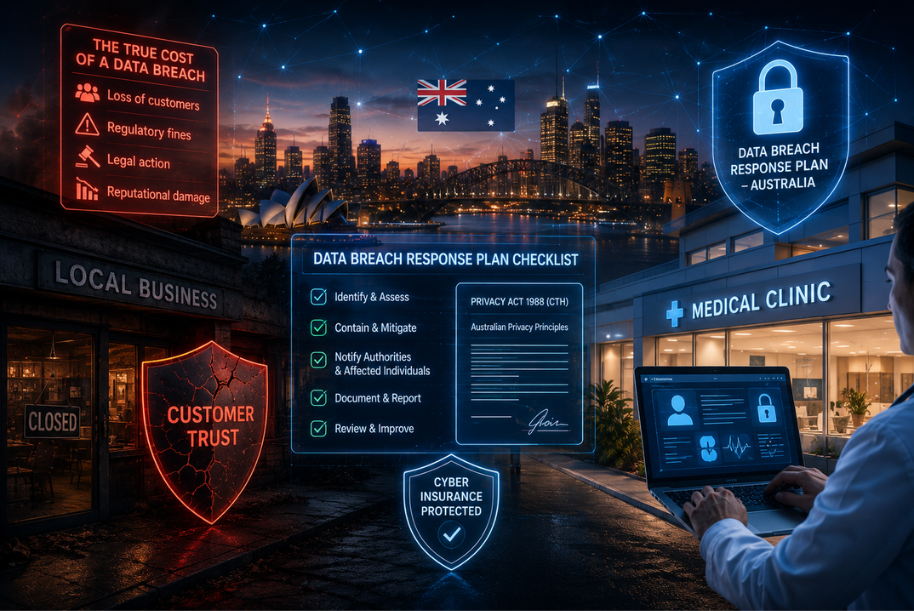
The True Cost of a Data Breach in Australia
Beyond direct costs, businesses face:
- Loss of customers
- Regulatory fines
- Legal action
- Long-term reputational damage
A strong data breach response plan, Australia strategy combined with the right insurance can significantly reduce these risks.
Why SMEs and Medical Practices Are High Risk?
Small Businesses
- Limited cybersecurity resources
- Higher vulnerability to attacks
Medical Practices
- Handle highly sensitive personal data
- Subject to stricter compliance requirements
This makes having a data breach response plan, an Australia requirements-aligned strategy, essential.
Final Thoughts: Prevention + Response = Protection
A data breach response plan is not just a compliance document. It is a critical business survival tool.
At Global Insurance Solutions, we see businesses focus heavily on prevention but overlook response. The reality is, breaches can still happen. What matters is how you respond.
Speak to a Broker Who Works for You
If your business does not have a structured data breach response plan or you are unsure whether your current cyber insurance will respond correctly, it is time to review your risk strategy.
📞 1300 710 665
🌐 https://www.globalinsurancesolutions.com.au/
Frequently Asked Questions
Q1. What is a data breach response plan?
Ans 1. A data breach response plan is a structured process that helps businesses detect, contain, assess, and respond to data breaches while meeting legal obligations.
Q2. Who is responsible for a data breach in Australia?
Ans 2. The organisation that collects and manages the data is typically responsible, although employees or third parties may share liability depending on the cause.
Q3. Who is responsible for reporting a data breach?
Ans 3. Under the Notifiable Data Breaches scheme, businesses must report breaches to the OAIC and affected individuals if serious harm is likely.
Q4. How do you develop a data breach incident response plan?
Ans 4. You should define roles, establish response procedures, create communication protocols, and align your plan with legal and insurance requirements.
Q5. Can an individual be held responsible for a data breach?
Ans 5. Yes, individuals such as employees or contractors can be held responsible if negligence or misconduct leads to a breach.
Q6. What causes most data breaches?
Ans 6. Phishing, human error, weak passwords, and poor cybersecurity controls are the most common causes.
Q7. Do small businesses need a data breach response plan?
Ans 7. Yes, SMEs are frequent targets of cyber attacks and must comply with Australian privacy laws.
Q8. Should medical practices have a data breach response plan?
Ans 8. Absolutely. Medical practices handle sensitive health data and face higher regulatory and reputational risks.
Q9. How does cyber insurance help with data breach response?
Ans 9. Cyber insurance covers costs such as legal advice, forensic investigations, notification expenses, and business interruption losses.
Important notice
This article is of a general nature only and does not take into account your specific objectives, financial situation or needs. It is also not financial advice, nor complete, so please discuss the full details with your insurance broker as to whether these types of insurance are appropriate for you. Deductibles, exclusions and limits apply. You should consider any relevant Target Market Determination and Product Disclosure Statement in deciding whether to buy or renew these types of insurance. Various insurers issue these types of insurance and cover can differ between insurers.
This article provides information rather than financial product or other advice. The content of this article, including any information contained in it, has been prepared without taking into account your objectives, financial situation or needs. You should consider the appropriateness of the information, taking these matters into account, before you act on any information. In particular, you should review the product disclosure statement for any product that the information relates to it before acquiring the product.
Information is current as at the date the article is written as specified within it but is subject to change. Global Insurance Solutions Pty Ltd make no representation as to the accuracy or completeness of the information. Various third parties have contributed to the production of this content. All information is subject to copyright and may not be reproduced without the prior written consent of Global Insurance Solutions Pty Ltd.

Risk Advisor, Insurance Broker & Director
With around 15 years in insurance, Yuvi Singh is a passionate Risk Advisor, Director, and Insurance Broker at Global Insurance Solutions. Backed by a Commerce degree and ANZIIF diploma, Yuvi leads a team servicing SMEs across industries like manufacturing, logistics, fuel, IT, and more. At GIS, clients benefit from tailored, transparent advice, access to 150+ insurers, and end-to-end risk solutions. Recognised as a 2022 Insurance Magazine Rising Star and 2024 Top Insurance Broker by Insurance Business Australia, Yuvi delivers flexible, effective outcomes with integrity and innovation.